• 文献检索
  • 文档翻译
  • 深度研究
  • 学术资讯
  • Suppr Zotero 插件Zotero 插件
  • 邀请有礼
  • 套餐&价格
  • 历史记录
应用&插件
Suppr Zotero 插件Zotero 插件浏览器插件Mac 客户端Windows 客户端微信小程序
定价
高级版会员购买积分包购买API积分包
服务
文献检索文档翻译深度研究API 文档MCP 服务
关于我们
关于 Suppr公司介绍联系我们用户协议隐私条款
关注我们

Suppr 超能文献

核心技术专利:CN118964589B侵权必究
粤ICP备2023148730 号-1Suppr @ 2026

文献检索

告别复杂PubMed语法,用中文像聊天一样搜索,搜遍4000万医学文献。AI智能推荐,让科研检索更轻松。

立即免费搜索

文件翻译

保留排版,准确专业,支持PDF/Word/PPT等文件格式,支持 12+语言互译。

免费翻译文档

深度研究

AI帮你快速写综述,25分钟生成高质量综述,智能提取关键信息,辅助科研写作。

立即免费体验

一种用于新冠肺炎的SIR-泊松模型:马格里布中部地区的演变与传播推断

A SIR-Poisson Model for COVID-19: Evolution and Transmission Inference in the Maghreb Central Regions.

作者信息

Ben Hassen Hanen, Elaoud Anis, Ben Salah Nahla, Masmoudi Afif

机构信息

Laboratory of Probability and Statistics, Faculty of Sciences of Sfax, Sfax University, Sfax, Tunisia.

Laboratory of Environmental Sciences and Technologies, Higher Institute of Sciences and Technologies of Environment, Carthage University, Tunis, Tunisia.

出版信息

Arab J Sci Eng. 2021;46(1):93-102. doi: 10.1007/s13369-020-04792-0. Epub 2020 Jul 23.

DOI:10.1007/s13369-020-04792-0
PMID:32837814
原文链接:https://pmc.ncbi.nlm.nih.gov/articles/PMC7377534/
Abstract

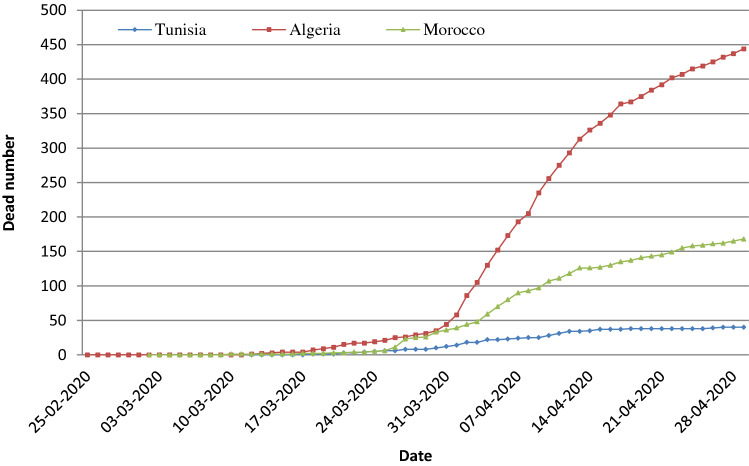
2019-nCoV is a virulent virus belonging to the coronavirus family that caused the new pneumonia (COVID-19) which has spread internationally very rapidly and has become pandemic. In this research paper, we set forward a statistical model called SIR-Poisson that predicts the evolution and the global spread of infectious diseases. The proposed SIR-Poisson model is able to predict the range of the infected cases in a future period. More precisely, it is used to infer the transmission of the COVID-19 in the three Maghreb Central countries (Tunisia, Algeria, and Morocco). Using the SIR-Poisson model and based on daily reported disease data, since its emergence until end April 2020, we attempted to predict the future disease period over 60 days. The estimated average number of contacts by an infected individual with others was around 2 for Tunisia and 3 for Algeria and Morocco. Relying on inferred scenarios, although the pandemic situation would tend to decline, it has not ended. From this perspective, the risk of COVID-19 spreading still exists after the deconfinement act. It is necessary, therefore, to carry on the containment until the estimated infected number achieves 0.

摘要

2019新型冠状病毒是一种属于冠状病毒科的高致病性病毒,它引发了新型肺炎(COVID-19),该肺炎在国际上传播速度极快,已成为大流行病。在本研究论文中,我们提出了一种名为SIR-泊松的统计模型,用于预测传染病的演变和全球传播情况。所提出的SIR-泊松模型能够预测未来一段时间内的感染病例范围。更确切地说,它被用于推断COVID-19在马格里布中部三个国家(突尼斯、阿尔及利亚和摩洛哥)的传播情况。利用SIR-泊松模型并基于每日报告的疾病数据,自COVID-19出现至2020年4月底,我们试图预测未来60天的疾病情况。突尼斯一名感染者与他人的估计平均接触次数约为2次,阿尔及利亚和摩洛哥为3次。根据推断的情景,尽管大流行情况趋于下降,但尚未结束。从这个角度来看,解封后COVID-19传播的风险仍然存在。因此,有必要继续实施隔离措施,直到估计感染人数达到0。

https://cdn.ncbi.nlm.nih.gov/pmc/blobs/b212/7377534/3165d919cc1f/13369_2020_4792_Fig6_HTML.jpg
https://cdn.ncbi.nlm.nih.gov/pmc/blobs/b212/7377534/6b91b123bd6b/13369_2020_4792_Fig1_HTML.jpg
https://cdn.ncbi.nlm.nih.gov/pmc/blobs/b212/7377534/cabbd5cbfecd/13369_2020_4792_Fig2_HTML.jpg
https://cdn.ncbi.nlm.nih.gov/pmc/blobs/b212/7377534/4008b38cebd5/13369_2020_4792_Fig3_HTML.jpg
https://cdn.ncbi.nlm.nih.gov/pmc/blobs/b212/7377534/9d6d7151f1e2/13369_2020_4792_Fig4_HTML.jpg
https://cdn.ncbi.nlm.nih.gov/pmc/blobs/b212/7377534/c8108d84254a/13369_2020_4792_Fig5_HTML.jpg
https://cdn.ncbi.nlm.nih.gov/pmc/blobs/b212/7377534/3165d919cc1f/13369_2020_4792_Fig6_HTML.jpg
https://cdn.ncbi.nlm.nih.gov/pmc/blobs/b212/7377534/6b91b123bd6b/13369_2020_4792_Fig1_HTML.jpg
https://cdn.ncbi.nlm.nih.gov/pmc/blobs/b212/7377534/cabbd5cbfecd/13369_2020_4792_Fig2_HTML.jpg
https://cdn.ncbi.nlm.nih.gov/pmc/blobs/b212/7377534/4008b38cebd5/13369_2020_4792_Fig3_HTML.jpg
https://cdn.ncbi.nlm.nih.gov/pmc/blobs/b212/7377534/9d6d7151f1e2/13369_2020_4792_Fig4_HTML.jpg
https://cdn.ncbi.nlm.nih.gov/pmc/blobs/b212/7377534/c8108d84254a/13369_2020_4792_Fig5_HTML.jpg
https://cdn.ncbi.nlm.nih.gov/pmc/blobs/b212/7377534/3165d919cc1f/13369_2020_4792_Fig6_HTML.jpg

相似文献

1
A SIR-Poisson Model for COVID-19: Evolution and Transmission Inference in the Maghreb Central Regions.一种用于新冠肺炎的SIR-泊松模型:马格里布中部地区的演变与传播推断
Arab J Sci Eng. 2021;46(1):93-102. doi: 10.1007/s13369-020-04792-0. Epub 2020 Jul 23.
2
Counter-COVID- 19 pandemic strategy in the Maghreb Central. Qualitative study of the perceptions of health professionals.马格里布中部地区应对新冠疫情的策略。对卫生专业人员认知的定性研究。
Tunis Med. 2020 Apr;98(4):266-282.
3
Cervical cancer in the Maghreb country (Morocco - Algeria - Tunisia) : epidemiological, clinical profile and control policy.马格里布国家(摩洛哥 - 阿尔及利亚 - 突尼斯)的宫颈癌:流行病学、临床特征及控制政策
Tunis Med. 2018 Oct-Nov;96(10-11):647-657.
4
Profile and evolution of the Global Burden of Morbidity in the Maghreb (Tunisia,Morocco, Algeria). The Triple burden of morbidity.马格里布地区(突尼斯、摩洛哥、阿尔及利亚)全球发病负担的概况与演变。发病的三重负担。
Tunis Med. 2018 Oct-Nov;96(10-11):760-773.
5
Modeling and tracking Covid-19 cases using Big Data analytics on HPCC system platformm.在惠普高性能计算集群(HPCC)系统平台上使用大数据分析对新冠病毒疾病(Covid-19)病例进行建模和追踪。
J Big Data. 2021;8(1):33. doi: 10.1186/s40537-021-00423-z. Epub 2021 Feb 15.
6
Network-based prediction of COVID-19 epidemic spreading in Italy.基于网络的意大利新冠疫情传播预测。
Appl Netw Sci. 2020;5(1):91. doi: 10.1007/s41109-020-00333-8. Epub 2020 Nov 17.
7
Cancers in the Central Maghreb: epidemiology from 1990 to 2017 and trends in 2040.马格里布中部地区的癌症:1990年至2017年的流行病学及2040年的趋势
Tunis Med. 2019 Jun;97(6):739-770.
8
Risk estimation and prediction of the transmission of coronavirus disease-2019 (COVID-19) in the mainland of China excluding Hubei province.中国大陆(不含湖北省) 2019 年冠状病毒病(COVID-19)传播的风险估计和预测。
Infect Dis Poverty. 2020 Aug 24;9(1):116. doi: 10.1186/s40249-020-00683-6.
9
Predictive model with analysis of the initial spread of COVID-19 in India.预测模型分析印度 COVID-19 的初始传播情况。
Int J Med Inform. 2020 Nov;143:104262. doi: 10.1016/j.ijmedinf.2020.104262. Epub 2020 Aug 25.
10
Predicting the Spread of COVID-19 Using Model Augmented to Incorporate Quarantine and Testing.使用纳入隔离和检测的模型增强方法预测新冠病毒病的传播
Trans Indian Natl Acad Eng. 2020;5(2):141-148. doi: 10.1007/s41403-020-00151-5. Epub 2020 Jul 24.

引用本文的文献

1
Systems Thinking, Causal Loop Diagram, and Systems Dynamic in Public Health Challenges: Navigating Long COVID Syndrome and Sense of Smell in LGBTQIA+ Communities.系统思维、因果循环图和系统动力学在公共卫生挑战中的应用:应对LGBTQIA+群体中的长期新冠综合征和嗅觉问题
Public Health Chall. 2024 Sep 3;3(3):e70004. doi: 10.1002/puh2.70004. eCollection 2024 Sep.
2
Comparison of Omicron and Delta Variants of SARS-CoV-2: A Systematic Review of Current Evidence.奥密克戎和德尔塔变异株的比较:当前证据的系统评价。
Infect Disord Drug Targets. 2024;24(7):e050324227686. doi: 10.2174/0118715265279242240216114548.
3
The relationship between staying at home during the pandemic and the number of conceptions: A national panel data analysis.

本文引用的文献

1
Analysis and forecast of COVID-19 spreading in China, Italy and France.新冠病毒在中国、意大利和法国传播情况的分析与预测。
Chaos Solitons Fractals. 2020 May;134:109761. doi: 10.1016/j.chaos.2020.109761. Epub 2020 Mar 21.
2
Modified SEIR and AI prediction of the epidemics trend of COVID-19 in China under public health interventions.公共卫生干预下中国新冠疫情趋势的改进型SEIR模型及人工智能预测
J Thorac Dis. 2020 Mar;12(3):165-174. doi: 10.21037/jtd.2020.02.64.
3
Genetic evolution analysis of 2019 novel coronavirus and coronavirus from other species.
疫情期间居家与受孕数量之间的关系:一项全国面板数据分析。
PLoS One. 2023 Aug 11;18(8):e0289604. doi: 10.1371/journal.pone.0289604. eCollection 2023.
4
Hierarchical Bayesian spatio-temporal modeling of COVID-19 in the United States.美国新冠肺炎的分层贝叶斯时空建模
J Appl Stat. 2022 May 16;50(11-12):2663-2680. doi: 10.1080/02664763.2022.2069232. eCollection 2023.
5
Production-sharing of critical resources with dynamic demand under pandemic situation: The COVID-19 pandemic.疫情下动态需求关键资源的生产共享:新冠疫情
Omega. 2023 Oct;120:102909. doi: 10.1016/j.omega.2023.102909. Epub 2023 Jun 4.
6
Transmission dynamics and baseline epidemiological parameter estimates of Coronavirus disease 2019 pre-vaccination: Davao City, Philippines.2019 年冠状病毒病疫苗接种前的传播动态和基本流行病学参数估计:菲律宾达沃市。
PLoS One. 2023 Apr 7;18(4):e0283068. doi: 10.1371/journal.pone.0283068. eCollection 2023.
7
Is the SARS CoV-2 Omicron Variant Deadlier and More Transmissible Than Delta Variant?奥密克戎变异株比德尔塔变异株更致命且更具传染性吗?
Int J Environ Res Public Health. 2022 Apr 11;19(8):4586. doi: 10.3390/ijerph19084586.
8
Modeling time evolving COVID-19 uncertainties with density dependent asymptomatic infections and social reinforcement.基于密度依赖无症状感染和社会强化建模时间演变的 COVID-19 不确定性。
Sci Rep. 2022 Apr 7;12(1):5891. doi: 10.1038/s41598-022-09879-2.
9
Gauging the Impact of Artificial Intelligence and Mathematical Modeling in Response to the COVID-19 Pandemic: A Systematic Review.评估人工智能和数学建模在应对 COVID-19 大流行中的影响:系统评价。
Biomed Res Int. 2022 Mar 14;2022:7731618. doi: 10.1155/2022/7731618. eCollection 2022.
10
Validity and reliability of a modified short version of a stigma scale for use among Tunisian COVID-19 patients after quarantine: A cross-sectional study.隔离后突尼斯COVID-19患者使用的耻辱感量表改良简短版本的效度和信度:一项横断面研究。
Health Sci Rep. 2022 Feb 18;5(2):e520. doi: 10.1002/hsr2.520. eCollection 2022 Mar.
新型冠状病毒和其他物种冠状病毒的遗传进化分析。
Infect Genet Evol. 2020 Aug;82:104285. doi: 10.1016/j.meegid.2020.104285. Epub 2020 Mar 10.
4
COVID-19: An Update on the Epidemiological, Clinical, Preventive and Therapeutic Evidence and Guidelines of Integrative Chinese-Western Medicine for the Management of 2019 Novel Coronavirus Disease.COVID-19:中西医结合管理 2019 年新型冠状病毒病的流行病学、临床、预防和治疗证据及指南的最新进展。
Am J Chin Med. 2020;48(3):737-762. doi: 10.1142/S0192415X20500378. Epub 2020 Mar 13.
5
Unique epidemiological and clinical features of the emerging 2019 novel coronavirus pneumonia (COVID-19) implicate special control measures.新型冠状病毒肺炎(COVID-19)具有独特的流行病学和临床特征,提示应采取特殊的控制措施。
J Med Virol. 2020 Jun;92(6):568-576. doi: 10.1002/jmv.25748. Epub 2020 Mar 29.
6
Review of the Clinical Characteristics of Coronavirus Disease 2019 (COVID-19).新型冠状病毒病 2019(COVID-19)的临床特征综述。
J Gen Intern Med. 2020 May;35(5):1545-1549. doi: 10.1007/s11606-020-05762-w. Epub 2020 Mar 4.
7
The epidemiology and pathogenesis of coronavirus disease (COVID-19) outbreak.冠状病毒病(COVID-19)疫情的流行病学和发病机制。
J Autoimmun. 2020 May;109:102433. doi: 10.1016/j.jaut.2020.102433. Epub 2020 Feb 26.
8
World Health Organization declares global emergency: A review of the 2019 novel coronavirus (COVID-19).世界卫生组织宣布全球紧急状态:对 2019 年新型冠状病毒(COVID-19)的回顾。
Int J Surg. 2020 Apr;76:71-76. doi: 10.1016/j.ijsu.2020.02.034. Epub 2020 Feb 26.
9
Genetic diversity and evolution of SARS-CoV-2.SARS-CoV-2 的遗传多样性与演化。
Infect Genet Evol. 2020 Jul;81:104260. doi: 10.1016/j.meegid.2020.104260. Epub 2020 Feb 21.
10
Severe acute respiratory syndrome coronavirus 2 (SARS-CoV-2) and coronavirus disease-2019 (COVID-19): The epidemic and the challenges.严重急性呼吸综合征冠状病毒 2(SARS-CoV-2)和 2019 年冠状病毒病(COVID-19):疫情和挑战。
Int J Antimicrob Agents. 2020 Mar;55(3):105924. doi: 10.1016/j.ijantimicag.2020.105924. Epub 2020 Feb 17.