Department of Epidemiology and Public Health, Norwich Medical School, Faculty of Medicine and Health Sciences, University of East Anglia, Norwich, United Kingdom.
MRC Epidemiology Unit, University of Cambridge School of Clinical Medicine, Cambridge, United Kingdom.
J Nutr. 2020 Oct 12;150(10):2789-2798. doi: 10.1093/jn/nxaa221.
Age-related loss of skeletal muscle mass contributes to poor outcomes including sarcopenia, physical disability, frailty, type 2 diabetes, and mortality. Vitamin C has physiological relevance to skeletal muscle and may protect it during aging, but few studies have investigated its importance in older populations.
We aimed to investigate cross-sectional associations of dietary and plasma vitamin C with proxy measures of skeletal muscle mass in a large cohort of middle- and older-aged individuals.
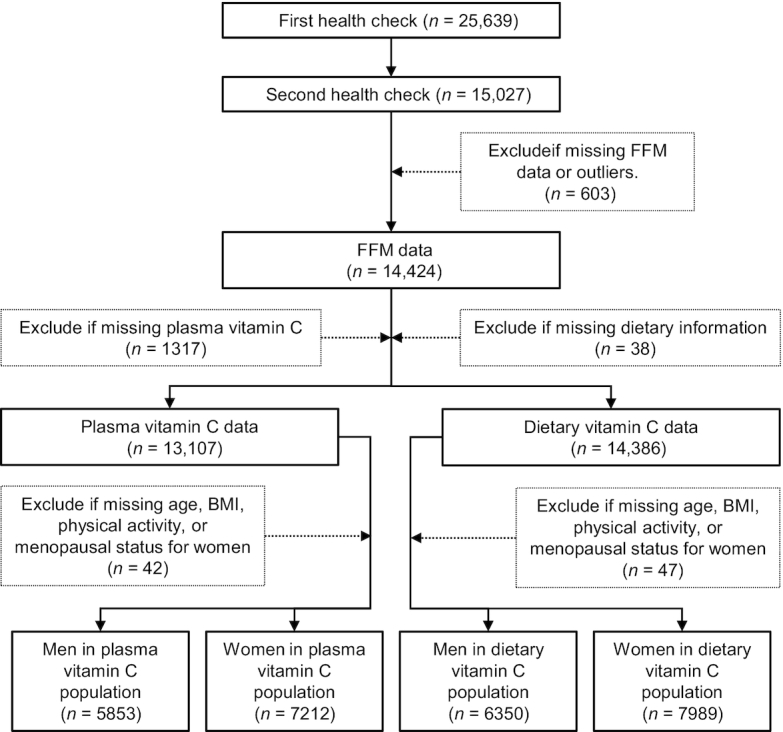
We analyzed data from >13,000 men and women in the European Prospective Investigation into Cancer and Nutrition-Norfolk cohort, aged 42-82 y. Fat-free mass (FFM), as a proxy for skeletal muscle mass, was estimated using bioelectrical impedance analysis and expressed as a percentage of total mass (FFM%) or standardized by BMI (FFMBMI). Dietary vitamin C intakes were calculated from 7-d food diary data, and plasma vitamin C was measured in peripheral blood. Multivariable regression models, including relevant lifestyle, dietary, and biological covariates, were used to determine associations between FFM measures and quintiles of dietary vitamin C or insufficient compared with sufficient plasma vitamin C (<50 μmol/L and ≥50 μmol/L).
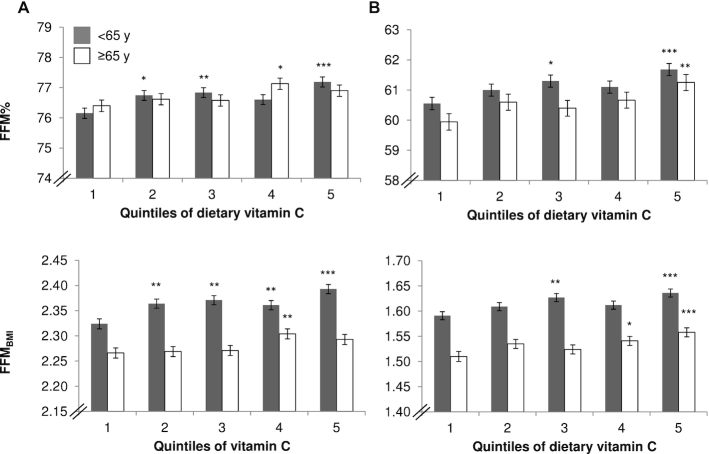
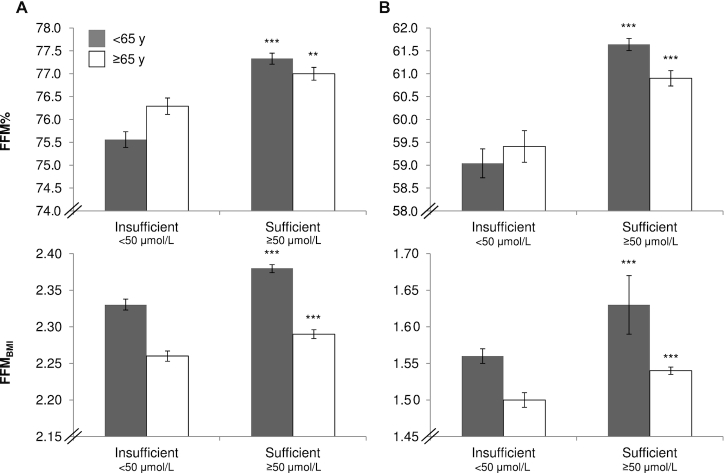
Positive trends were found across quintiles of dietary vitamin C and FFM measures for both sexes, with interquintile differences in FFM% and FFMBMI of 1.0% and 2.3% for men and 1.9% and 2.9% for women, respectively (all P < 0.001). Similarly, FFM% and FFMBMI measures were higher in participants with sufficient than with insufficient plasma vitamin C: by 1.6% and 2.0% in men, and 3.4% and 3.9% in women, respectively (all P < 0.001). Associations were also evident in analyses stratified into <65-y and ≥65-y age groups.
Our findings of positive associations, of both dietary and circulating vitamin C with measures of skeletal muscle mass in middle- and older-aged men and women, suggest that dietary vitamin C intake may be useful for reducing age-related muscle loss.
与年龄相关的骨骼肌量损失可导致不良后果,包括肌少症、身体残疾、虚弱、2 型糖尿病和死亡。维生素 C 与骨骼肌具有生理相关性,并且在衰老过程中可能对其具有保护作用,但很少有研究调查其在老年人群中的重要性。
我们旨在研究饮食和血浆维生素 C 与大量中老年人群中骨骼肌量替代指标的横断面相关性。
我们分析了欧洲癌症与营养前瞻性调查-诺福克队列中 >13000 名年龄在 42-82 岁的男性和女性的数据。使用生物电阻抗分析估计无脂肪质量(FFM),作为骨骼肌量的替代指标,并表示为总质量的百分比(FFM%)或按 BMI 标准化(FFMBMI)。饮食维生素 C 摄入量由 7 天食物日记数据计算得出,外周血中测量血浆维生素 C。使用包含相关生活方式、饮食和生物学协变量的多变量回归模型,确定 FFM 指标与饮食维生素 C 五分位区间或与血浆维生素 C 不足(<50 μmol/L 和≥50 μmol/L)的五分位区间之间的关系。
在男性和女性中,饮食维生素 C 五分位区间与 FFM 指标均呈现出正相关趋势,FFM%和 FFMBMI 的五分位区间差异分别为 1.0%和 2.3%(均 P < 0.001)。同样,血浆维生素 C 充足的参与者的 FFM%和 FFMBMI 指标高于不足的参与者:男性分别高出 1.6%和 2.0%,女性分别高出 3.4%和 3.9%(均 P < 0.001)。在按<65 岁和≥65 岁年龄组分层的分析中也观察到了类似的关联。
我们发现饮食和循环维生素 C 与中老年男性和女性骨骼肌量替代指标之间存在正相关关系,这表明饮食维生素 C 摄入可能有助于减少与年龄相关的肌肉损失。