Goodwin Renee D, Weinberger Andrea H, Kim June H, Wu Melody, Galea Sandro
Department of Epidemiology and Biostatistics, Graduate School of Public Health and Health Policy, The City University of New York, New York, NY, USA; Department of Epidemiology, Mailman School of Public Health, Columbia University, New York, NY, USA.
Ferkauf Graduate School of Psychology, Yeshiva University, Bronx, NY, USA; Department of Epidemiology & Population Health, Albert Einstein College of Medicine, Bronx, NY, USA.
J Psychiatr Res. 2020 Nov;130:441-446. doi: 10.1016/j.jpsychires.2020.08.014. Epub 2020 Aug 21.
In a time of global uncertainty, understanding the psychological health of the American public is imperative. There are no current data on anxiety trends among adults in the United States (US) over time. This study aimed to investigate prevalence of anxiety among US adults from 2008 to 2018.
Data from the National Survey on Drug Use and Health (NSDUH), which is an annual, cross-sectional survey on substance use and mental health in the US, were analyzed in 2020. Prevalence of past-month anxiety was estimated among those ages ≥18, by survey year from 2008 to 2018. Time trends were tested using logistic regression.
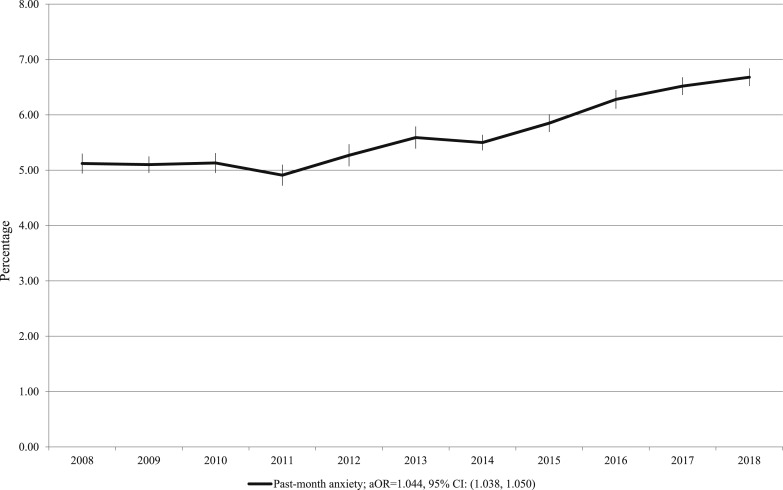
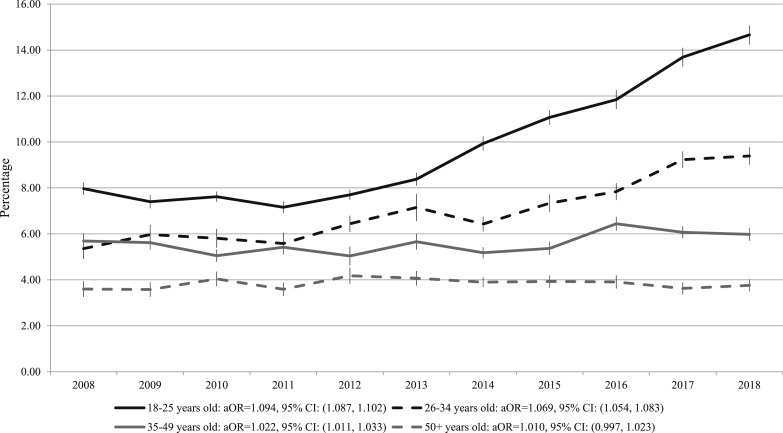
Anxiety increased from 5.12% in 2008 to 6.68% in 2018 (p < 0.0001) among adult Americans. Stratification by age revealed the most notable increase from 7.97% to 14.66% among respondents 18-25 years old (p < 0.001), which was a more rapid increase than among 26-34 and 35-49 year olds (differential time trend p < 0.001). Anxiety did not significantly increase among those ages 50 and older. Anxiety increased more rapidly among those never married and with some college education, relative to their respective counterparts. Apart from age, marital status and education, anxiety increased consistently among sociodemographic groups.
Anxiety is increasing among adults under age 50 in the US, with more rapid increase among young adults. To prepare for a healthier adulthood and given direct and indirect (via 24/7 media) exposure to anxiety-provoking world events, prophylactic measures that can bolster healthy coping responses and/or treatment seeking seem warranted on a broad scale.
在全球局势不确定的时代,了解美国公众的心理健康状况至关重要。目前尚无关于美国成年人焦虑趋势随时间变化的数据。本研究旨在调查2008年至2018年美国成年人中焦虑症的患病率。
2020年对美国全国药物使用和健康调查(NSDUH)的数据进行了分析,该调查是一项关于美国药物使用和心理健康的年度横断面调查。对2008年至2018年各调查年份中年龄≥18岁人群过去一个月焦虑症的患病率进行了估计。使用逻辑回归检验时间趋势。
美国成年人中焦虑症患病率从2008年的5.12%上升至2018年的6.68%(p<0.0001)。按年龄分层显示,18至25岁受访者中焦虑症患病率从7.97%升至14.66%最为显著(p<0.001),其上升速度快于26至34岁和35至49岁人群(时间趋势差异p<0.001)。50岁及以上人群中焦虑症患病率未显著上升。相对于各自的同龄人,从未结婚和受过一些大学教育的人群中焦虑症上升更快。除年龄、婚姻状况和教育程度外,社会人口统计学群体中的焦虑症患病率持续上升。
美国50岁以下成年人的焦虑症患病率在上升,其中年轻人上升更快。为了迎接更健康的成年生活,鉴于直接和间接(通过全天候媒体)接触引发焦虑的世界事件,广泛采取能够增强健康应对反应和/或寻求治疗的预防措施似乎是有必要的。