Tecnologico de Monterrey, Escuela de Medicina y Ciencias de la Salud, Ave. Morones Prieto 3000, 64710, Monterrey, NL, Mexico.
Tecnologico de Monterrey, Centro de Investigación Biomédica, Hospital Zambrano Hellion, TecSalud, 66278, San Pedro Garza García, NL, Mexico.
Curr Cardiol Rep. 2020 Sep 10;22(11):139. doi: 10.1007/s11886-020-01382-2.
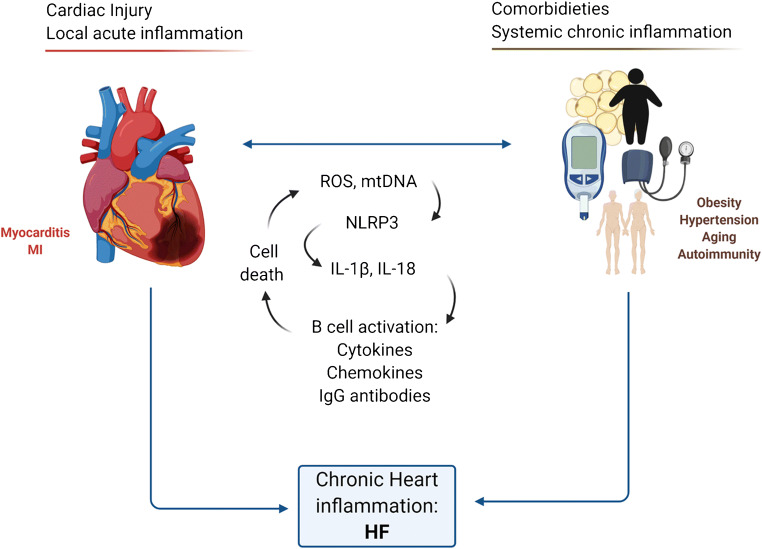
In heart failure, whether it is associated with reduced or preserved ejection fraction, the immune system is activated and contributes to heart remodeling and impaired function.
Studies indicate that cells of the immune system not only play a role in the pathology but are also critical regulators of heart function. Knowledge about the role of the immune system driving heart failure will lead to the development of new targets to this system, particularly in those patients that, despite the apparent wellness, relapse and worsen. In this review, we will address the diverse mechanisms that trigger inflammation and their impact on heart failure progression.
在心力衰竭中,无论射血分数降低或保留,免疫系统都会被激活,并导致心脏重构和功能障碍。
研究表明,免疫系统的细胞不仅在病理学中起作用,而且还是心脏功能的关键调节因子。对免疫系统驱动心力衰竭的作用的了解将导致针对该系统的新靶点的发展,特别是在那些尽管表面上健康,但仍会复发和恶化的患者中。在这篇综述中,我们将讨论引发炎症的各种机制及其对心力衰竭进展的影响。