Division of Rheumatology, Department of Medicine Solna, Karolinska Institutet, Stockholm, Sweden.
Rheumatology, Karolinska University Hospital, Stockholm, Sweden.
Rheumatology (Oxford). 2021 Mar 2;60(3):1260-1272. doi: 10.1093/rheumatology/keaa453.
Associations between BMI and health-related quality of life (HRQoL) in SLE have been implied, but data are scarce. We determined the impact of overweight and obesity on HRQoL in a large SLE population.
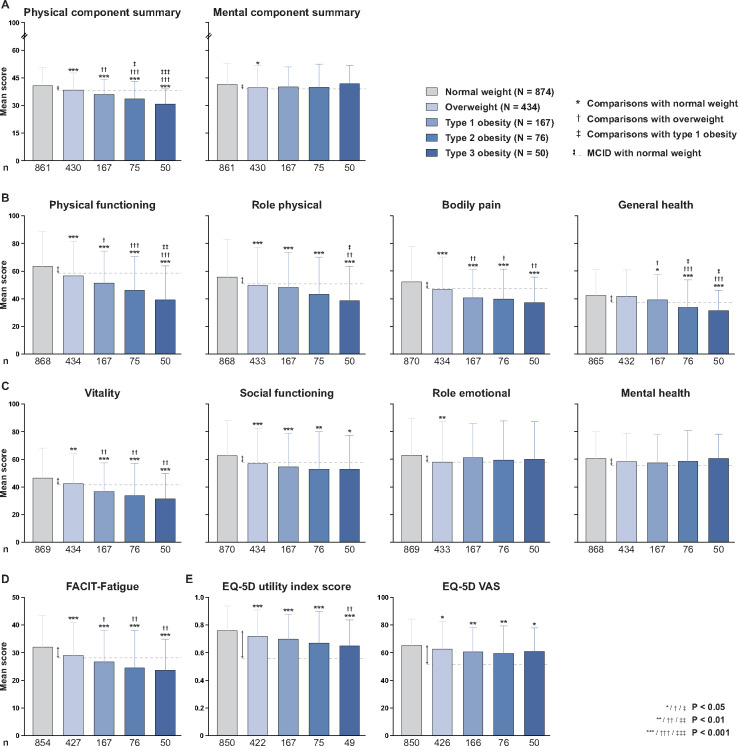
We pooled cross-sectional baseline data from the BLISS-52 (NCT00424476) and BLISS-76 (NCT00410384) trials (N = 1684). HRQoL was evaluated using the 36-item Short Form Health Survey (SF-36), Functional Assessment of Chronic Illness Therapy (FACIT)-Fatigue scale and the European Quality of Life 5-dimension questionnaire (EQ-5D). Comparisons between BMI groups were conducted using the Mann-Whitney U test and adjustments using linear regression. Clinical relevance was determined by minimal clinically important differences (MCIDs).
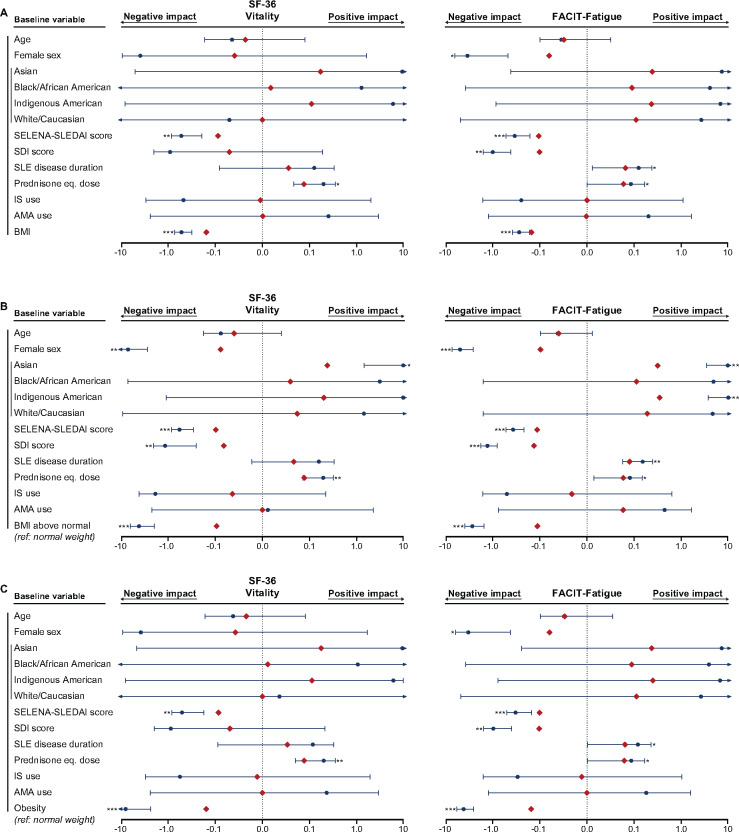
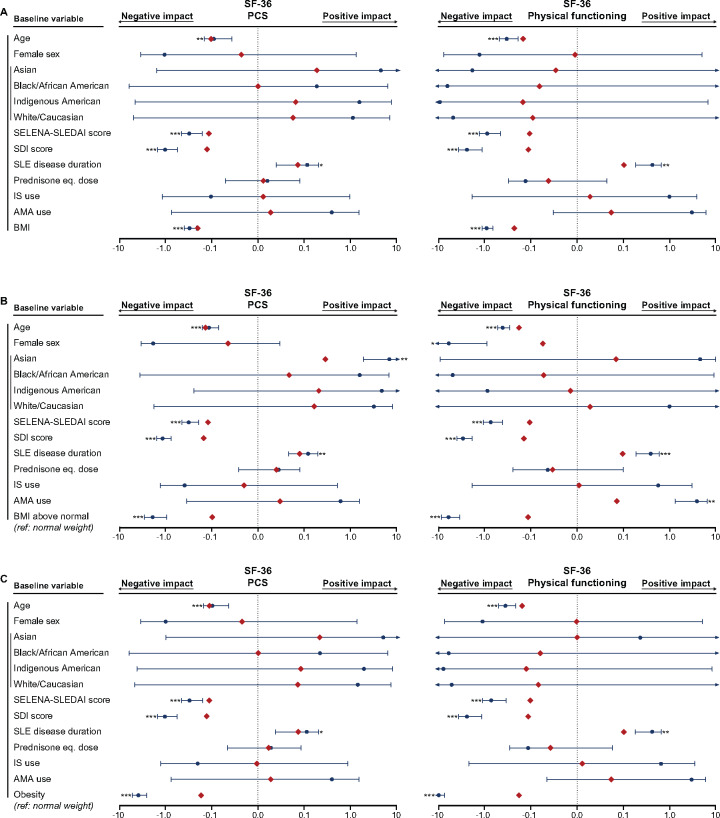
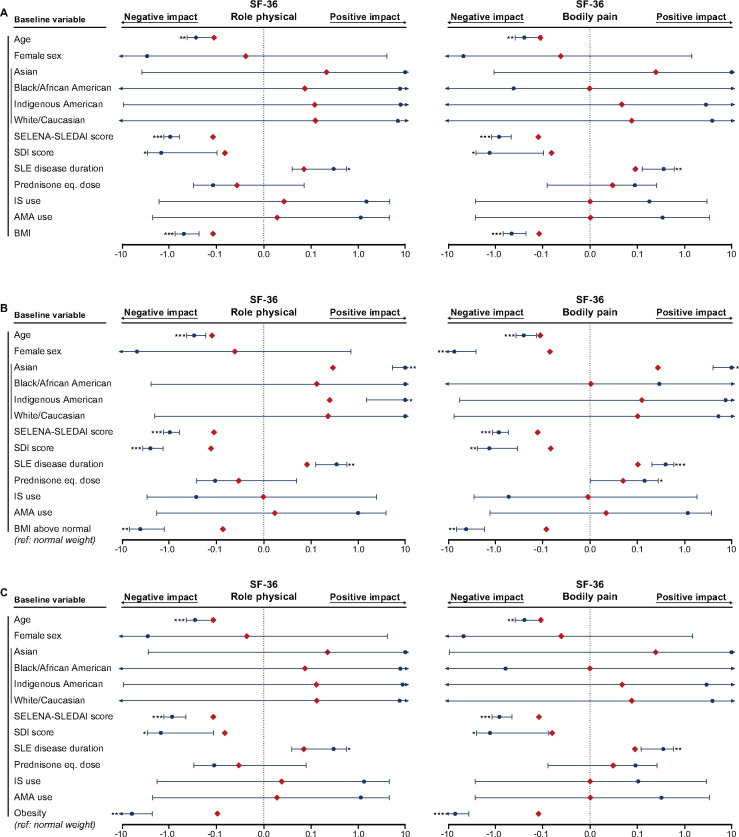
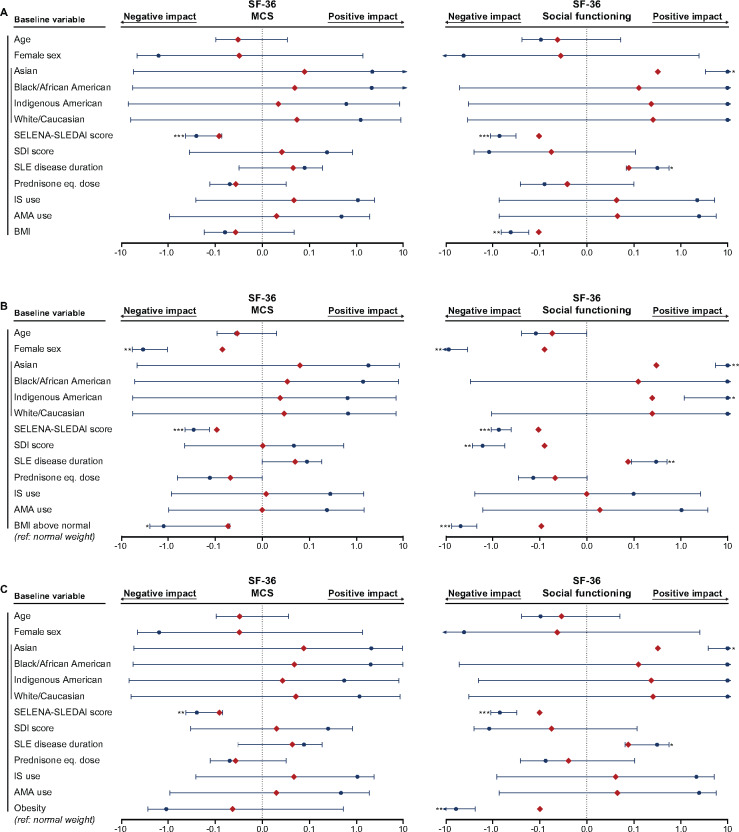
In total, 43.2% of the patients had BMI above normal and 17.4% were obese. Overweight and obese patients reported worse SF-36 physical component summary (PCS), physical functioning, role physical, bodily pain and FACIT-Fatigue scores than normal weight patients. Divergences were greater than corresponding MCIDs and more prominent with increasing BMI. Despite no clinically important difference in SF-36 mental component summary scores across BMI categories, patients experienced progressively diminished vitality and social functioning with increasing BMI. In linear regression analysis, BMI above normal and obesity were associated with worse PCS (standardized coefficient β = -0.10, P < 0.001 and β = -0.17, P < 0.001, respectively), FACIT-Fatigue (β = -0.11, P < 0.001 and β = -0.16, P < 0.001) and EQ-5D (β = -0.08, P = 0.001 and β = -0.12, P < 0.001) scores, independently of demographic and disease-related factors. The impact of BMI on the PCS and FACIT-Fatigue was more pronounced than that of SLE activity.
Patients with SLE and BMI above normal experienced clinically important HRQoL diminutions in physical aspects, fatigue and social functioning. A survey of potential causality underlying this association is warranted.
已有研究表明,BMI 与 SLE 患者的健康相关生活质量(HRQoL)之间存在关联,但相关数据仍然有限。本研究旨在探究超重和肥胖对大型 SLE 患者 HRQoL 的影响。
本研究对 BLISS-52(NCT00424476)和 BLISS-76(NCT00410384)两项临床试验的基线横断面数据进行了汇总分析(N=1684)。采用 36 项简明健康调查问卷(SF-36)、慢性病治疗功能评估-疲劳量表(FACIT-Fatigue)和欧洲五维健康量表(EQ-5D)评估 HRQoL。使用 Mann-Whitney U 检验比较 BMI 组间差异,并用线性回归进行调整。采用最小临床重要差异(MCID)来判断临床相关性。
共 43.2%的患者 BMI 高于正常值,17.4%的患者为肥胖。与体重正常的患者相比,超重和肥胖患者的 SF-36 生理成分综合评分(PCS)、生理职能、躯体疼痛和 FACIT-Fatigue 疲劳评分更差。这种差异大于相应的 MCID,且随着 BMI 的增加而更加显著。尽管 BMI 类别之间的 SF-36 心理成分综合评分无明显的临床差异,但患者的活力和社会功能随着 BMI 的增加而逐渐下降。在线性回归分析中,BMI 高于正常值和肥胖与 PCS(标准化系数β=-0.10,P<0.001 和β=-0.17,P<0.001)、FACIT-Fatigue(β=-0.11,P<0.001 和β=-0.16,P<0.001)和 EQ-5D(β=-0.08,P=0.001 和β=-0.12,P<0.001)评分差独立相关,且不受人口统计学和疾病相关因素的影响。BMI 对 PCS 和 FACIT-Fatigue 的影响比 SLE 疾病活动度的影响更为显著。
BMI 高于正常值的 SLE 患者在生理功能、疲劳和社会功能方面的 HRQoL 明显下降。有必要对这种关联的潜在因果关系进行调查。