
CVDNet:一种用于从胸部X光图像中检测冠状病毒(COVID-19)的新型深度学习架构。
CVDNet: A novel deep learning architecture for detection of coronavirus (Covid-19) from chest x-ray images.
作者信息
Ouchicha Chaimae, Ammor Ouafae, Meknassi Mohammed
机构信息
Department of Mathematics, Faculty of Science and Technology of Fez S.M.B. Abdellah University, P.O. Box 2202, Morocco.
Department of informatics, Faculty of Sciences Dhar El Mehraz S.M.B. Abdellah University, P.O. Box 1796 Atlas Fez, Morocco.
出版信息
Chaos Solitons Fractals. 2020 Nov;140:110245. doi: 10.1016/j.chaos.2020.110245. Epub 2020 Sep 4.
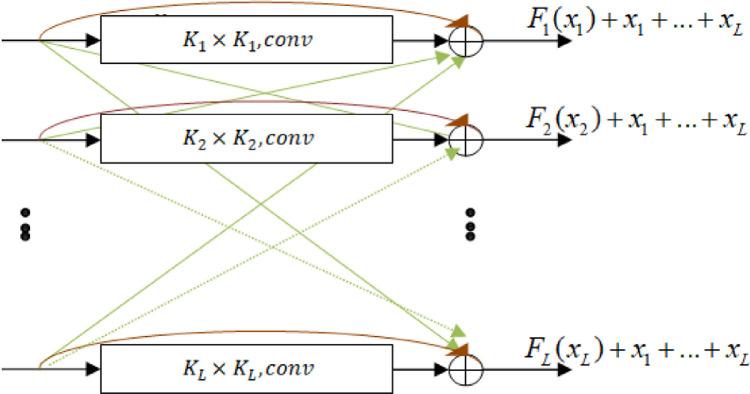
The COVID-19 pandemic is an emerging respiratory infectious disease, also known as coronavirus 2019. It appears in November 2019 in Hubei province (in China), and more specifically in the city of Wuhan, then spreads in the whole world. As the number of cases increases with unprecedented speed, many parts of the world are facing a shortage of resources and testing. Faced with this problem, physicians, scientists and engineers, including specialists in Artificial Intelligence (AI), have encouraged the development of a Deep Learning model to help healthcare professionals to detect COVID-19 from chest X-ray images and to determine the severity of the infection in a very short time, with low cost. In this paper, we propose CVDNet, a Deep Convolutional Neural Network (CNN) model to classify COVID-19 infection from normal and other pneumonia cases using chest X-ray images. The proposed architecture is based on the residual neural network and it is constructed by using two parallel levels with different kernel sizes to capture local and global features of the inputs. This model is trained on a dataset publically available containing a combination of 219 COVID-19, 1341 normal and 1345 viral pneumonia chest x-ray images. The experimental results reveal that our CVDNet. These results represent a promising classification performance on a small dataset which can be further achieve better results with more training data. Overall, our CVDNet model can be an interesting tool to help radiologists in the diagnosis and early detection of COVID-19 cases.
新型冠状病毒肺炎疫情是一种新出现的呼吸道传染病,也被称为2019冠状病毒病。它于2019年11月出现在中国湖北省,更具体地说是武汉市,随后在全球范围内传播。随着病例数量以前所未有的速度增加,世界许多地区正面临资源和检测短缺的问题。面对这一问题,包括人工智能(AI)专家在内的医生、科学家和工程师鼓励开发深度学习模型,以帮助医疗专业人员在短时间内以低成本从胸部X光图像中检测新型冠状病毒肺炎,并确定感染的严重程度。在本文中,我们提出了CVDNet,一种深度卷积神经网络(CNN)模型,用于使用胸部X光图像从正常病例和其他肺炎病例中对新型冠状病毒肺炎感染进行分类。所提出的架构基于残差神经网络,它由两个具有不同内核大小的并行层构建而成,以捕获输入的局部和全局特征。该模型在一个公开可用的数据集上进行训练,该数据集包含219张新型冠状病毒肺炎、1341张正常和1345张病毒性肺炎胸部X光图像的组合。实验结果表明我们的CVDNet。这些结果在一个小数据集上显示出了有前景的分类性能,通过更多的训练数据可以进一步取得更好的结果。总体而言,我们的CVDNet模型可以成为帮助放射科医生诊断和早期检测新型冠状病毒肺炎病例的一个有趣工具。




 Zotero 插件