Department of Civil and Mechanical Engineering, University of Cassino and Southern Lazio, Cassino, FR, Italy; International Laboratory for Air Quality and Health, Queensland University of Technology, Brisbane, Qld, Australia.
International Laboratory for Air Quality and Health, Queensland University of Technology, Brisbane, Qld, Australia.
Environ Int. 2020 Dec;145:106112. doi: 10.1016/j.envint.2020.106112. Epub 2020 Sep 6.
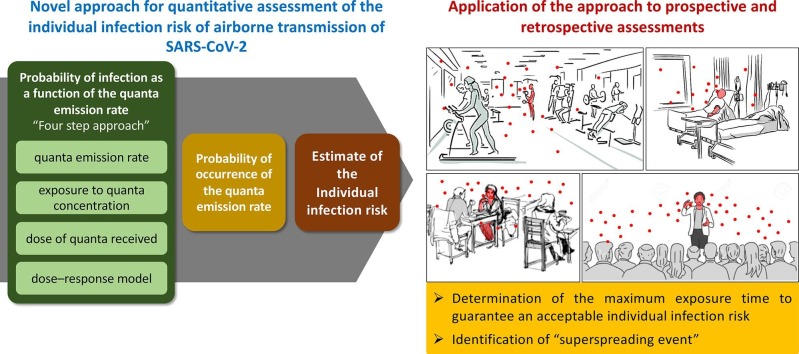
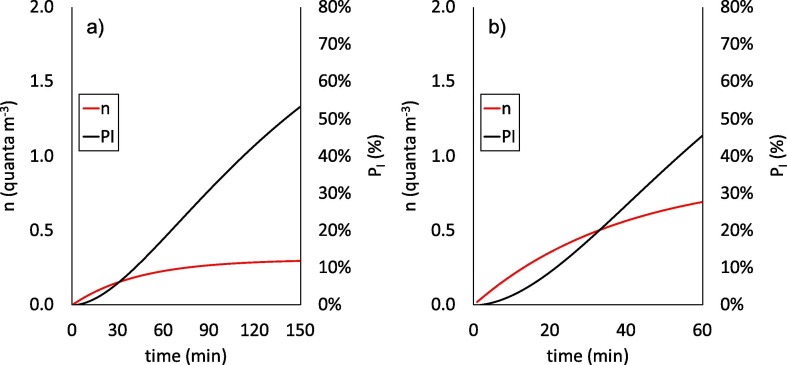
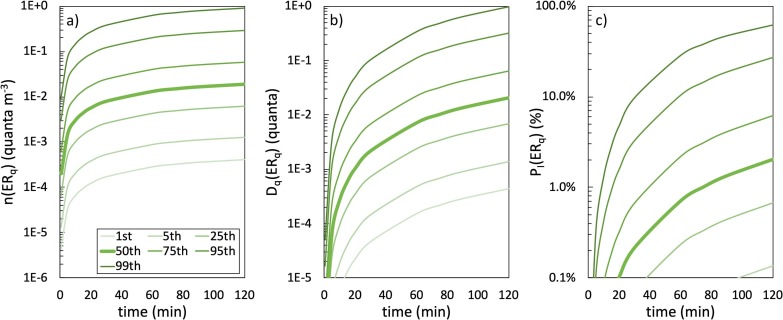
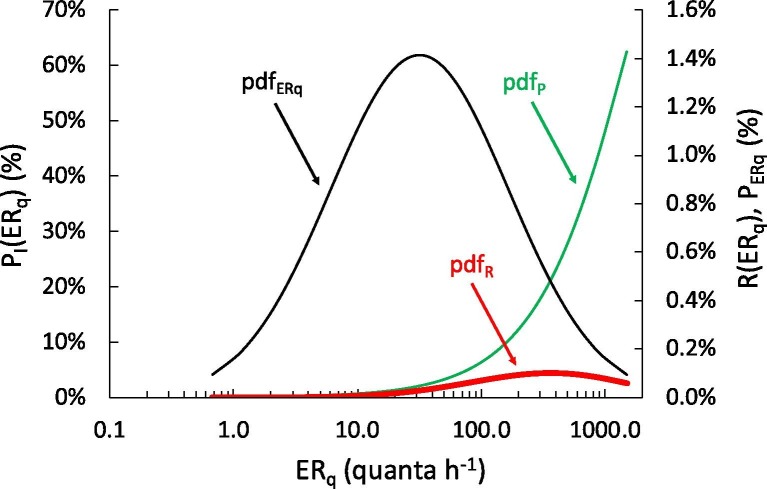
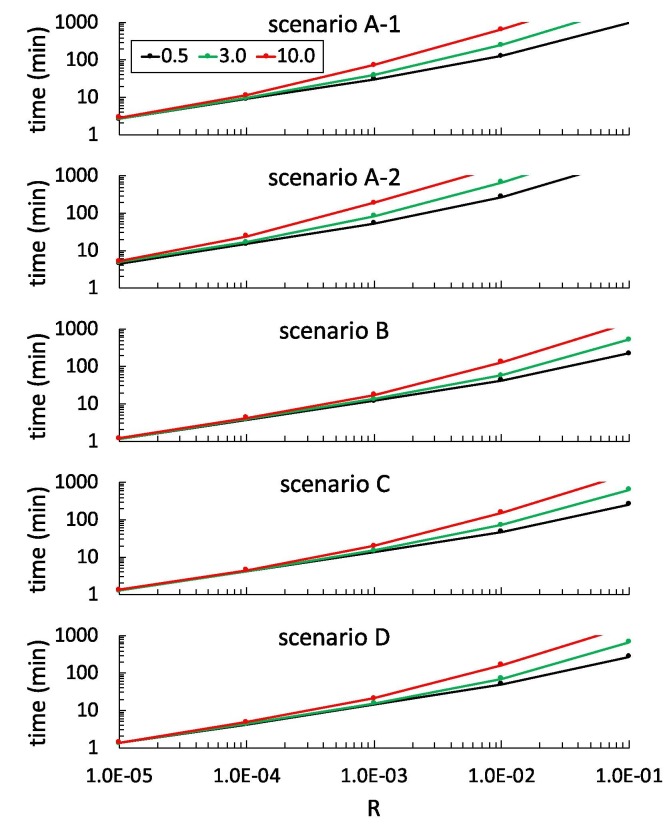
Airborne transmission is a recognized pathway of contagion; however, it is rarely quantitatively evaluated. The numerous outbreaks that have occurred during the SARS-CoV-2 pandemic are putting a demand on researchers to develop approaches capable of both predicting contagion in closed environments (predictive assessment) and analyzing previous infections (retrospective assessment). This study presents a novel approach for quantitative assessment of the individual infection risk of susceptible subjects exposed in indoor microenvironments in the presence of an asymptomatic infected SARS-CoV-2 subject. The application of a Monte Carlo method allowed the risk for an exposed healthy subject to be evaluated or, starting from an acceptable risk, the maximum exposure time. We applied the proposed approach to four distinct scenarios for a prospective assessment, highlighting that, in order to guarantee an acceptable risk of 10 for exposed subjects in naturally ventilated indoor environments, the exposure time could be well below one hour. Such maximum exposure time clearly depends on the viral load emission of the infected subject and on the exposure conditions; thus, longer exposure times were estimated for mechanically ventilated indoor environments and lower viral load emissions. The proposed approach was used for retrospective assessment of documented outbreaks in a restaurant in Guangzhou (China) and at a choir rehearsal in Mount Vernon (USA), showing that, in both cases, the high attack rate values can be justified only assuming the airborne transmission as the main route of contagion. Moreover, we show that such outbreaks are not caused by the rare presence of a superspreader, but can be likely explained by the co-existence of conditions, including emission and exposure parameters, leading to a highly probable event, which can be defined as a "superspreading event".
空气传播是公认的传染途径;然而,其很少被定量评估。在 SARS-CoV-2 大流行期间发生的众多暴发,正促使研究人员开发出既能预测封闭环境中的传染(预测评估),又能分析以往感染情况(回顾性评估)的方法。本研究提出了一种定量评估易感个体在存在无症状感染 SARS-CoV-2 个体的室内微环境中暴露的个体感染风险的新方法。蒙特卡罗方法的应用允许评估暴露于健康个体的风险,或者从可接受的风险开始,评估最大暴露时间。我们将提出的方法应用于四个不同的场景进行前瞻性评估,突出表明,为了保证暴露于自然通风室内环境中的个体可接受的 10 风险,暴露时间可以远远低于一个小时。这种最大暴露时间显然取决于感染个体的病毒载量排放和暴露条件;因此,在机械通风的室内环境和较低的病毒载量排放中,预计会有更长的暴露时间。该方法用于回顾性评估中国广州一家餐厅和美国弗农山的合唱团排练中的记录暴发,结果表明,在这两种情况下,只有假设空气传播是主要的传染途径,才能解释高发病率值。此外,我们表明,此类暴发不是由罕见的超级传播者引起的,而是可能由于包括排放和暴露参数在内的条件共同存在导致的高概率事件,即“超级传播事件”。