Zhang Yu, Dong Zhichao, Li Chuxin, Du Huifeng, Fang Nicholas X, Wu Lei, Song Yanlin
Key Laboratory of Green Printing, Institute of Chemistry, Chinese Academy of Sciences, Zhongguancun North First Street 2, 100190, Beijing, P.R. China.
University of Chinese Academy of Sciences, Beijing, 100049, P. R. China.
Nat Commun. 2020 Sep 17;11(1):4685. doi: 10.1038/s41467-020-18518-1.
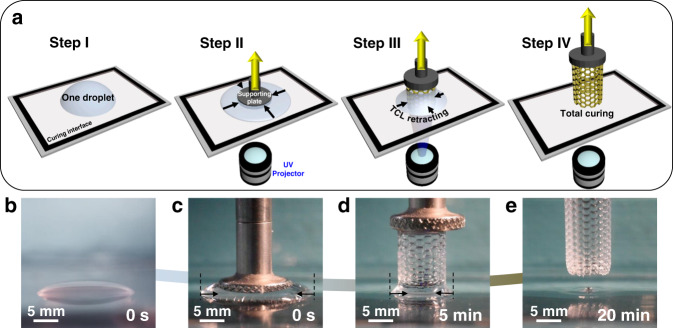
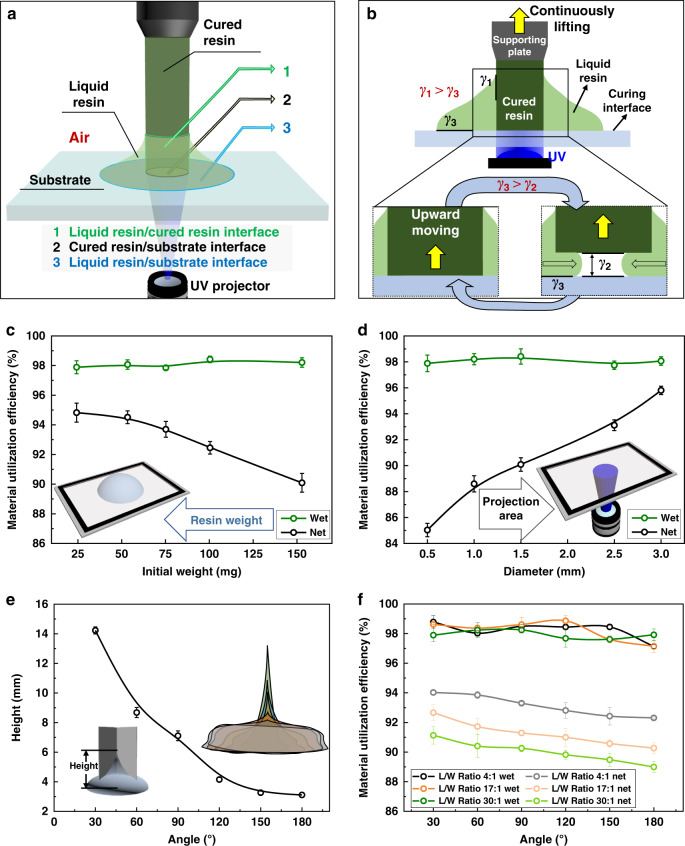
3D printing has become one of the most promising methods to construct delicate 3D structures. However, precision and material utilization efficiency are limited. Here, we propose a one-droplet 3D printing strategy to fabricate controllable 3D structures from a single droplet ascribing to the receding property of the three-phase contact line (TCL) of the resin droplet. The well-controlled dewetting force of liquid resin on the cured structure results in the minimization of liquid residue and the high wet and net material utilization efficiency in forming a droplet into a 3D structure. Additionally, extra curing induced protruding or stepped sidewalls under high printing speed, which require high UV intensity, can be prevented. The critical is the free contact surface property of the droplet system with the introduction of the receding TCL, which increased the inner droplet liquid circulation and reduces the adhesion properties among the liquid resin, cured resin, and resin vat.
3D打印已成为构建精细3D结构最具前景的方法之一。然而,其精度和材料利用效率有限。在此,我们提出一种单滴3D打印策略,借助树脂液滴三相接触线(TCL)的后退特性,从单个液滴制造可控的3D结构。液态树脂在固化结构上受到良好控制的去湿力,使得液体残留最小化,并在将液滴成型为3D结构时实现了高湿态和净材料利用效率。此外,还能防止在高打印速度下因额外固化导致的突出或阶梯状侧壁,而这需要高紫外线强度。关键在于引入后退TCL的液滴系统的自由接触表面特性,这增加了液滴内部液体循环,并降低了液态树脂、固化树脂和树脂槽之间的粘附特性。