• 文献检索
  • 文档翻译
  • 深度研究
  • 学术资讯
  • Suppr Zotero 插件Zotero 插件
  • 邀请有礼
  • 套餐&价格
  • 历史记录
应用&插件
Suppr Zotero 插件Zotero 插件浏览器插件Mac 客户端Windows 客户端微信小程序
定价
高级版会员购买积分包购买API积分包
服务
文献检索文档翻译深度研究API 文档MCP 服务
关于我们
关于 Suppr公司介绍联系我们用户协议隐私条款
关注我们

Suppr 超能文献

核心技术专利:CN118964589B侵权必究
粤ICP备2023148730 号-1Suppr @ 2026

文献检索

告别复杂PubMed语法,用中文像聊天一样搜索,搜遍4000万医学文献。AI智能推荐,让科研检索更轻松。

立即免费搜索

文件翻译

保留排版,准确专业,支持PDF/Word/PPT等文件格式,支持 12+语言互译。

免费翻译文档

深度研究

AI帮你快速写综述,25分钟生成高质量综述,智能提取关键信息,辅助科研写作。

立即免费体验

基于广义分数阶SEIR模型的美国新冠肺炎疫情趋势预测分析

Forecast analysis of the epidemics trend of COVID-19 in the USA by a generalized fractional-order SEIR model.

作者信息

Xu Conghui, Yu Yongguang, Chen YangQuan, Lu Zhenzhen

机构信息

Department of Mathematics ,School of Science, Beijing Jiaotong University, Beijing, 100044 China.

Mechatronics, Embedded Systems and Automation Lab, University of California, Merced, Merced, CA 95343 USA.

出版信息

Nonlinear Dyn. 2020;101(3):1621-1634. doi: 10.1007/s11071-020-05946-3. Epub 2020 Sep 14.

DOI:10.1007/s11071-020-05946-3
PMID:32952299
原文链接:https://pmc.ncbi.nlm.nih.gov/articles/PMC7487266/
Abstract

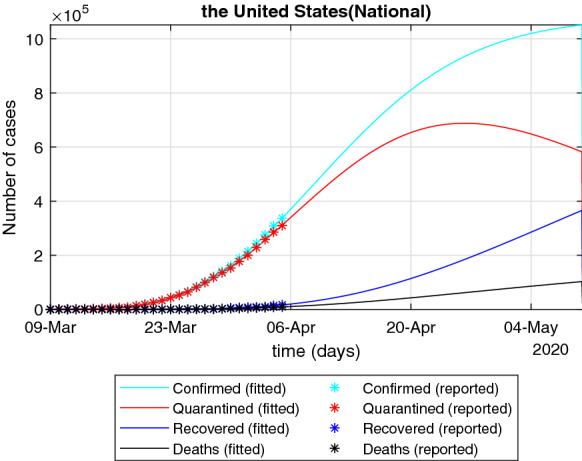
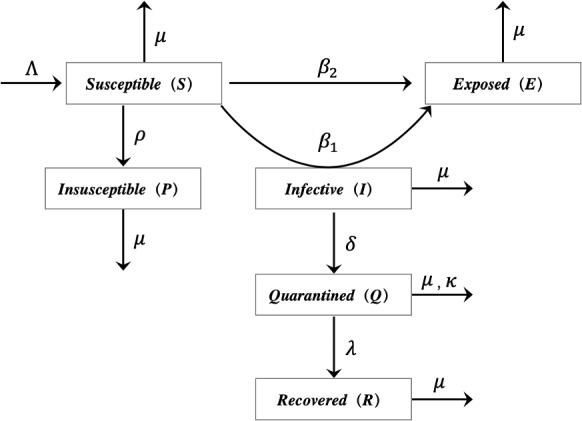
In this paper, a generalized fractional-order SEIR model is proposed, denoted by SEIQRP model, which divided the population into susceptible, exposed, infectious, quarantined, recovered and insusceptible individuals and has a basic guiding significance for the prediction of the possible outbreak of infectious diseases like the coronavirus disease in 2019 (COVID-19) and other insect diseases in the future. Firstly, some qualitative properties of the model are analyzed. The basic reproduction number is derived. When , the disease-free equilibrium point is unique and locally asymptotically stable. When , the endemic equilibrium point is also unique. Furthermore, some conditions are established to ensure the local asymptotic stability of disease-free and endemic equilibrium points. The trend of COVID-19 spread in the USA is predicted. Considering the influence of the individual behavior and government mitigation measurement, a modified SEIQRP model is proposed, defined as SEIQRPD model, which is divided the population into susceptible, exposed, infectious, quarantined, recovered, insusceptible and dead individuals. According to the real data of the USA, it is found that our improved model has a better prediction ability for the epidemic trend in the next two weeks. Hence, the epidemic trend of the USA in the next two weeks is investigated, and the peak of isolated cases is predicted. The modified SEIQRP model successfully capture the development process of COVID-19, which provides an important reference for understanding the trend of the outbreak.

摘要

本文提出了一种广义分数阶SEIR模型,记为SEIQRP模型,该模型将人群分为易感者、潜伏者、感染者、隔离者、康复者和不易感者,对预测2019年冠状病毒病(COVID-19)等传染病未来可能的爆发具有重要指导意义。首先,分析了该模型的一些定性性质。推导了基本再生数。当 时,无病平衡点是唯一的且局部渐近稳定。当 时,地方病平衡点也是唯一的。此外,建立了一些条件以确保无病平衡点和地方病平衡点的局部渐近稳定性。预测了COVID-19在美国的传播趋势。考虑到个体行为和政府缓解措施的影响,提出了一种改进的SEIQRP模型,记为SEIQRPD模型,该模型将人群分为易感者、潜伏者、感染者、隔离者、康复者、不易感者和死亡者。根据美国的实际数据,发现我们改进后的模型对未来两周的疫情趋势具有更好的预测能力。因此,研究了美国未来两周的疫情趋势,并预测了隔离病例的峰值。改进后的SEIQRP模型成功地捕捉了COVID-19的发展过程,为理解疫情爆发趋势提供了重要参考。
https://cdn.ncbi.nlm.nih.gov/pmc/blobs/534d/7487266/fd37a6bf6096/11071_2020_5946_Fig5_HTML.jpg
https://cdn.ncbi.nlm.nih.gov/pmc/blobs/534d/7487266/2a02cf4e1a0f/11071_2020_5946_Fig1_HTML.jpg
https://cdn.ncbi.nlm.nih.gov/pmc/blobs/534d/7487266/9ea1ca4150c4/11071_2020_5946_Fig2_HTML.jpg
https://cdn.ncbi.nlm.nih.gov/pmc/blobs/534d/7487266/41cf14fd1727/11071_2020_5946_Fig3_HTML.jpg
https://cdn.ncbi.nlm.nih.gov/pmc/blobs/534d/7487266/d30e1b74adaf/11071_2020_5946_Fig4_HTML.jpg
https://cdn.ncbi.nlm.nih.gov/pmc/blobs/534d/7487266/fd37a6bf6096/11071_2020_5946_Fig5_HTML.jpg
https://cdn.ncbi.nlm.nih.gov/pmc/blobs/534d/7487266/2a02cf4e1a0f/11071_2020_5946_Fig1_HTML.jpg
https://cdn.ncbi.nlm.nih.gov/pmc/blobs/534d/7487266/9ea1ca4150c4/11071_2020_5946_Fig2_HTML.jpg
https://cdn.ncbi.nlm.nih.gov/pmc/blobs/534d/7487266/41cf14fd1727/11071_2020_5946_Fig3_HTML.jpg
https://cdn.ncbi.nlm.nih.gov/pmc/blobs/534d/7487266/d30e1b74adaf/11071_2020_5946_Fig4_HTML.jpg
https://cdn.ncbi.nlm.nih.gov/pmc/blobs/534d/7487266/fd37a6bf6096/11071_2020_5946_Fig5_HTML.jpg

相似文献

1
Forecast analysis of the epidemics trend of COVID-19 in the USA by a generalized fractional-order SEIR model.基于广义分数阶SEIR模型的美国新冠肺炎疫情趋势预测分析
Nonlinear Dyn. 2020;101(3):1621-1634. doi: 10.1007/s11071-020-05946-3. Epub 2020 Sep 14.
2
Study on the Global Stability for a Generalized SEIR Epidemic Model.广义 SEIR 传染病模型的全局稳定性研究。
Comput Intell Neurosci. 2022 Aug 8;2022:8215214. doi: 10.1155/2022/8215214. eCollection 2022.
3
Qualitative and quantitative analysis of the COVID-19 pandemic by a two-side fractional-order compartmental model.基于双边分数阶 compartmental 模型的 COVID-19 大流行的定性和定量分析。
ISA Trans. 2022 May;124:144-156. doi: 10.1016/j.isatra.2022.01.008. Epub 2022 Jan 12.
4
The effect mitigation measures for COVID-19 by a fractional-order SEIHRDP model with individuals migration.具有个体迁移的分数阶 SEIHRDP 模型对 COVID-19 的影响缓解措施。
ISA Trans. 2023 Jan;132:582-597. doi: 10.1016/j.isatra.2022.12.006. Epub 2022 Dec 14.
5
Fractional-Order SEIQRDP Model for Simulating the Dynamics of COVID-19 Epidemic.用于模拟COVID-19疫情动态的分数阶SEIQRDP模型
IEEE Open J Eng Med Biol. 2020 Aug 26;1:249-256. doi: 10.1109/OJEMB.2020.3019758. eCollection 2020.
6
Stability analysis and optimal control of a fractional-order generalized SEIR model for the COVID-19 pandemic.COVID-19大流行的分数阶广义SEIR模型的稳定性分析与最优控制
Appl Math Comput. 2023 Jun 27:128210. doi: 10.1016/j.amc.2023.128210.
7
Fractional epidemic model of coronavirus disease with vaccination and crowding effects.带接种和拥挤效应的冠状病毒病分数阶模型。
Sci Rep. 2024 Apr 8;14(1):8157. doi: 10.1038/s41598-024-58192-7.
8
A modified SEIR model applied to the data of COVID-19 spread in Saudi Arabia.一种应用于沙特阿拉伯新冠病毒传播数据的改进型SEIR模型。
AIP Adv. 2020 Dec 4;10(12):125210. doi: 10.1063/5.0029698. eCollection 2020 Dec.
9
Coronavirus disease 2019 epidemic prediction in Shanghai under the "dynamic zero-COVID policy" using time-dependent SEAIQR model.基于时间依赖型SEAIQR模型的“动态清零”政策下上海市2019年冠状病毒病疫情预测
J Biosaf Biosecur. 2022 Dec;4(2):105-113. doi: 10.1016/j.jobb.2022.06.002. Epub 2022 Jun 20.
10
Study of Fractional Order SEIR Epidemic Model and Effect of Vaccination on the Spread of COVID-19.分数阶SEIR疫情模型及疫苗接种对COVID-19传播影响的研究
Int J Appl Comput Math. 2022;8(5):237. doi: 10.1007/s40819-022-01411-4. Epub 2022 Aug 26.

引用本文的文献

1
StatModPredict: A user-friendly R-Shiny interface for fitting and forecasting with statistical models.StatModPredict:一个用于使用统计模型进行拟合和预测的用户友好型R-Shiny界面。
PLoS One. 2025 Aug 7;20(8):e0329791. doi: 10.1371/journal.pone.0329791. eCollection 2025.
2
A preliminary validation of the public's emergency preparedness questionnaire for major emerging infectious diseases.重大新发传染病公众应急准备调查问卷的初步验证
BMC Public Health. 2025 Apr 11;25(1):1361. doi: 10.1186/s12889-025-22532-7.
3
A mathematical system of COVID-19 disease model: Existence, uniqueness, numerical and sensitivity analysis.

本文引用的文献

1
Hopf bifurcation in a chronological age-structured SIR epidemic model with age-dependent infectivity.时变年龄结构 SIR 传染病模型中具有年龄相关感染率的 Hopf 分支
Math Biosci Eng. 2023 Jun 5;20(7):13036-13060. doi: 10.3934/mbe.2023581.
2
A fractional-order SEIHDR model for COVID-19 with inter-city networked coupling effects.一种具有城际网络耦合效应的 COVID-19 分数阶 SEIHDR 模型。
Nonlinear Dyn. 2020;101(3):1717-1730. doi: 10.1007/s11071-020-05848-4. Epub 2020 Aug 5.
3
A mathematical model of COVID-19 using fractional derivative: outbreak in India with dynamics of transmission and control.
一种新冠肺炎疾病模型的数学系统:存在性、唯一性、数值分析和敏感性分析。
MethodsX. 2023;10:102045. doi: 10.1016/j.mex.2023.102045. Epub 2023 Jan 28.
4
The effect mitigation measures for COVID-19 by a fractional-order SEIHRDP model with individuals migration.具有个体迁移的分数阶 SEIHRDP 模型对 COVID-19 的影响缓解措施。
ISA Trans. 2023 Jan;132:582-597. doi: 10.1016/j.isatra.2022.12.006. Epub 2022 Dec 14.
5
Using simulation modelling and systems science to help contain COVID-19: A systematic review.利用模拟建模和系统科学助力控制2019冠状病毒病:一项系统综述
Syst Res Behav Sci. 2022 Aug 19. doi: 10.1002/sres.2897.
6
Toward an efficient approximate analytical solution for 4-compartment COVID-19 fractional mathematical model.迈向四房室新冠病毒-19分数阶数学模型的高效近似解析解
J Comput Appl Math. 2022 Dec 15;416:114506. doi: 10.1016/j.cam.2022.114506. Epub 2022 Jul 15.
7
Analysis of COVID-19 epidemic model with sumudu transform.基于苏梅杜变换的新型冠状病毒肺炎疫情模型分析
AIMS Public Health. 2022 Feb 14;9(2):316-330. doi: 10.3934/publichealth.2022022. eCollection 2022.
8
Improving performance of deep learning predictive models for COVID-19 by incorporating environmental parameters.通过纳入环境参数提高用于新冠肺炎的深度学习预测模型的性能。
Gondwana Res. 2023 Feb;114:69-77. doi: 10.1016/j.gr.2022.03.014. Epub 2022 Apr 8.
9
Modeling Rumor Diffusion Process With the Consideration of Individual Heterogeneity: Take the Imported Food Safety Issue as an Example During the COVID-19 Pandemic.考虑个体异质性的谣言传播过程建模:以 COVID-19 大流行期间的进口食品安全问题为例。
Front Public Health. 2022 Mar 7;10:781691. doi: 10.3389/fpubh.2022.781691. eCollection 2022.
10
Qualitative and quantitative analysis of the COVID-19 pandemic by a two-side fractional-order compartmental model.基于双边分数阶 compartmental 模型的 COVID-19 大流行的定性和定量分析。
ISA Trans. 2022 May;124:144-156. doi: 10.1016/j.isatra.2022.01.008. Epub 2022 Jan 12.
使用分数阶导数的COVID-19数学模型:印度的疫情爆发与传播及控制动态
Adv Differ Equ. 2020;2020(1):373. doi: 10.1186/s13662-020-02834-3. Epub 2020 Jul 22.
4
On fractional order differential equations model for nonlocal epidemics.关于非局部流行病的分数阶微分方程模型。
Physica A. 2007 Jun 15;379(2):607-614. doi: 10.1016/j.physa.2007.01.010. Epub 2007 Feb 16.
5
Modified SEIR and AI prediction of the epidemics trend of COVID-19 in China under public health interventions.公共卫生干预下中国新冠疫情趋势的改进型SEIR模型及人工智能预测
J Thorac Dis. 2020 Mar;12(3):165-174. doi: 10.21037/jtd.2020.02.64.
6
A conceptual model for the coronavirus disease 2019 (COVID-19) outbreak in Wuhan, China with individual reaction and governmental action.中国武汉市 2019 年冠状病毒病(COVID-19)爆发的概念模型,包括个体反应和政府行动。
Int J Infect Dis. 2020 Apr;93:211-216. doi: 10.1016/j.ijid.2020.02.058. Epub 2020 Mar 4.
7
Preliminary estimation of the basic reproduction number of novel coronavirus (2019-nCoV) in China, from 2019 to 2020: A data-driven analysis in the early phase of the outbreak.2019 年至 2020 年中国新型冠状病毒(2019-nCoV)基本繁殖数的初步估计:疫情早期的基于数据的分析。
Int J Infect Dis. 2020 Mar;92:214-217. doi: 10.1016/j.ijid.2020.01.050. Epub 2020 Jan 30.