• 文献检索
  • 文档翻译
  • 深度研究
  • 学术资讯
  • Suppr Zotero 插件Zotero 插件
  • 邀请有礼
  • 套餐&价格
  • 历史记录
应用&插件
Suppr Zotero 插件Zotero 插件浏览器插件Mac 客户端Windows 客户端微信小程序
定价
高级版会员购买积分包购买API积分包
服务
文献检索文档翻译深度研究API 文档MCP 服务
关于我们
关于 Suppr公司介绍联系我们用户协议隐私条款
关注我们

Suppr 超能文献

核心技术专利:CN118964589B侵权必究
粤ICP备2023148730 号-1Suppr @ 2026

文献检索

告别复杂PubMed语法,用中文像聊天一样搜索,搜遍4000万医学文献。AI智能推荐,让科研检索更轻松。

立即免费搜索

文件翻译

保留排版,准确专业,支持PDF/Word/PPT等文件格式,支持 12+语言互译。

免费翻译文档

深度研究

AI帮你快速写综述,25分钟生成高质量综述,智能提取关键信息,辅助科研写作。

立即免费体验

从丧亲家属角度评估临终患者护理质量的国际“临终关怀评估”(CODE™)工具中文版的翻译与文化调适。

Translation and cultural adaptation of the Chinese version of the International 'Care Of the Dying Evaluation' (CODE™) tool for assessing the quality of care for dying patients from the perspective of bereaved family members.

作者信息

Zheng Xuejiao, Zhao Juanjuan, Mayland Catriona R, Dong Lei, Cong Feixue, Zhang Xijia, Wen Ya, Xie Dong, Miyashita Mitsunori

机构信息

Department of Palliative Nursing, Tohoku University Graduate School of Medicine, Sendai, Japan.

Changchun Humanities and Science College, Changchun, China.

出版信息

BMC Palliat Care. 2025 May 6;24(1):128. doi: 10.1186/s12904-025-01772-9.

DOI:10.1186/s12904-025-01772-9
PMID:40329248
原文链接:https://pmc.ncbi.nlm.nih.gov/articles/PMC12054271/
Abstract

BACKGROUND

Culturally appropriate assessments are needed to improve care during the last days of life. One way of assessment is to use a tool with bereaved family members after death. The aim of this study was to translate and cross-culturally adapt the International 'Care Of the Dying Evaluation' questionnaire (i-CODE) into Mandarin Chinese.

METHODS

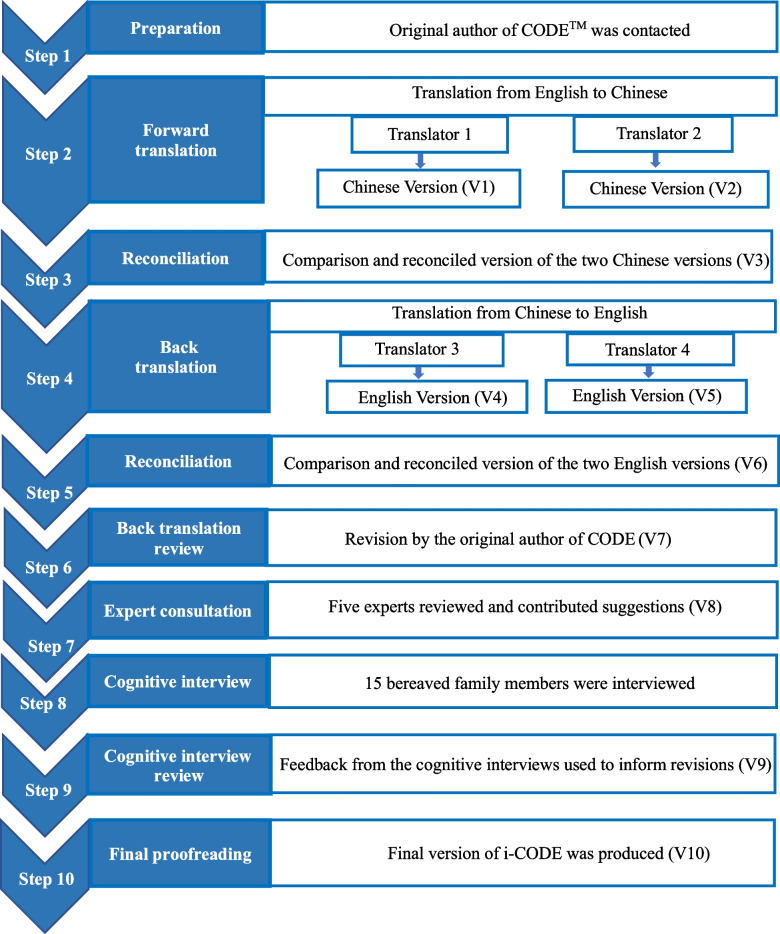
Translation and cultural adaptation process was performed according to the Brislin Classical Backtranslation Model and the principles of the European Organization for Research and Treatment of Cancer (EORTC) quality-of-life group translation procedure. Fifteen bereaved family members, 5 palliative care experts and 4 translators were involved in the process, which followed 10 steps: a) Preparation; b) Forward translation; c) Reconciliation; d) Backward translation; e) Reconciliation; f) Backward translation review; g) Expert consultation; h) Cognitive interview; i) Cognitive interview review; h) Final proofreading.

RESULTS

The translation and cultural adaptation followed established guidelines. items 1 ("washing"), 2 ("giving medicines"), 14 ("noisy rattle"), 18 ("giving fluids through a 'drip'") emerged divergence and reached a consensus among the research team, translators, and original author. In the cultural adaptation, demographic items were restructured to align with Chinese context. Gender-neutral terminology was employed by using "they/them". Inconsistent subject, terminology "healthcare team" and Items 4 ("had adequate privacy"), 14 ("noisy rattle"), 27 ("in the right place"), and 28 ("at the actual time of his/her death") was modified based on experts' assessments and bereaved families' comments. Linguistic, cultural, and conceptual equivalence was achieved in the process of translation and cultural adaptation.

CONCLUSION

A questionnaire allowing for international comparisons related to quality of care for dying individuals has been developed in Mandarin Chinese. Key cultural adaptations were required to ensure that the Chinese version of the i-CODE was suitable for use. It has proved content and face validity. Future work will focus on psychometric testing assessing the validity and reliability of questionnaire and its use in assessing and improving care.

摘要

背景

需要进行符合文化背景的评估,以改善临终关怀。一种评估方法是在患者去世后与丧亲家庭成员一起使用某种工具。本研究的目的是将国际“临终关怀评估”问卷(i-CODE)翻译成中文普通话并进行跨文化调适。

方法

翻译和文化调适过程按照布里斯林经典回译模型以及欧洲癌症研究与治疗组织(EORTC)生活质量小组翻译程序的原则进行。15名丧亲家庭成员、5名姑息治疗专家和4名翻译人员参与了该过程,该过程遵循10个步骤:a)准备;b)正向翻译;c)核对;d)反向翻译;e)核对;f)反向翻译审核;g)专家咨询;h)认知访谈;i)认知访谈审核;h)最终校对。

结果

翻译和文化调适遵循既定指南。条目1(“洗漱”)、2(“给药”)、14(“发出嘎嘎声”)、18(“通过‘点滴’输液”)出现分歧,并在研究团队、翻译人员和原作者之间达成共识。在文化调适过程中,对人口统计学条目进行了重新构建,以使其符合中国国情。通过使用“他们/她们”采用了中性性别术语。根据专家评估和丧亲家庭的意见,对不一致的主语、术语“医疗团队”以及条目4(“有足够隐私”)、14(“发出嘎嘎声”)、27(“在合适的地方”)和28(“在其实际死亡时”)进行了修改。在翻译和文化调适过程中实现了语言、文化和概念上的等效。

结论

已开发出一份允许对临终个体护理质量进行国际比较的中文问卷。需要进行关键的文化调适,以确保中文版的i-CODE适合使用。它已证明具有内容效度和表面效度。未来的工作将集中在心理测量测试上,评估问卷的效度和信度及其在评估和改善护理方面的应用。
https://cdn.ncbi.nlm.nih.gov/pmc/blobs/21e1/12054271/fd8d3671bdcb/12904_2025_1772_Fig1_HTML.jpg

相似文献

1
Translation and cultural adaptation of the Chinese version of the International 'Care Of the Dying Evaluation' (CODE™) tool for assessing the quality of care for dying patients from the perspective of bereaved family members.从丧亲家属角度评估临终患者护理质量的国际“临终关怀评估”(CODE™)工具中文版的翻译与文化调适。
BMC Palliat Care. 2025 May 6;24(1):128. doi: 10.1186/s12904-025-01772-9.
2
Adaptation and validation of the VOICES (SF) questionnaire - for evaluation of end-of-life care in Sweden.VOICES(SF)问卷的改编与验证——用于瑞典临终关怀评估
Scand J Caring Sci. 2018 Sep;32(3):1254-1260. doi: 10.1111/scs.12542. Epub 2017 Nov 17.
3
Psychometric assessment of the Chinese version of the Problems and Needs in Palliative Care questionnaire-short version in advanced cancer patients.中文版晚期癌症患者舒缓护理问题和需求问卷简表的心理计量学评估。
BMC Palliat Care. 2019 Aug 6;18(1):68. doi: 10.1186/s12904-019-0450-5.
4
Assessment of the quality of end-of-life care: translation and validation of the German version of the "Care of the Dying Evaluation" (CODE-GER) - a questionnaire for bereaved relatives.终末期护理质量评估:“临终关怀评估”(CODE-GER)德文版的翻译和验证 - 一种针对丧亲家属的问卷。
Health Qual Life Outcomes. 2020 Sep 22;18(1):311. doi: 10.1186/s12955-020-01473-2.
5
Assessing quality of care for the dying: the development and initial validation of a postal self-completion questionnaire for bereaved relatives.评估临终关怀质量:为丧亲亲属开发和初步验证的邮寄自填式问卷。
Palliat Med. 2012 Oct;26(7):897-907. doi: 10.1177/0269216311424953. Epub 2011 Nov 1.
6
Translation and cultural adaptation of the Family Centered Care Assessment Scale (FCCAS) for Finnish pediatric nursing.芬兰儿科护理中家庭为中心的护理评估量表(FCCAS)的翻译和文化调适。
J Pediatr Nurs. 2022 Jan-Feb;62:51-59. doi: 10.1016/j.pedn.2021.11.004. Epub 2021 Nov 18.
7
Translation, Cross-Cultural Adaptation, and Psychometric Validation of the Health Information Technology Usability Evaluation Scale in China: Instrument Validation Study.《健康信息技术可用性评估量表在中国的翻译、跨文化调适及心理测量学验证:工具验证研究》
J Med Internet Res. 2025 May 2;27:e67948. doi: 10.2196/67948.
8
Translation, cross-cultural adaptation and validation of the Chinese version of supportive and palliative care indicators tool (SPICT-CH) to identify cancer patients with palliative care needs.支持性与姑息治疗指标工具中文版(SPICT-CH)的翻译、跨文化调适及验证,以识别有姑息治疗需求的癌症患者。
BMC Palliat Care. 2025 Jan 7;24(1):4. doi: 10.1186/s12904-024-01641-x.
9
Enhancing the cross-cultural adaptation and validation process: linguistic and psychometric testing of the Brazilian-Portuguese version of a self-report measure for dry eye.增强跨文化适应和验证过程:对一种自我报告干眼测量工具的巴西葡萄牙语版本进行语言和心理计量学测试。
J Clin Epidemiol. 2015 Apr;68(4):370-8. doi: 10.1016/j.jclinepi.2014.07.009. Epub 2014 Dec 17.
10
Translation and cross-cultural adaptation of the Posthumous Dignity Therapy Schedule of Questions to Brazilian Portuguese.《身后尊严疗法问题清单》翻译成巴西葡萄牙语及跨文化调适
Palliat Support Care. 2024 Oct;22(5):1384-1393. doi: 10.1017/S1478951524001408.

本文引用的文献

1
Translation, cross-cultural adaptation and validation of the Chinese version of supportive and palliative care indicators tool (SPICT-CH) to identify cancer patients with palliative care needs.支持性与姑息治疗指标工具中文版(SPICT-CH)的翻译、跨文化调适及验证,以识别有姑息治疗需求的癌症患者。
BMC Palliat Care. 2025 Jan 7;24(1):4. doi: 10.1186/s12904-024-01641-x.
2
Cross-cultural adaptation and psychometric validation of point-of-care outcome assessment tools in Chinese palliative care clinical practice.中文姑息治疗临床中即时护理结局评估工具的跨文化调适和心理测量学验证。
BMC Palliat Care. 2024 Apr 3;23(1):89. doi: 10.1186/s12904-024-01395-6.
3
Validation of 'Care Of the Dying Evaluation' (CODE) within an international study exploring bereaved relatives' perceptions about quality of care in the last days of life.
在一项国际研究中验证“临终关怀评估”(CODE),该研究旨在探讨失去亲人的家属对生命最后几天的护理质量的看法。
J Pain Symptom Manage. 2022 Jul;64(1):e23-e33. doi: 10.1016/j.jpainsymman.2022.02.340. Epub 2022 Mar 5.
4
Cross Country Comparison of Expert Assessments of the Quality of Death and Dying 2021.2021年死亡与临终质量专家评估的跨国比较。
J Pain Symptom Manage. 2022 Apr;63(4):e419-e429. doi: 10.1016/j.jpainsymman.2021.12.015. Epub 2021 Dec 22.
5
Validation of the Chinese version of the Care Evaluation Scale for measuring the quality of structure and process of end-of-life care from the perspective of bereaved family.验证中文版关怀评价量表,从丧亲家庭的角度衡量临终关怀的结构和过程质量。
BMC Palliat Care. 2021 Jun 22;20(1):85. doi: 10.1186/s12904-021-00777-4.
6
Global Cancer Statistics 2020: GLOBOCAN Estimates of Incidence and Mortality Worldwide for 36 Cancers in 185 Countries.《全球癌症统计数据 2020:全球 185 个国家和地区 36 种癌症的发病率和死亡率估计》。
CA Cancer J Clin. 2021 May;71(3):209-249. doi: 10.3322/caac.21660. Epub 2021 Feb 4.
7
Validation of the Chinese Version of the Quality of Dying and Death Questionnaire for Family Members of ICU Patients.验证中文版 ICU 患者家属濒死和死亡体验问卷。
J Pain Symptom Manage. 2021 Sep;62(3):599-608. doi: 10.1016/j.jpainsymman.2020.12.022. Epub 2021 Jan 1.
8
Assessment of the quality of end-of-life care: translation and validation of the German version of the "Care of the Dying Evaluation" (CODE-GER) - a questionnaire for bereaved relatives.终末期护理质量评估:“临终关怀评估”(CODE-GER)德文版的翻译和验证 - 一种针对丧亲家属的问卷。
Health Qual Life Outcomes. 2020 Sep 22;18(1):311. doi: 10.1186/s12955-020-01473-2.
9
A Review of the Current State of Hospice Care in China.中国 Hospice 护理现状综述。
Curr Oncol Rep. 2020 Jul 28;22(10):99. doi: 10.1007/s11912-020-00959-y.
10
Validation of the Chinese Version of the Good Death Inventory for Evaluating End-of-Life Care From the Perspective of the Bereaved Family.中文版善终评估量表评估临终关怀的信度和效度验证:基于遗属视角。
J Pain Symptom Manage. 2019 Sep;58(3):472-480. doi: 10.1016/j.jpainsymman.2019.05.014. Epub 2019 Jun 5.