Park Jongsun, Xi Hong, Kim Yongsung
InfoBoss Inc., 301 Room, 670, Seolleung-ro, Gangnam-gu, Seoul, Republic of Korea.
InfoBoss Research Center, 301 Room, 670, Seolleung-ro, Gangnam-gu, Seoul, Republic of Korea.
Int J Genomics. 2020 Sep 5;2020:3236461. doi: 10.1155/2020/3236461. eCollection 2020.
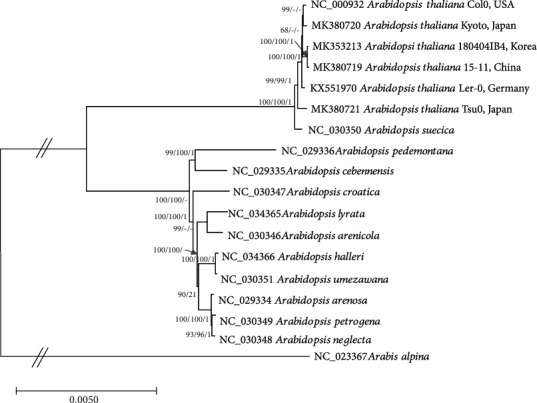
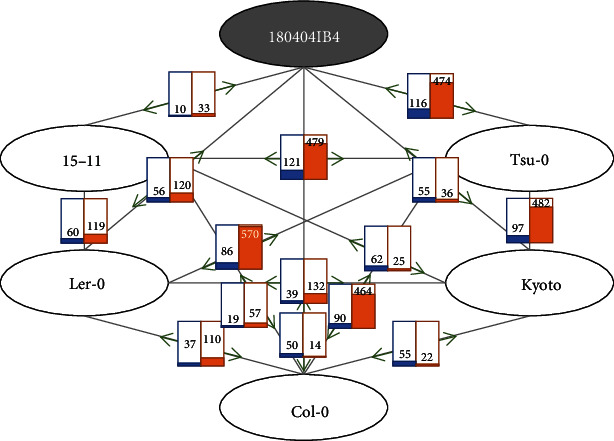
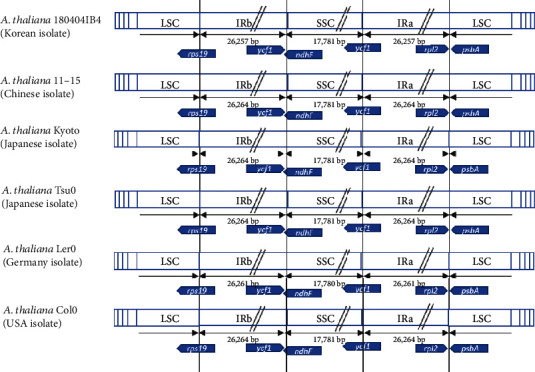
(L.) Heynh. is a model organism of plant molecular biology. More than 1,700 whole genome sequences have been sequenced, but no Korean isolate genomes have been sequenced thus far despite the fact that many isolated in Japan and China have been sequenced. To understand the genetic background of Korean natural (named as 180404IB4), we presented its complete chloroplast genome, which is 154,464 bp long and has four subregions: 85,164 bp of large single copy (LSC) and 17,781 bp of small single copy (SSC) regions are separated by 26,257 bp of inverted repeat (IRs) regions including 130 genes (85 protein-coding genes, eight rRNAs, and 37 tRNAs). Fifty single nucleotide polymorphisms (SNPs) and 14 insertion and deletions (INDELs) are identified between 180404IB4 and Col0. In addition, 101 SSRs and 42 extendedSSRs were identified on the Korean chloroplast genome, indicating a similar number of SSRs on the rest five chloroplast genomes with a preference of sequence variations toward the SSR region. A nucleotide diversity analysis revealed two highly variable regions on chloroplast genomes. Phylogenetic trees with three more chloroplast genomes of East Asian natural isolates show that Korean and Chinese natural isolates are clustered together, whereas two Japanese isolates are not clustered, suggesting the need for additional investigations of the chloroplast genomes of East Asian isolates.
(L.)Heynh. 是植物分子生物学的模式生物。已经对1700多个全基因组序列进行了测序,但尽管在日本和中国分离出的许多样本已被测序,到目前为止韩国分离株的基因组尚未测序。为了解韩国天然样本(命名为180404IB4)的遗传背景,我们展示了其完整的叶绿体基因组,该基因组长度为154,464 bp,有四个亚区域:85,164 bp的大单拷贝(LSC)和17,781 bp的小单拷贝(SSC)区域被26,257 bp的反向重复(IR)区域隔开,IR区域包含130个基因(85个蛋白质编码基因、8个rRNA和37个tRNA)。在180404IB4和Col0之间鉴定出50个单核苷酸多态性(SNP)和14个插入缺失(INDEL)。此外,在韩国叶绿体基因组上鉴定出101个简单序列重复(SSR)和42个扩展SSR,表明其余五个叶绿体基因组上的SSR数量相似,且序列变异倾向于SSR区域。核苷酸多样性分析揭示了叶绿体基因组上的两个高变区域。与另外三个东亚天然分离株的叶绿体基因组构建的系统发育树表明,韩国和中国的天然分离株聚在一起,而两个日本分离株没有聚在一起,这表明需要对东亚分离株的叶绿体基因组进行更多研究。