Department of Veterinary Pathology, Microbiology and Parasitology, Faculty of Veterinary Medicine and Surgery, Egerton University, P.O. Box 536, Egerton 20115, Kenya.
Department of Food Safety and Infectious Biology, Faculty of Veterinary Medicine, Norwegian University of Life Sciences (NMBU), P.O. Box 8146, 0454 Oslo, Norway.
Toxins (Basel). 2020 Sep 30;12(10):627. doi: 10.3390/toxins12100627.
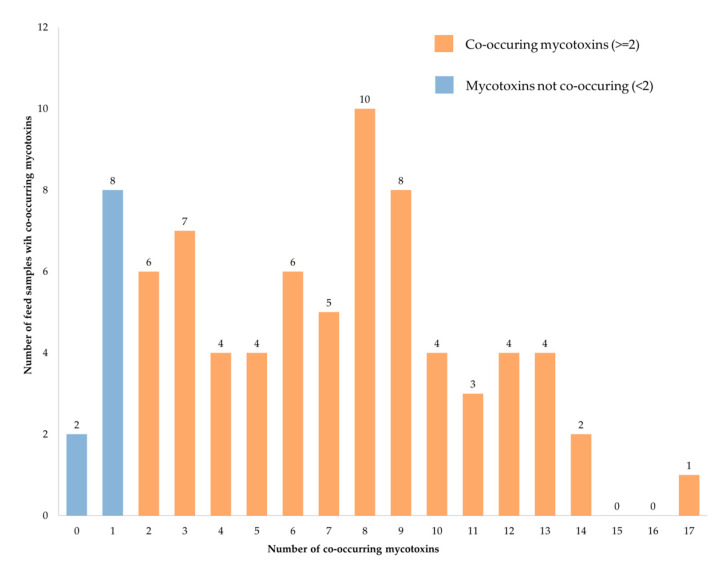
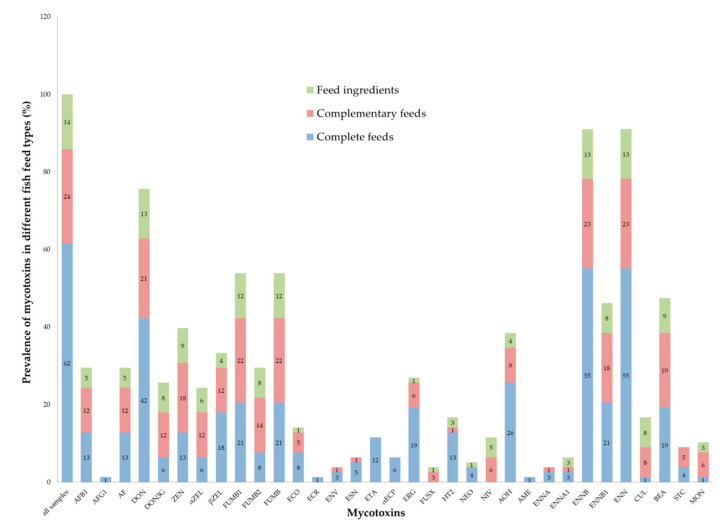
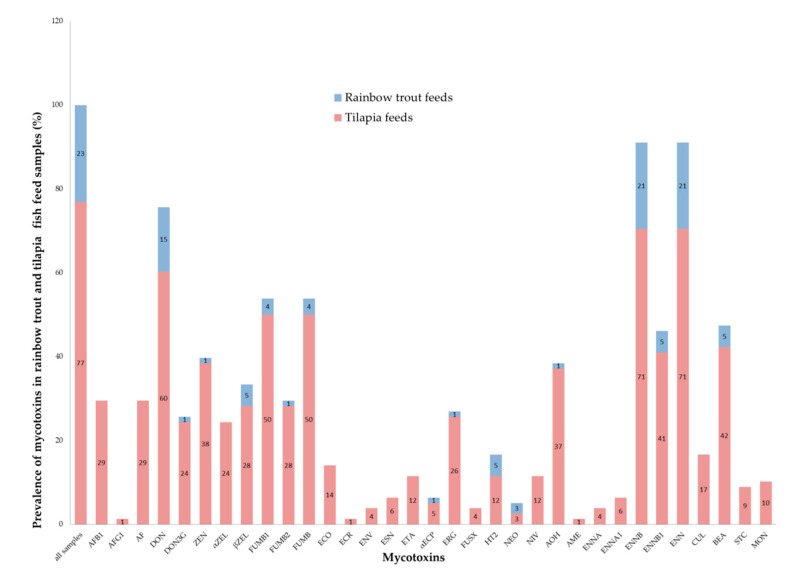
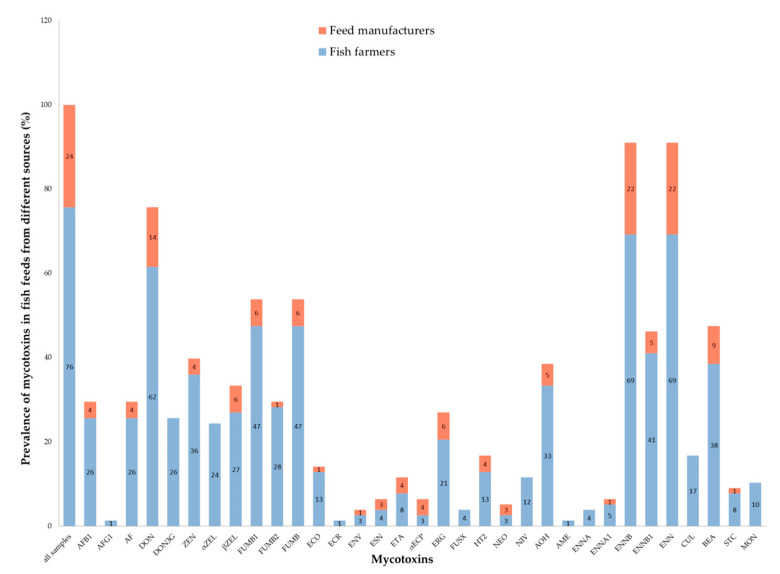
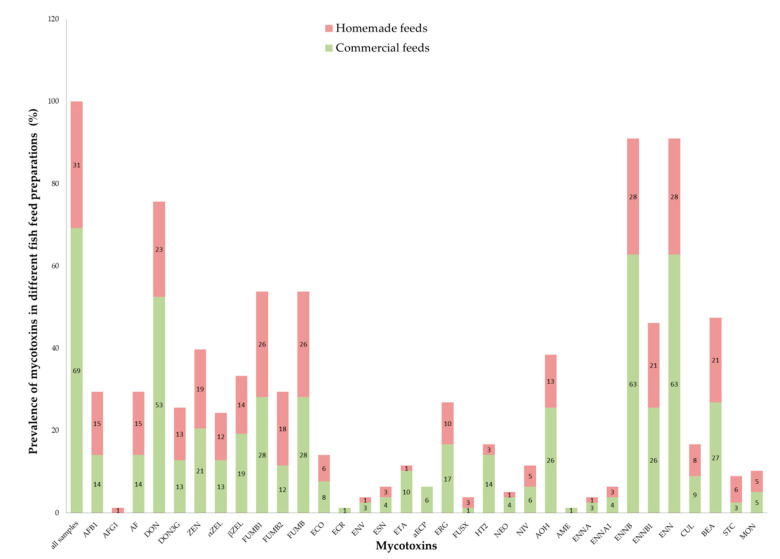
This study determined the presence, levels and co-occurrence of mycotoxins in fish feeds in Kenya. Seventy-eight fish feeds and ingredients were sampled from fish farms and fish feed manufacturing plants and analysed for 40 mycotoxins using high-performance liquid chromatography-high resolution mass spectrometry. Twenty-nine (73%) mycotoxins were identified with 76 (97%) samples testing positive for mycotoxins presence. Mycotoxins with the highest prevalences were enniatin B (91%), deoxynivalenol (76%) and fumonisin B1 (54%) while those with the highest maximum levels were sterigmatocystin (<30.5-3517.1 µg/kg); moniliformin (<218.9-2583.4 µg/kg) and ergotamine (<29.3-1895.6 µg/kg). Mycotoxin co-occurrence was observed in 68 (87%) samples. Correlations were observed between the fumonisins; enniatins B and zearalenone and its metabolites. Fish dietary exposure estimates ranged between <0.16 and 43.38 µg/kg body weight per day. This study shows evidence of mycotoxin presence and co-occurrence in fish feeds and feed ingredients in Kenya. Fish exposure to these levels of mycotoxins over a long period of time may lead to adverse health effects due to their possible additive, synergistic or antagonist toxic effects. Measures to reduce fish feed mycotoxin contamination should be taken to avoid mycotoxicosis in fish and subsequently in humans and animals through residues.
本研究旨在确定肯尼亚鱼类饲料中霉菌毒素的存在、水平和共同出现情况。从鱼类养殖场和鱼类饲料制造厂采集了 78 种鱼类饲料和成分样本,并使用高效液相色谱-高分辨率质谱法对 40 种霉菌毒素进行了分析。确定了 29 种(73%)霉菌毒素,76 种(97%)样本检测出霉菌毒素存在。存在率最高的霉菌毒素为恩镰孢菌素 B(91%)、脱氧雪腐镰刀菌烯醇(76%)和伏马菌素 B1(54%),而最高浓度的霉菌毒素为桔青霉素(<30.5-3517.1 µg/kg);单端孢霉烯族化合物(<218.9-2583.4 µg/kg)和麦角胺(<29.3-1895.6 µg/kg)。在 68 种(87%)样本中观察到霉菌毒素的共同出现。还观察到了伏马菌素、恩镰孢菌素 B 和玉米赤霉烯酮及其代谢物之间的相关性。鱼类膳食暴露估计值在每天每公斤体重 0.16 至 43.38 µg 之间。本研究表明,肯尼亚鱼类饲料和饲料成分中存在霉菌毒素及其共同出现的证据。鱼类长期暴露于这些水平的霉菌毒素可能会导致健康不良影响,因为它们可能具有相加、协同或拮抗的毒性作用。应采取措施减少鱼类饲料的霉菌毒素污染,以避免鱼类、继而通过残留进入人类和动物体内的霉菌毒素中毒。