• 文献检索
  • 文档翻译
  • 深度研究
  • 学术资讯
  • Suppr Zotero 插件Zotero 插件
  • 邀请有礼
  • 套餐&价格
  • 历史记录
应用&插件
Suppr Zotero 插件Zotero 插件浏览器插件Mac 客户端Windows 客户端微信小程序
定价
高级版会员购买积分包购买API积分包
服务
文献检索文档翻译深度研究API 文档MCP 服务
关于我们
关于 Suppr公司介绍联系我们用户协议隐私条款
关注我们

Suppr 超能文献

核心技术专利:CN118964589B侵权必究
粤ICP备2023148730 号-1Suppr @ 2026

文献检索

告别复杂PubMed语法,用中文像聊天一样搜索,搜遍4000万医学文献。AI智能推荐,让科研检索更轻松。

立即免费搜索

文件翻译

保留排版,准确专业,支持PDF/Word/PPT等文件格式,支持 12+语言互译。

免费翻译文档

深度研究

AI帮你快速写综述,25分钟生成高质量综述,智能提取关键信息,辅助科研写作。

立即免费体验

新冠疫情时代心房颤动与癌症的综合管理:药物相互作用、血栓栓塞风险及心律失常

The Complex Management of Atrial Fibrillation and Cancer in the COVID-19 Era: Drug Interactions, Thromboembolic Risk, and Proarrhythmia.

作者信息

Gatti Milo, Raschi Emanuel, Poluzzi Elisabetta, Martignani Cristian, Salvagni Stefania, Ardizzoni Andrea, Diemberger Igor

机构信息

Department of Medical and Surgical Sciences, Alma Mater Studiorum - University of Bologna, Bologna, Italy.

Cardiology Unit, Department of Experimental, Diagnostic and Specialty Medicine, Alma Mater Studiorum - University of Bologna, Bologna, Italy.

出版信息

Curr Heart Fail Rep. 2020 Dec;17(6):365-383. doi: 10.1007/s11897-020-00485-9.

DOI:10.1007/s11897-020-00485-9
PMID:33025463
原文链接:https://pmc.ncbi.nlm.nih.gov/articles/PMC7537958/
Abstract

PURPOSE OF REVIEW

Cardiotoxicity by anticancer agents has emerged as a multifaceted issue and is expected to affect both mortality and morbidity. This review summarizes clinical challenges in the management of oncological patients requiring anticoagulants for atrial fibrillation (AF) also considering the current outbreak of the COVID-19 (coronavirus disease 2019) pandemic, since this infection can add challenges to the management of both conditions. Specifically, the aims are manyfold: (1) describe the evolving use of direct oral anticoagulants (DOACs) in AF patients with cancer; (2) critically appraise the risk of clinically important drug-drug interactions (DDIs) between DOACs and oral targeted anticancer agents; (3) address expected DDIs between DOACs and candidate anti-COVID drugs, with implications on management of the underlying thrombotic risk; and (4) characterize the proarrhythmic liability in cardio-oncology in the setting of COVID-19, focusing on QT prolongation.

RECENT FINDINGS

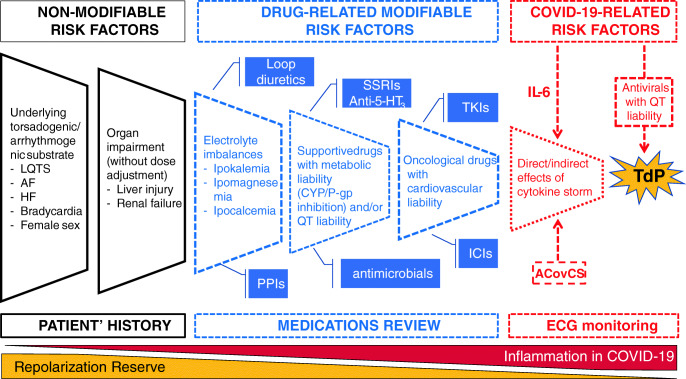
AF in cardio-oncology poses diagnostic and management challenges, also due to the number of anticancer drugs recently associated with AF onset/worsening. Oral targeted drugs can potentially interact with DOACs, with increased bleeding risk mainly due to pharmacokinetic DDIs. Moreover, the vast majority of oral anticancer agents cause QT prolongation with direct and indirect mechanisms, potentially resulting in the occurrence of torsade de pointes, especially in susceptible patients with COVID-19 receiving additional drugs with QT liability. Oncologists and cardiologists must be aware of the increased bleeding risk and arrhythmic susceptibility of patients with AF and cancer due to DDIs. High-risk individuals with COVID-19 should be prioritized to target preventive strategies, including optimal antithrombotic management, medication review, and stringent monitoring.

摘要

综述目的

抗癌药物引起的心脏毒性已成为一个多方面的问题,预计会影响死亡率和发病率。本综述总结了在管理因心房颤动(AF)需要抗凝治疗的肿瘤患者时面临的临床挑战,同时也考虑了当前2019冠状病毒病(COVID-19)大流行的情况,因为这种感染会给这两种疾病的管理带来更多挑战。具体而言,目标是多方面的:(1)描述直接口服抗凝剂(DOACs)在癌症合并房颤患者中的使用演变;(2)严格评估DOACs与口服靶向抗癌药物之间临床上重要的药物相互作用(DDIs)风险;(3)探讨DOACs与候选抗COVID药物之间预期的药物相互作用,及其对潜在血栓形成风险管理的影响;(4)描述在COVID-19背景下心脏肿瘤学中致心律失常的可能性,重点关注QT间期延长。

最新发现

心脏肿瘤学中的房颤带来了诊断和管理挑战,这也归因于最近与房颤发作/恶化相关的抗癌药物数量。口服靶向药物可能与DOACs相互作用,主要由于药代动力学药物相互作用导致出血风险增加。此外,绝大多数口服抗癌药物通过直接和间接机制导致QT间期延长,可能导致尖端扭转型室速的发生,特别是在患有COVID-19且易患的患者中,这些患者还接受了具有QT间期延长风险的其他药物。肿瘤学家和心脏病学家必须意识到,由于药物相互作用,房颤合并癌症患者的出血风险和心律失常易感性增加。应优先对COVID-19高危个体采取预防策略,包括优化抗栓管理、药物审查和严格监测。
https://cdn.ncbi.nlm.nih.gov/pmc/blobs/1deb/7683471/afaec5d6810c/11897_2020_485_Fig1_HTML.jpg

相似文献

1
The Complex Management of Atrial Fibrillation and Cancer in the COVID-19 Era: Drug Interactions, Thromboembolic Risk, and Proarrhythmia.新冠疫情时代心房颤动与癌症的综合管理:药物相互作用、血栓栓塞风险及心律失常
Curr Heart Fail Rep. 2020 Dec;17(6):365-383. doi: 10.1007/s11897-020-00485-9.
2
Glycemic status and risks of thromboembolism and major bleeding in patients with atrial fibrillation.血糖状况与房颤患者的血栓栓塞和大出血风险。
Cardiovasc Diabetol. 2020 Mar 10;19(1):30. doi: 10.1186/s12933-020-01005-8.
3
Atrial Fibrillation and Mitral Regurgitation: Clinical Performance of Direct Oral Anticoagulants in a Real-World Setting.心房颤动和二尖瓣反流:直接口服抗凝剂在真实世界环境中的临床表现。
J Cardiovasc Pharmacol Ther. 2020 Nov;25(6):564-569. doi: 10.1177/1074248420935263. Epub 2020 Jun 30.
4
Lower Major Bleeding Rates with Direct Oral Anticoagulants in Catheter Ablation of Atrial Fibrillation: an Updated Meta-analysis of Randomized Controlled Studies.直接口服抗凝剂在房颤导管消融中降低大出血发生率:一项随机对照研究的更新荟萃分析。
Cardiovasc Drugs Ther. 2020 Apr;34(2):209-214. doi: 10.1007/s10557-020-06947-5.
5
Risk factors for thromboembolic and bleeding events in anticoagulated patients with atrial fibrillation: the prospective, multicentre observational PREvention oF thromboembolic events - European Registry in Atrial Fibrillation (PREFER in AF).心房颤动抗凝治疗患者血栓栓塞和出血事件的风险因素:前瞻性、多中心观察性预防血栓栓塞事件-心房颤动欧洲登记研究(PREFER in AF)。
BMJ Open. 2019 Mar 30;9(3):e022478. doi: 10.1136/bmjopen-2018-022478.
6
Anticoagulation of Cardiovascular Conditions in the Cancer Patient: Review of Old and New Therapies.癌症患者心血管疾病的抗凝治疗:新旧疗法综述。
Curr Oncol Rep. 2019 Apr 4;21(5):45. doi: 10.1007/s11912-019-0797-z.
7
Direct oral anticoagulants for patients aged over 80 years in nonvalvular atrial fibrillation: the impact of frailty.直接口服抗凝剂在非瓣膜性心房颤动高龄患者中的应用:衰弱的影响。
J Cardiovasc Med (Hagerstown). 2020 Aug;21(8):562-569. doi: 10.2459/JCM.0000000000000986.
8
The increased risk of bleeding due to drug-drug interactions in patients administered direct oral anticoagulants.服用直接口服抗凝剂的患者因药物相互作用导致出血风险增加。
Thromb Res. 2020 Nov;195:243-249. doi: 10.1016/j.thromres.2020.07.054. Epub 2020 Aug 3.
9
Clinical profile of direct oral anticoagulants versus vitamin K anticoagulants in octogenarians with atrial fibrillation: a multicentre propensity score matched real-world cohort study.八旬老年房颤患者中直接口服抗凝剂与维生素 K 拮抗剂的临床特征:一项多中心倾向评分匹配真实世界队列研究。
J Thromb Thrombolysis. 2020 Jan;49(1):42-53. doi: 10.1007/s11239-019-01923-9.
10
Atrial fibrillation, cancer and anticancer drugs.心房颤动、癌症和抗癌药物。
Arch Cardiovasc Dis. 2023 Apr;116(4):219-226. doi: 10.1016/j.acvd.2023.02.005. Epub 2023 Mar 11.

引用本文的文献

1
Atrial fibrillation and ischemic stroke in cancer: the latest scientific evidence, current management, and future directions.癌症中的心房颤动与缺血性卒中:最新科学证据、当前管理及未来方向
J Thromb Thrombolysis. 2025 Apr 26. doi: 10.1007/s11239-025-03104-3.
2
Safety of Hydroxychloroquine: What a Dermatologist Should Know.羟氯喹的安全性:皮肤科医生应了解的内容。
Am J Clin Dermatol. 2025 Mar;26(2):251-264. doi: 10.1007/s40257-025-00919-x. Epub 2025 Feb 3.
3
Screening for clinically relevant drug-drug interactions between direct oral anticoagulants and antineoplastic agents: a pharmacovigilance approach.

本文引用的文献

1
COVID-19, Clinical Trials, and QT-Prolonging Prophylactic Therapy in Healthy Subjects: First, Do No Harm.2019冠状病毒病、临床试验以及健康受试者的QT间期延长预防性治疗:首要的是,不伤害患者。
J Am Coll Cardiol. 2020 Jun 30;75(25):3184-3186. doi: 10.1016/j.jacc.2020.05.008. Epub 2020 May 11.
2
Safety of catheter ablation of atrial fibrillation in cancer survivors.房颤患者接受导管消融治疗的安全性。
J Interv Card Electrophysiol. 2021 Apr;60(3):419-426. doi: 10.1007/s10840-020-00745-7. Epub 2020 May 6.
3
Cardiac safety of off-label COVID-19 drug therapy: a review and proposed monitoring protocol.
直接口服抗凝剂与抗肿瘤药物之间临床相关药物相互作用的筛查:一种药物警戒方法。
J Thromb Thrombolysis. 2023 Nov;56(4):555-567. doi: 10.1007/s11239-023-02879-7. Epub 2023 Aug 10.
4
Application of Amiodarone and Cedilan in the Treatment of Patients with Arrhythmia after Esophageal and Lung Cancer.胺碘酮与西地兰在食管癌和肺癌术后心律失常患者治疗中的应用
Evid Based Complement Alternat Med. 2023 Apr 13;2023:8026918. doi: 10.1155/2023/8026918. eCollection 2023.
5
The Cytokine Release Syndrome and/or the Proinflammatory Cytokines as Underlying Mechanisms of Downregulation of Drug Metabolism and Drug Transport: A Systematic Review of the Clinical Pharmacokinetics of Victim Drugs of this Drug-Disease Interaction Under Different Clinical Conditions.细胞因子释放综合征和/或前炎症细胞因子作为下调药物代谢和药物转运的潜在机制:不同临床条件下该药物-疾病相互作用的致害药物临床药代动力学的系统评价。
Clin Pharmacokinet. 2022 Nov;61(11):1519-1544. doi: 10.1007/s40262-022-01173-8. Epub 2022 Sep 5.
6
Strategies and Tools for Supporting the Appropriateness of Drug Use in Older People.支持老年人合理用药的策略与工具
Pharmaceuticals (Basel). 2022 Aug 8;15(8):977. doi: 10.3390/ph15080977.
7
Identification of Drug Interaction Adverse Events in Patients With COVID-19: A Systematic Review.识别 COVID-19 患者中的药物相互作用不良事件:一项系统评价。
JAMA Netw Open. 2022 Apr 1;5(4):e227970. doi: 10.1001/jamanetworkopen.2022.7970.
8
Atrial fibrillation in older adults with cancer.老年癌症患者的心房颤动
J Geriatr Cardiol. 2022 Jan 28;19(1):1-8. doi: 10.11909/j.issn.1671-5411.2022.01.001.
9
ANMCO POSITION PAPER: cardio-oncology in the COVID era (CO and CO).意大利心脏病学协会立场文件:新冠疫情时代的心衰与癌症共病(CO与CO)
Eur Heart J Suppl. 2021 Aug 26;23(Suppl C):C128-C153. doi: 10.1093/eurheartj/suab067. eCollection 2021 Aug.
10
Janus Kinase Inhibitors and Coronavirus Disease (COVID)-19: Rationale, Clinical Evidence and Safety Issues.Janus激酶抑制剂与冠状病毒病(COVID)-19:理论依据、临床证据及安全性问题
Pharmaceuticals (Basel). 2021 Jul 28;14(8):738. doi: 10.3390/ph14080738.
COVID-19 药物治疗的心脏安全性:综述及建议监测方案。
Eur Heart J Acute Cardiovasc Care. 2020 Apr;9(3):215-221. doi: 10.1177/2048872620922784. Epub 2020 May 6.
4
Urgent Guidance for Navigating and Circumventing the QTc-Prolonging and Torsadogenic Potential of Possible Pharmacotherapies for Coronavirus Disease 19 (COVID-19).急件:针对新型冠状病毒病(COVID-19)可能的药物治疗的 QTc 延长和致扭转型心动过速的潜在风险的应对和规避指导建议。
Mayo Clin Proc. 2020 Jun;95(6):1213-1221. doi: 10.1016/j.mayocp.2020.03.024. Epub 2020 Apr 7.
5
Use of drugs with potential cardiac effect in the setting of SARS-CoV-2 infection.在新型冠状病毒2019感染的情况下使用具有潜在心脏效应的药物。
Arch Cardiovasc Dis. 2020 May;113(5):293-296. doi: 10.1016/j.acvd.2020.04.003. Epub 2020 Apr 24.
6
Identification of anticancer drugs associated with atrial fibrillation: analysis of the WHO pharmacovigilance database.识别与心房颤动相关的抗癌药物:世卫组织药物警戒数据库分析。
Eur Heart J Cardiovasc Pharmacother. 2021 Jul 23;7(4):312-320. doi: 10.1093/ehjcvp/pvaa037.
7
COVID-19 and the cardiovascular system: implications for risk assessment, diagnosis, and treatment options.COVID-19 与心血管系统:对风险评估、诊断和治疗选择的影响。
Cardiovasc Res. 2020 Aug 1;116(10):1666-1687. doi: 10.1093/cvr/cvaa106.
8
Direct oral anticoagulant plasma levels' striking increase in severe COVID-19 respiratory syndrome patients treated with antiviral agents: The Cremona experience.严重 COVID-19 呼吸综合征患者接受抗病毒药物治疗后直接口服抗凝剂血浆水平显著升高:克雷莫纳经验。
J Thromb Haemost. 2020 Jun;18(6):1320-1323. doi: 10.1111/jth.14871. Epub 2020 May 6.
9
COVID-19 and Thrombotic or Thromboembolic Disease: Implications for Prevention, Antithrombotic Therapy, and Follow-Up: JACC State-of-the-Art Review.新型冠状病毒肺炎与血栓栓塞性疾病:预防、抗栓治疗与随访的相关问题:美国心脏病学会临床实践更新。
J Am Coll Cardiol. 2020 Jun 16;75(23):2950-2973. doi: 10.1016/j.jacc.2020.04.031. Epub 2020 Apr 17.
10
Prevalence and significance of potential drug-drug interactions among cancer patients receiving chemotherapy.癌症患者化疗中潜在药物-药物相互作用的流行率和意义。
BMC Cancer. 2020 Apr 19;20(1):335. doi: 10.1186/s12885-020-06855-9.