Lee Jihye, Kim Yoo Sun, Kim Eunju, Kim Yerin, Kim Yuri
Department of Nutritional Science and Food Management, Ewha Womans University, Seoul 03760, Korea.
Nutr Res Pract. 2020 Oct;14(5):438-452. doi: 10.4162/nrp.2020.14.5.438. Epub 2020 Aug 6.
BACKGROUND/OBJECTIVES: Brain senescence causes cognitive impairment and neurodegeneration. It has also been demonstrated that curcumin (Cur) and hesperetin (Hes), both antioxidant polyphenolic compounds, mediate anti-aging and neuroprotective effects. Therefore, the objective of this study was to investigate whether Cur, Hes, and/or their combination exert anti-aging effects in D-galactose (Dg)-induced aged neuronal cells and rats.
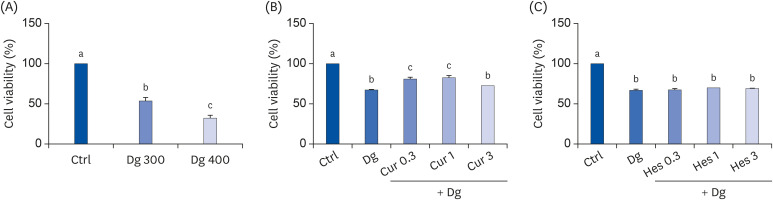
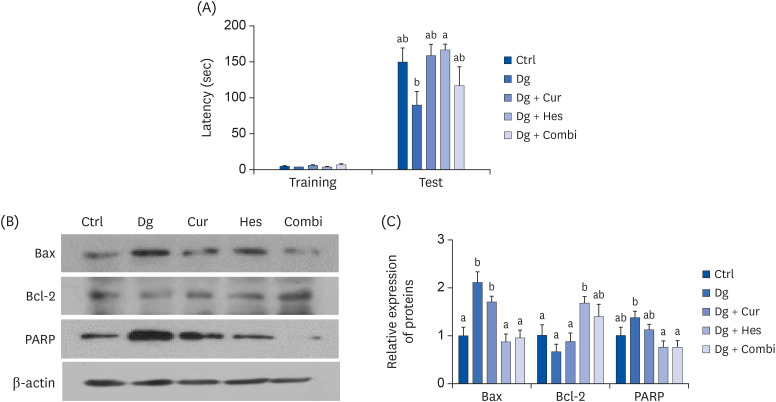
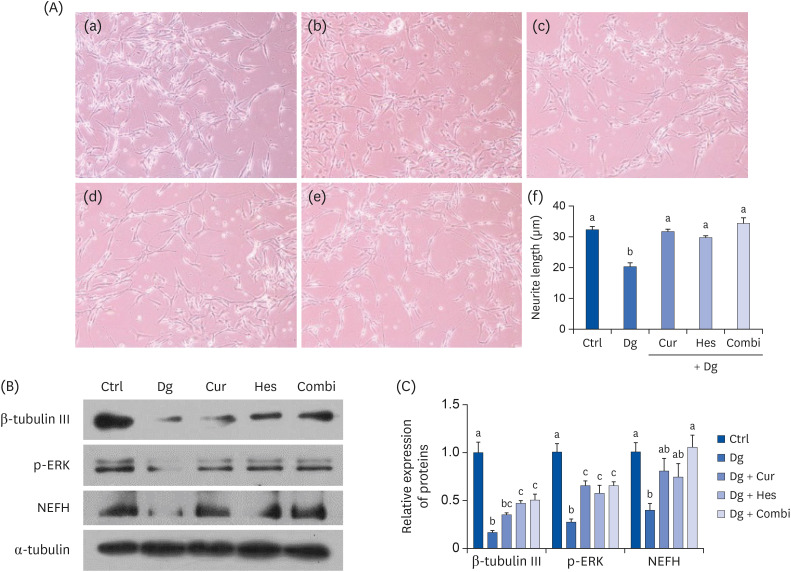
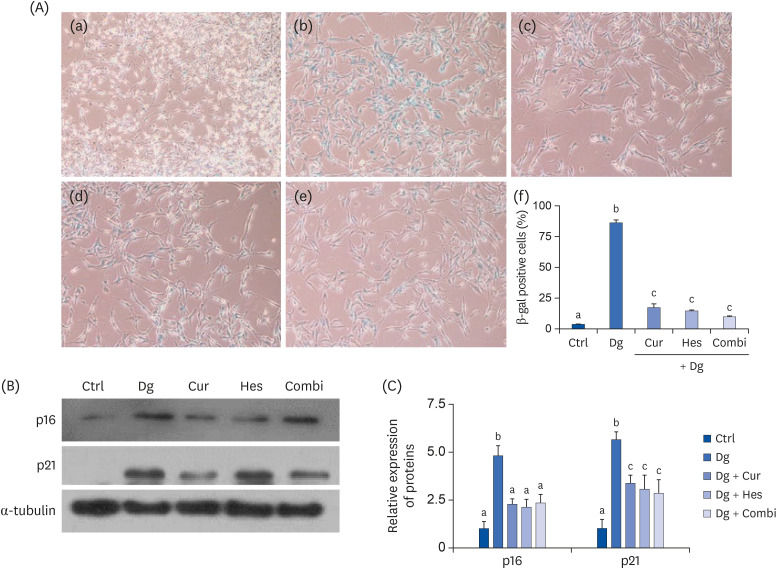
MATERIALS/METHODS: SH-SY5Y cells differentiated in response to retinoic acid were treated with Cur (1 μM), Hes (1 μM), or a combination of both, followed by 300 mM Dg. Neuronal loss was subsequently evaluated by measuring average neurite length and analyzing expression of β-tubulin III, phosphorylated extracellular signal-regulated kinases, and neurofilament heavy polypeptide. Cellular senescence and related proteins, p16 and p21, were also investigated, including their regulation of antioxidant enzymes. , brain aging was induced by injecting 250 mg/kg body weight (b.w.) Dg. The effects of supplementing this model with 50 mg/kg b.w. Cur, 50 mg/kg b.w. Hes, or a combination of both for 3 months were subsequently evaluated. Brain aging was examined with a step-through passive avoidance test and apoptosis markers were analyzed in brain cortex tissues.
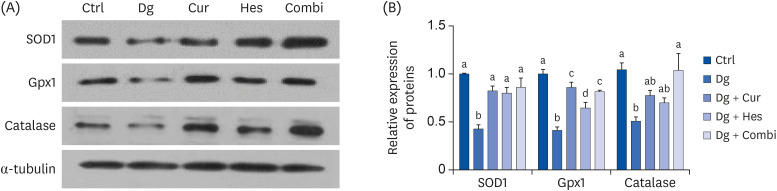
Cur, Hes, and their combination improved neuron length and cellular senescence by decreasing the number of β-gal stained cells, down-regulated expression of p16 and p21, and up-regulated expression of antioxidant enzymes, including superoxide dismutase 1, glutathione peroxidase 1, and catalase. Administration of Cur, Hes, or their combination also tended to ameliorate cognitive impairment and suppress apoptosis in the cerebral cortex by down-regulating Bax and poly (ADP-ribose) polymerase expression and increasing Bcl-2 expression.
Cur and Hes appear to attenuate Dg-induced brain aging via regulation of antioxidant enzymes and apoptosis. These results suggest that Cur and Hes may mediate neuroprotective effects in the aging process, and further study of these antioxidant polyphenolic compounds is warranted.
背景/目的:脑衰老会导致认知障碍和神经退行性变。研究还表明,姜黄素(Cur)和橙皮素(Hes)这两种抗氧化多酚化合物具有介导抗衰老和神经保护作用。因此,本研究旨在探讨Cur、Hes及其组合是否对D-半乳糖(Dg)诱导的衰老神经元细胞和大鼠具有抗衰老作用。
材料/方法:用视黄酸诱导分化的SH-SY5Y细胞分别用Cur(1 μM)、Hes(1 μM)或两者组合处理,随后加入300 mM Dg。随后通过测量平均神经突长度以及分析β-微管蛋白III、磷酸化细胞外信号调节激酶和神经丝重多肽的表达来评估神经元损失。还研究了细胞衰老和相关蛋白p16和p21,包括它们对抗氧化酶的调节。通过注射250 mg/kg体重(b.w.)的Dg诱导脑衰老。随后评估用50 mg/kg b.w.的Cur、50 mg/kg b.w.的Hes或两者组合补充该模型3个月的效果。用穿梭式被动回避试验检测脑衰老情况,并分析大脑皮质组织中的凋亡标志物。
Cur、Hes及其组合通过减少β-半乳糖苷酶染色细胞数量、下调p16和p21的表达以及上调包括超氧化物歧化酶1、谷胱甘肽过氧化物酶1和过氧化氢酶在内的抗氧化酶的表达,改善了神经元长度和细胞衰老。给予Cur、Hes或其组合还倾向于通过下调Bax和聚(ADP-核糖)聚合酶的表达并增加Bcl-2的表达来改善认知障碍并抑制大脑皮质中的细胞凋亡。
Cur和Hes似乎通过调节抗氧化酶和细胞凋亡来减轻Dg诱导的脑衰老。这些结果表明,Cur和Hes可能在衰老过程中介导神经保护作用,有必要对这些抗氧化多酚化合物进行进一步研究。