Kochańczyk Marek, Grabowski Frederic, Lipniacki Tomasz
Department of Biosystems and Soft Matter, Institute of Fundamental Technological Research, Polish Academy of Sciences, 02-106 Warsaw, Poland.
Faculty of Mathematics, Informatics and Mechanics, University of Warsaw, 02-097 Warsaw, Poland.
R Soc Open Sci. 2020 Sep 23;7(9):200786. doi: 10.1098/rsos.200786. eCollection 2020 Sep.
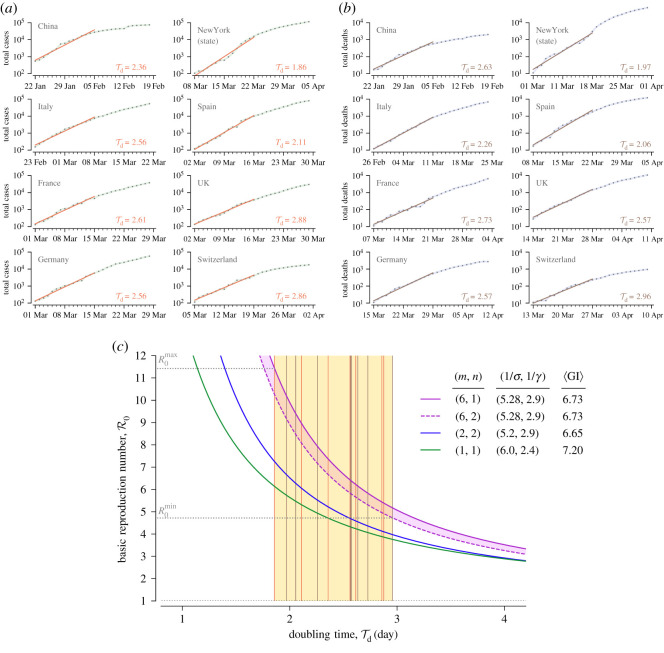
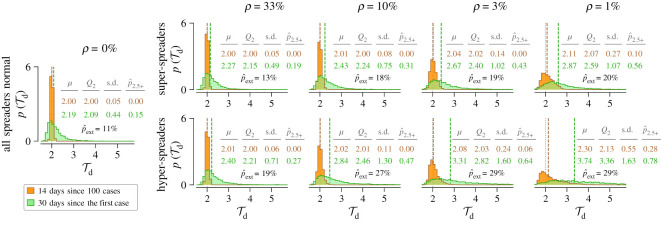
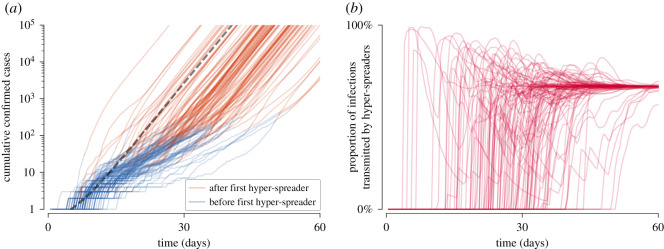
The basic reproduction number of the coronavirus disease 2019 has been estimated to range between 2 and 4. Here, we used an SEIR model that properly accounts for the distribution of the latent period and, based on empirical estimates of the doubling time in the near-exponential phases of epidemic progression in China, Italy, Spain, France, UK, Germany, Switzerland and New York State, we estimated that lies in the range 4.7-11.4. We explained this discrepancy by performing stochastic simulations of model dynamics in a population with a small proportion of super-spreaders. The simulations revealed two-phase dynamics, in which an initial phase of relatively slow epidemic progression diverts to a faster phase upon appearance of infectious super-spreaders. Early estimates obtained for this initial phase may suggest lower .
2019年冠状病毒病的基本再生数估计在2至4之间。在此,我们使用了一个能恰当考虑潜伏期分布的SEIR模型,并根据中国、意大利、西班牙、法国、英国、德国、瑞士和纽约州疫情进展的近似指数阶段中倍增时间的经验估计,我们估计该数值在4.7 - 11.4的范围内。我们通过在有一小部分超级传播者的人群中对模型动态进行随机模拟来解释这种差异。模拟揭示了两阶段动态,其中疫情进展相对缓慢的初始阶段在传染性超级传播者出现后转向更快的阶段。针对这个初始阶段获得的早期估计可能表明基本再生数较低。