Nova School of Business and Economics, Universidade NOVA de Lisboa, Campus de Carcavelos, Carcavelos, Portugal.
Department of Public Health, Erasmus Medical Center, Rotterdam, Netherlands.
PLoS One. 2020 Oct 14;15(10):e0240500. doi: 10.1371/journal.pone.0240500. eCollection 2020.
The COVID-19 pandemic has led to disruptive changes worldwide, with different implications across countries. The evolution of citizens' concerns and behaviours over time is a central piece to support public policies.
To unveil perceptions and behaviours of the Portuguese population regarding social and economic impacts of the COVID-19 pandemic, allowing for more informed public policies.
Online panel survey distributed in three waves between March 13th and May 6th 2020. Data collected from a non-representative sample of 7,448 respondents includes socio-demographic characteristics and self-reported measures on levels of concern and behaviours related to COVID-19. We performed descriptive analysis and probit regressions to understand relationships between the different variables.
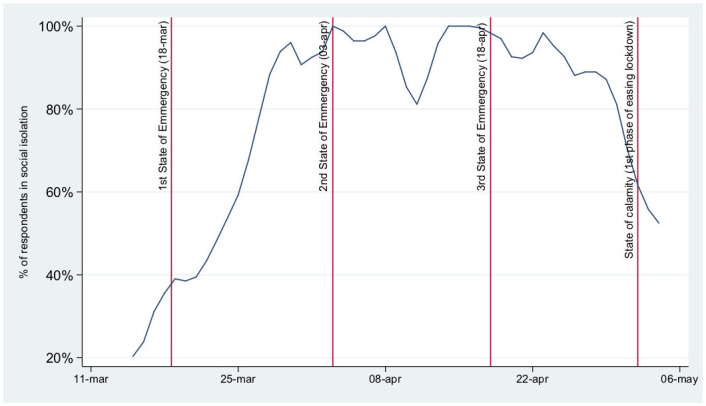
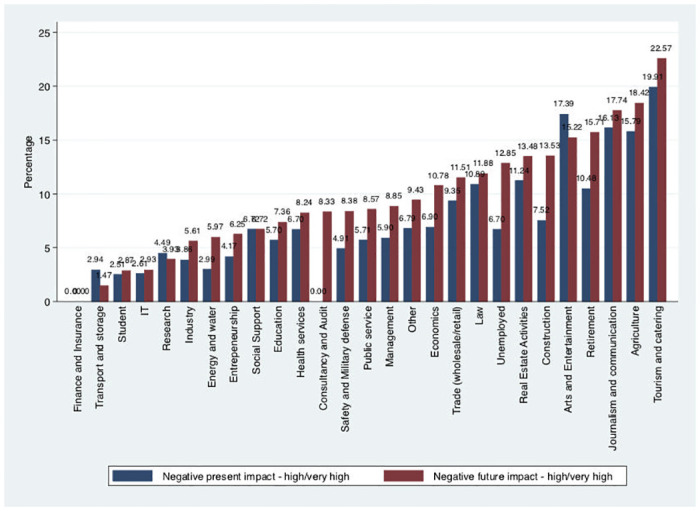
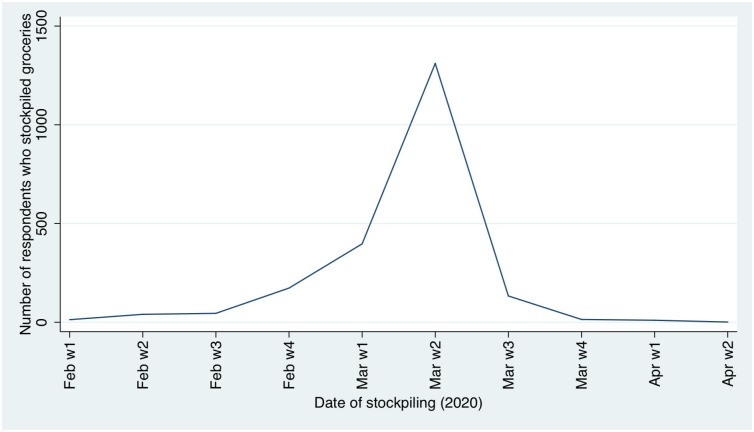
Most participants (85%) report being at least very concerned with the consequences of the COVID-19 pandemic and social isolation reached a high level of adherence during the state of emergency. Around 36% of the sample anticipated consumption decisions, stockpiling ahead of the state of emergency declaration. Medical appointments suffered severe consequences, being re-rescheduled or cancelled. We find important variation in concerns with the economic impact across activity sectors.
We show that high level of concern and behaviour adaptation in our sample preceded the implementation of lockdown measures in Portugal around mid-March. One month later, a large share of individuals had suffered disruption in their routine health care and negative impacts in their financial status.
COVID-19 大流行在全球范围内引发了颠覆性的变化,对各国的影响也各不相同。随着时间的推移,公民关注的问题和行为的演变是支持公共政策的核心部分。
揭示葡萄牙人口对 COVID-19 大流行的社会和经济影响的看法和行为,为制定更明智的公共政策提供依据。
2020 年 3 月 13 日至 5 月 6 日期间,通过在线小组调查分三个阶段进行。从一个非代表性的 7448 名受访者样本中收集的数据包括社会人口统计学特征以及自我报告的对 COVID-19 的关注水平和相关行为的测量。我们进行了描述性分析和概率回归分析,以了解不同变量之间的关系。
大多数参与者(85%)表示对 COVID-19 大流行的后果至少非常关注,在紧急状态期间社会隔离达到了很高的遵守水平。大约 36%的样本预计会在宣布紧急状态之前做出消费决策,进行囤货。医疗预约受到了严重影响,被重新安排或取消。我们发现,不同活动领域对经济影响的关注存在重要差异。
我们表明,在葡萄牙大约在 3 月中旬实施封锁措施之前,我们的样本中已经存在高度的关注和行为适应。一个月后,很大一部分人已经在他们的日常医疗保健中遭受了干扰,并对他们的财务状况产生了负面影响。