• 文献检索
  • 文档翻译
  • 深度研究
  • 学术资讯
  • Suppr Zotero 插件Zotero 插件
  • 邀请有礼
  • 套餐&价格
  • 历史记录
应用&插件
Suppr Zotero 插件Zotero 插件浏览器插件Mac 客户端Windows 客户端微信小程序
定价
高级版会员购买积分包购买API积分包
服务
文献检索文档翻译深度研究API 文档MCP 服务
关于我们
关于 Suppr公司介绍联系我们用户协议隐私条款
关注我们

Suppr 超能文献

核心技术专利:CN118964589B侵权必究
粤ICP备2023148730 号-1Suppr @ 2026

文献检索

告别复杂PubMed语法,用中文像聊天一样搜索,搜遍4000万医学文献。AI智能推荐,让科研检索更轻松。

立即免费搜索

文件翻译

保留排版,准确专业,支持PDF/Word/PPT等文件格式,支持 12+语言互译。

免费翻译文档

深度研究

AI帮你快速写综述,25分钟生成高质量综述,智能提取关键信息,辅助科研写作。

立即免费体验

自制口罩材料预防 COVID-19 传播的选择:一项实验室研究。

Selection of homemade mask materials for preventing transmission of COVID-19: A laboratory study.

机构信息

Department of Equipment, West China Hospital, Sichuan University, Chengdu, China.

Sichuan Testing Center of Medical Devices, Chengdu, China.

出版信息

PLoS One. 2020 Oct 15;15(10):e0240285. doi: 10.1371/journal.pone.0240285. eCollection 2020.

DOI:10.1371/journal.pone.0240285
PMID:33057355
原文链接:https://pmc.ncbi.nlm.nih.gov/articles/PMC7561133/
Abstract

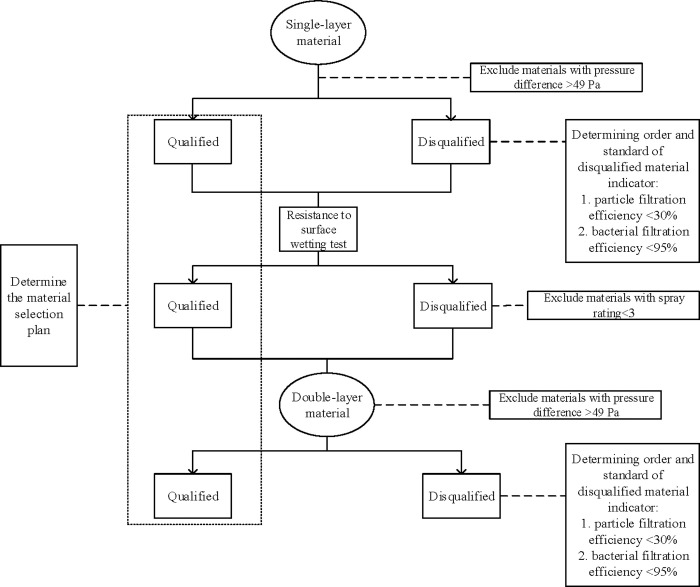
The Coronavirus Disease 2019 (COVID-19) has swept the whole world with high mortality. Since droplet transmission is the main route of transmission, wearing a mask serves as a crucial preventive measure. However, the virus has spread quite quickly, causing severe mask shortage. Finding alternative materials for homemade masks while ensuring the significant performance indicators will help alleviate the shortage of masks. Referring to the national standard for the "Surgical Mask" of China, 17 materials to be selected for homemade masks were tested in four key indicators: pressure difference, particle filtration efficiency, bacterial filtration efficiency and resistance to surface wetting. Eleven single-layer materials met the standard of pressure difference (≤49 Pa), of which 3 met the standard of resistance to surface wetting (≥3), 1 met the standard of particle filtration efficiency (≥30%), but none met the standard of bacterial filtration efficiency (≥95%). Based on the testing results of single-layer materials, fifteen combinations of paired materials were tested. The results showed that three double-layer materials including double-layer medical non-woven fabric, medical non-woven fabric plus non-woven shopping bag, and medical non-woven fabric plus granular tea towel could meet all the standards of pressure difference, particle filtration efficiency, and resistance to surface wetting, and were close to the standard of the bacterial filtration efficiency. In conclusion, if resources are severely lacking and medical masks cannot be obtained, homemade masks using available materials, based on the results of this study, can minimize the chance of infection to the maximum extent.

摘要

新型冠状病毒病(COVID-19)具有高死亡率,已席卷全球。由于飞沫传播是主要的传播途径,因此佩戴口罩是一项重要的预防措施。然而,病毒传播速度相当快,导致严重的口罩短缺。寻找替代材料来制作自制口罩,同时确保重要的性能指标,将有助于缓解口罩短缺的问题。参考中国的《医用口罩》国家标准,对 17 种待选自制口罩材料在四个关键指标:压差、颗粒过滤效率、细菌过滤效率和抗湿性进行了测试。有 11 种单层材料符合压差标准(≤49 Pa),其中 3 种符合抗湿性标准(≥3),1 种符合颗粒过滤效率标准(≥30%),但没有一种符合细菌过滤效率标准(≥95%)。基于单层材料的测试结果,测试了 15 种配对材料的组合。结果表明,包括双层医用无纺布、医用无纺布加无纺购物袋和医用无纺布加颗粒茶巾在内的三种双层材料均符合压差、颗粒过滤效率和抗湿性的所有标准,且接近细菌过滤效率标准。总之,如果资源严重短缺,无法获得医用口罩,根据本研究的结果,使用现有材料制作自制口罩可以最大限度地减少感染的机会。
https://cdn.ncbi.nlm.nih.gov/pmc/blobs/b236/7561133/36b0534906aa/pone.0240285.g001.jpg

相似文献

1
Selection of homemade mask materials for preventing transmission of COVID-19: A laboratory study.自制口罩材料预防 COVID-19 传播的选择:一项实验室研究。
PLoS One. 2020 Oct 15;15(10):e0240285. doi: 10.1371/journal.pone.0240285. eCollection 2020.
2
Filtration Efficiencies of Nanoscale Aerosol by Cloth Mask Materials Used to Slow the Spread of SARS-CoV-2.织物口罩材料对 SARS-CoV-2 传播的减缓作用下的纳米气溶胶过滤效率。
ACS Nano. 2020 Jul 28;14(7):9188-9200. doi: 10.1021/acsnano.0c05025. Epub 2020 Jul 7.
3
[Validation of surgical masks during COVID19 emergency: activities at the University of Napoli Federico II].[新冠疫情期间外科口罩的验证:那不勒斯费德里科二世大学的相关活动]
G Ital Med Lav Ergon. 2020 Jun;42(2):73-81.
4
Measurement of filtration efficiencies of healthcare and consumer materials using modified respirator fit tester setup.采用改良的呼吸器适配性测试设备来测量医疗和消费材料的过滤效率。
PLoS One. 2020 Oct 13;15(10):e0240499. doi: 10.1371/journal.pone.0240499. eCollection 2020.
5
A laboratory-based study examining the properties of silk fabric to evaluate its potential as a protective barrier for personal protective equipment and as a functional material for face coverings during the COVID-19 pandemic.一项基于实验室的研究,旨在探究丝绸织物的特性,评估其在 COVID-19 大流行期间作为个人防护装备的防护屏障以及作为口罩功能材料的潜力。
PLoS One. 2020 Sep 18;15(9):e0239531. doi: 10.1371/journal.pone.0239531. eCollection 2020.
6
Cloth masks versus medical masks for COVID-19 protection.布口罩与医用口罩对新冠病毒的防护效果对比
Cardiol J. 2020;27(2):218-219. doi: 10.5603/CJ.a2020.0054. Epub 2020 Apr 14.
7
Pretreated household materials carry similar filtration protection against pathogens when compared with surgical masks.预处理后的家用材料在过滤病原体方面与外科口罩具有相似的防护作用。
Am J Infect Control. 2020 Aug;48(8):883-889. doi: 10.1016/j.ajic.2020.05.024. Epub 2020 May 25.
8
Household Materials Selection for Homemade Cloth Face Coverings and Their Filtration Efficiency Enhancement with Triboelectric Charging.家用材料选择自制布面口罩及其摩擦起电增强过滤效率。
Nano Lett. 2020 Jul 8;20(7):5544-5552. doi: 10.1021/acs.nanolett.0c02211. Epub 2020 Jun 9.
9
Homemade facemasks: particle filtration, breathability, fit, and other performance characteristics.自制口罩:颗粒过滤、透气性、贴合度以及其他性能特点。
J Occup Environ Hyg. 2021 Jul;18(7):334-344. doi: 10.1080/15459624.2021.1925124. Epub 2021 Jun 3.
10
Is there an adequate alternative to commercially manufactured face masks? A comparison of various materials and forms.是否有可替代商业制造口罩的合适物品?对各种材料和形式的比较。
J Hosp Infect. 2020 Oct;106(2):246-253. doi: 10.1016/j.jhin.2020.07.024. Epub 2020 Aug 5.

引用本文的文献

1
A simple and cheap aerosol penetrometer for filter testing using an electronic cigarette.一种用于使用电子烟进行滤嘴测试的简单且廉价的气溶胶透过率测定仪。
Open Res Eur. 2021 Oct 28;1:5. doi: 10.12688/openreseurope.13087.3. eCollection 2021.
2
Microstructural evaluation and recommendations for face masks in community use to reduce the transmission of respiratory infectious diseases.用于减少呼吸道传染病传播的社区使用口罩的微观结构评估和建议。
Comput Methods Programs Biomed. 2022 Nov;226:107154. doi: 10.1016/j.cmpb.2022.107154. Epub 2022 Sep 24.
3
A comparison of performance metrics for cloth masks as source control devices for simulated cough and exhalation aerosols.

本文引用的文献

1
New evidence-based clinical practice guideline timely supports hospital infection control of coronavirus disease 2019.新的循证临床实践指南及时支持了2019冠状病毒病的医院感染控制。
Precis Clin Med. 2020 Mar;3(1):1-2. doi: 10.1093/pcmedi/pbaa008. Epub 2020 Feb 24.
2
Personnel protection strategy for healthcare workers in Wuhan during the COVID-19 epidemic.新冠疫情期间武汉医护人员的个人防护策略
Precis Clin Med. 2020 Jul 20;3(3):169-174. doi: 10.1093/pcmedi/pbaa024. eCollection 2020 Sep.
3
Facemask shortage and the novel coronavirus disease (COVID-19) outbreak: Reflections on public health measures.
作为模拟咳嗽和呼气气溶胶源控制装置的布口罩性能指标比较。
Aerosol Sci Technol. 2021 Jun 14;55(10):1125-1142. doi: 10.1080/02786826.2021.1933377.
4
One year of surgical mask testing at the University of Bologna labs: Lessons learned from data analysis.博洛尼亚大学实验室对手术口罩进行的一年测试:数据分析所得经验教训
Sep Purif Technol. 2022 Aug 1;294:121180. doi: 10.1016/j.seppur.2022.121180. Epub 2022 Apr 30.
5
Fabrication of a highly protective 3D-printed mask and evaluation of its viral filtration efficiency using a human head mannequin.使用人体头部模型制造高度防护性的3D打印口罩并评估其病毒过滤效率。
HardwareX. 2022 May 8;11:e00314. doi: 10.1016/j.ohx.2022.e00314.
6
A Simple and Precise Estimation of Water Sliding Angle by Monitoring Image Brightness: A Case Study of the Fluid Repellency of Commercial Face Masks.通过监测图像亮度对水滑动角进行简单而精确的估计:以商用口罩的拒液性为例
ACS Omega. 2022 Apr 5;7(15):13178-13188. doi: 10.1021/acsomega.2c00628. eCollection 2022 Apr 19.
7
Comparison of filtration efficiency and respiratory resistance of COVID-19 protective masks by multi-national standards.不同国家标准下的 COVID-19 防护口罩过滤效率和呼吸阻力的比较。
Am J Infect Control. 2022 May;50(5):516-524. doi: 10.1016/j.ajic.2022.02.009. Epub 2022 Feb 11.
8
Face Coverings, Aerosol Dispersion and Mitigation of Virus Transmission Risk.面部覆盖物、气溶胶扩散与病毒传播风险的减轻
IEEE Open J Eng Med Biol. 2021 Jan 20;2:26-35. doi: 10.1109/OJEMB.2021.3053215. eCollection 2021.
9
Triple-target stimuli-responsive anti-COVID-19 face mask with physiological virus-inactivating agents.含生理病毒灭活剂的三重靶向刺激响应型抗 COVID-19 口罩。
Biomater Sci. 2021 Sep 14;9(18):6052-6063. doi: 10.1039/d1bm00502b.
10
Review of the Breathability and Filtration Efficiency of Common Household Materials for Face Masks.常见家用口罩材料的透气性和过滤效率综述。
ACS Nano. 2021 Apr 27;15(4):5904-5924. doi: 10.1021/acsnano.0c10146. Epub 2021 Apr 6.
口罩短缺与新型冠状病毒病(COVID-19)疫情:对公共卫生措施的思考
EClinicalMedicine. 2020 Apr 3;21:100329. doi: 10.1016/j.eclinm.2020.100329. eCollection 2020 Apr.
4
Comparison of the Filter Efficiency of Medical Nonwoven Fabrics against Three Different Microbe Aerosols.医用无纺布对三种不同微生物气溶胶的过滤效率比较。
Biocontrol Sci. 2018;23(2):61-69. doi: 10.4265/bio.23.61.
5
Considerations for recommending extended use and limited reuse of filtering facepiece respirators in health care settings.关于在医疗环境中推荐延长过滤式面罩呼吸器使用时间和有限度重复使用的考量因素。
J Occup Environ Hyg. 2014;11(8):D115-28. doi: 10.1080/15459624.2014.902954.
6
Testing the efficacy of homemade masks: would they protect in an influenza pandemic?自制口罩的效果测试:它们能在流感大流行中起到保护作用吗?
Disaster Med Public Health Prep. 2013 Aug;7(4):413-8. doi: 10.1017/dmp.2013.43.
7
Simple respiratory protection--evaluation of the filtration performance of cloth masks and common fabric materials against 20-1000 nm size particles.简易呼吸防护——布口罩及常见织物材料对20 - 1000纳米粒径颗粒的过滤性能评估
Ann Occup Hyg. 2010 Oct;54(7):789-98. doi: 10.1093/annhyg/meq044. Epub 2010 Jun 28.
8
The effect of mask use on the spread of influenza during a pandemic.口罩使用对大流行期间流感传播的影响。
Risk Anal. 2010 Aug;30(8):1210-8. doi: 10.1111/j.1539-6924.2010.01428.x. Epub 2010 May 20.
9
Evaluation of five decontamination methods for filtering facepiece respirators.过滤式面罩呼吸器五种净化方法的评估
Ann Occup Hyg. 2009 Nov;53(8):815-27. doi: 10.1093/annhyg/mep070. Epub 2009 Oct 4.
10
Face mask use and control of respiratory virus transmission in households.家庭中使用口罩与呼吸道病毒传播的控制
Emerg Infect Dis. 2009 Feb;15(2):233-41. doi: 10.3201/eid1502.081167.