Department of Obstetrics and Gynaecology, the First Affiliated Hospital of Bengbu Medical College, Bengbu, China.
J Int Med Res. 2020 Oct;48(10):300060520964011. doi: 10.1177/0300060520964011.
To investigate the role of fucoxanthin, reported to have significant anticancer effects, and histone Cluster 1 H3 Family Member D (HIST1H3D; implicated in tumorigenesis) in cervical cancer.
The half maximal inhibitory concentration (IC50) of fucoxanthin against HeLa and SiHa cervical cancer cells was determined. Differentially expressed genes (DEGs) in SiHa cells treated with IC50 fucoxanthin were screened by high-throughput techniques and subjected to signal enrichment. Following identification of as a candidate gene, HIST1H3D-knockdown models were created via transfection with a short hairpin HIST1H3D payload. Impacts on cell proliferation, cell-cycle distribution, colony formation, and apoptosis were studied.
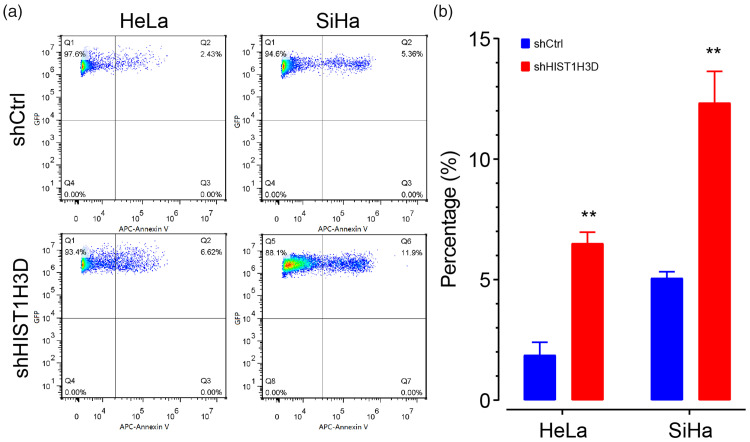
The fucoxanthin IC50 was 1 445 and 1 641 µM (Hela and SiHa cells, respectively). Chip results revealed 2 255 DEGs, including 943 upregulated and 1 312 downregulated genes, in fucoxanthin-treated versus untreated SiHa cells. Disease and function analysis indicated that these DEGs are primarily associated with cancer and organismal injuries and abnormalities, and online integrated pathway analysis showed that the DEGs were mainly enriched in p53 signalling. HIST1H3D was significantly downregulated in response to fucoxanthin. Inhibition of HIST1H3D mRNA significantly reduced cell proliferation and colony formation, significantly augmented the percentage of apoptotic HeLa and SiHa cells, and cells were arrested in G/G cell cycle phase.
The results suggest that may be an oncogene in cervical carcinogenesis and a potential fucoxanthin target in treating cervical cancer.
研究岩藻黄质在宫颈癌中的作用。岩藻黄质具有显著的抗癌作用,组蛋白簇 1 H3 家族成员 D(HIST1H3D;参与肿瘤发生)。
测定岩藻黄质对 HeLa 和 SiHa 宫颈癌细胞的半抑制浓度(IC50)。用高通量技术筛选 IC50 岩藻黄质处理的 SiHa 细胞中的差异表达基因(DEGs),并进行信号富集。鉴定为候选基因后,通过转染短发夹 HIST1H3D 载体构建 HIST1H3D 敲低模型。研究对细胞增殖、细胞周期分布、集落形成和细胞凋亡的影响。
岩藻黄质的 IC50 分别为 1445 和 1641μM(Hela 和 SiHa 细胞)。芯片结果显示,岩藻黄质处理与未处理的 SiHa 细胞相比,有 2255 个差异表达基因,包括 943 个上调基因和 1312 个下调基因。疾病和功能分析表明,这些 DEGs 主要与癌症和机体损伤及异常有关,在线综合通路分析表明,DEGs 主要富集在 p53 信号通路。岩藻黄质处理后,HIST1H3D 明显下调。抑制 HIST1H3D mRNA 显著降低细胞增殖和集落形成,显著增加 HeLa 和 SiHa 细胞凋亡比例,使细胞停滞在 G1/G0 细胞周期。
研究结果提示,可能是宫颈癌发生过程中的癌基因,也是治疗宫颈癌的潜在岩藻黄质靶点。