Lee Juliet P, Ponicki William, Mair Christina, Gruenewald Paul, Ghanem Lina
Prevention Research Center, Pacific Institute for Research and Evaluation, 2150 Shattuck Ave #601, Berkeley, CA, 94704, USA.
Department of Behavioral and Community Health Sciences, University of Pittsburgh Graduate School of Public Health, 130 De Soto Street, Pittsburgh, PA, 15261, USA.
SSM Popul Health. 2020 Sep 24;12:100669. doi: 10.1016/j.ssmph.2020.100669. eCollection 2020 Dec.
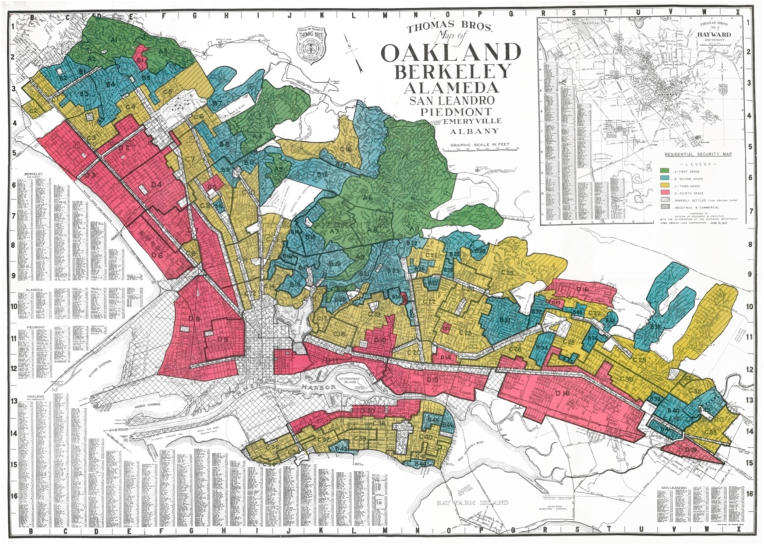
Greater availability of commercial alcohol is associated with increased alcohol use and related public health problems. Greater alcohol outlet density, a marker of alcohol availability, is associated with poorer and predominantly minority neighborhoods. However, poorer populations, African Americans, and Latinxs report using less alcohol compared to Whites and wealthier groups. We consider the role of structural racism in the social ecology of alcohol availability. Specifically we examine racist urban land use practices in the USA which became codified in the 1930s through Federal Home Owner Lending Corporation (HOLC) designations for assigning parcel values, known as "redlining." Redlining demarcated low-density residential zones for wealthy Whites which excluded poor and non-White people as well as certain businesses, including alcohol retailers. We assessed the impacts of historic redlining on present day risks for exposure to retail alcohol availability in urban Northern California.
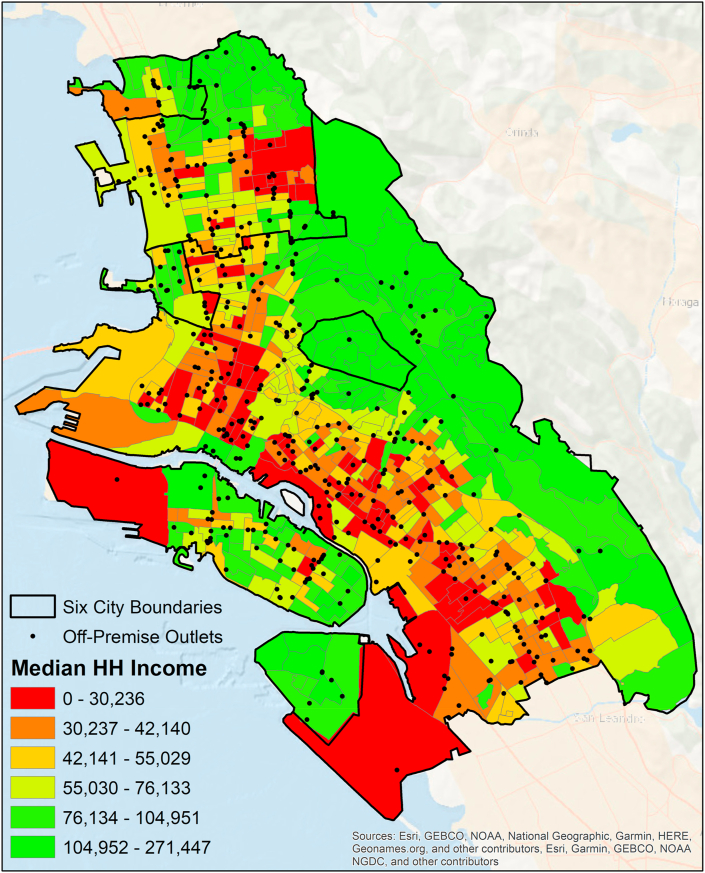
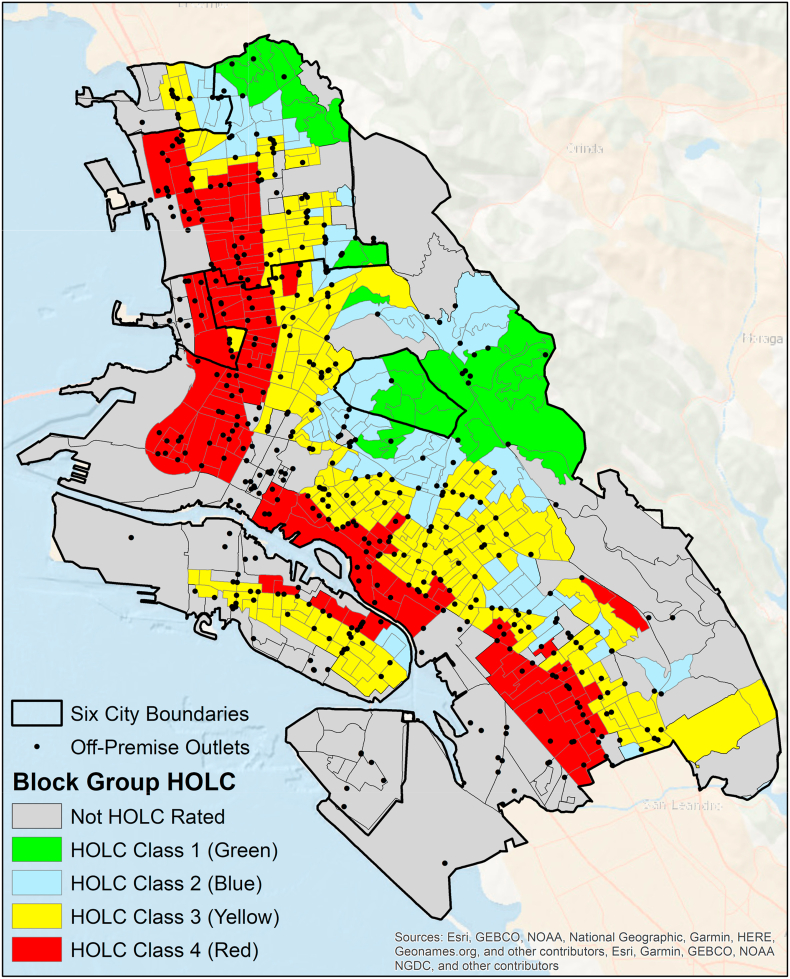
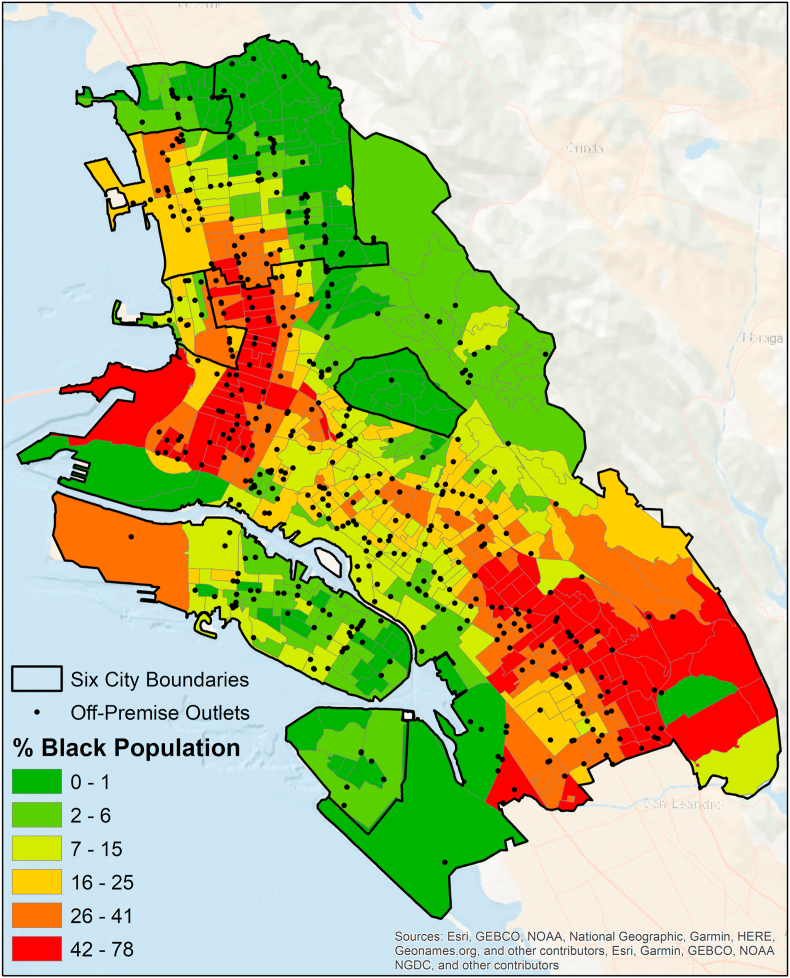
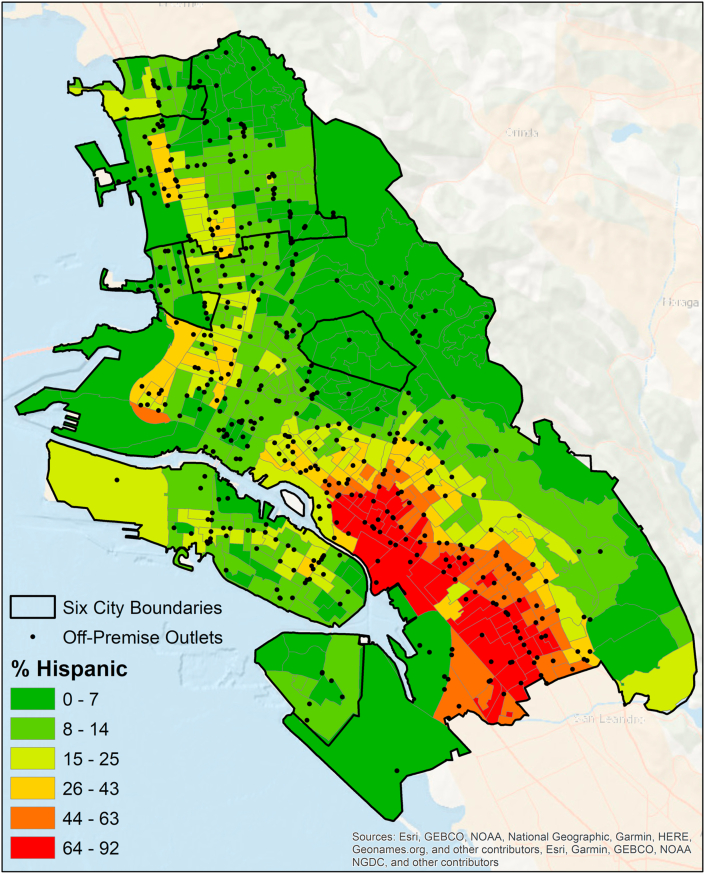
For six contiguous and demographically diverse Northern California cities we obtained digital renderings of HOLC maps (1937) which demarcated exclusions of people and businesses for 119 neighborhood areas across four land valuation zones. We then identified the most prevalent HOLC rating for each of 520 current Census block groups in the six cities, including a residual category for areas not rated by HOLC. We geolocated all current (2016) off-premise alcohol sales outlets operating in the six cities (N = 401). We used Bayesian spatial Poisson models to relate current alcohol outlet densities and Census-based estimates of neighborhood characteristics to historic HOLC classifications.
Spatial Poisson analyses found far greater contemporary off-premise outlet densities in the lowest-valued HOLC zones than in the highest (median relative rate [RR] 9.6, 95% CI 4.8-22.1). The lowest-valued HOLC zones were also characterized by far higher current percentages of both Black residents (RR 30.4, 95% CI 17.0-54.6) and Hispanic residents (RR 9.7, 95% CI 7.2-12.9).
Present day risks for exposure to retail alcohol availability were delimited by historic exclusionary land use practices. Current inequitable health risks may be founded on racist spatial projects of past decades.
商业酒精的可得性增加与酒精使用的增加以及相关的公共卫生问题有关。酒精销售点密度更高,作为酒精可得性的一个指标,与较贫困且主要为少数族裔的社区相关。然而,与白人和较富裕群体相比,贫困人群、非裔美国人和拉丁裔报告的酒精使用量较少。我们考虑结构性种族主义在酒精可得性社会生态中的作用。具体而言,我们研究了美国的种族主义城市土地使用做法,这些做法在20世纪30年代通过联邦房主贷款公司(HOLC)对地块价值的指定(即“红线划定”)而被编纂成法。红线划定为富裕的白人划定了低密度住宅区,将穷人和非白人以及某些企业(包括酒精零售商)排除在外。我们评估了历史上的红线划定对北加利福尼亚城市当前接触零售酒精可得性风险的影响。
对于北加利福尼亚六个相邻且人口结构多样的城市,我们获取了HOLC地图(1937年)的数字版本,这些地图划定了四个土地评估区域内119个社区区域对人和企业的排除情况。然后,我们确定了这六个城市中520个当前人口普查街区组各自最普遍的HOLC评级,包括未被HOLC评级区域的一个剩余类别。我们对六个城市中所有当前(2016年)的非店内酒精销售点进行了地理定位(N = 401)。我们使用贝叶斯空间泊松模型将当前的酒精销售点密度以及基于人口普查的社区特征估计与历史HOLC分类相关联。
空间泊松分析发现,价值最低的HOLC区域当代非店内销售点密度远高于价值最高的区域(中位数相对率[RR] 9.6,95%置信区间4.8 - 22.1)。价值最低的HOLC区域目前黑人居民(RR 30.4,95%置信区间17.0 - 54.6)和西班牙裔居民(RR 9.7,95%置信区间7.2 - 12.9)的百分比也高得多。
当前接触零售酒精可得性的风险受到历史上排他性土地使用做法的限制。当前不公平的健康风险可能基于过去几十年的种族主义空间规划。