Department of Paediatrics and Adolescent Medicine, The University of Hong Kong, Hong Kong, People's Republic of China.
Department of Integrated Chinese and Western Medicine, Wuhan Children's Hospital (Wuhan Maternal and Child Healthcare Hospital), Tongji Medical College, Huazhong University of Science and Technology, Wuhan, People's Republic of China.
Emerg Microbes Infect. 2020 Dec;9(1):2588-2596. doi: 10.1080/22221751.2020.1846462.
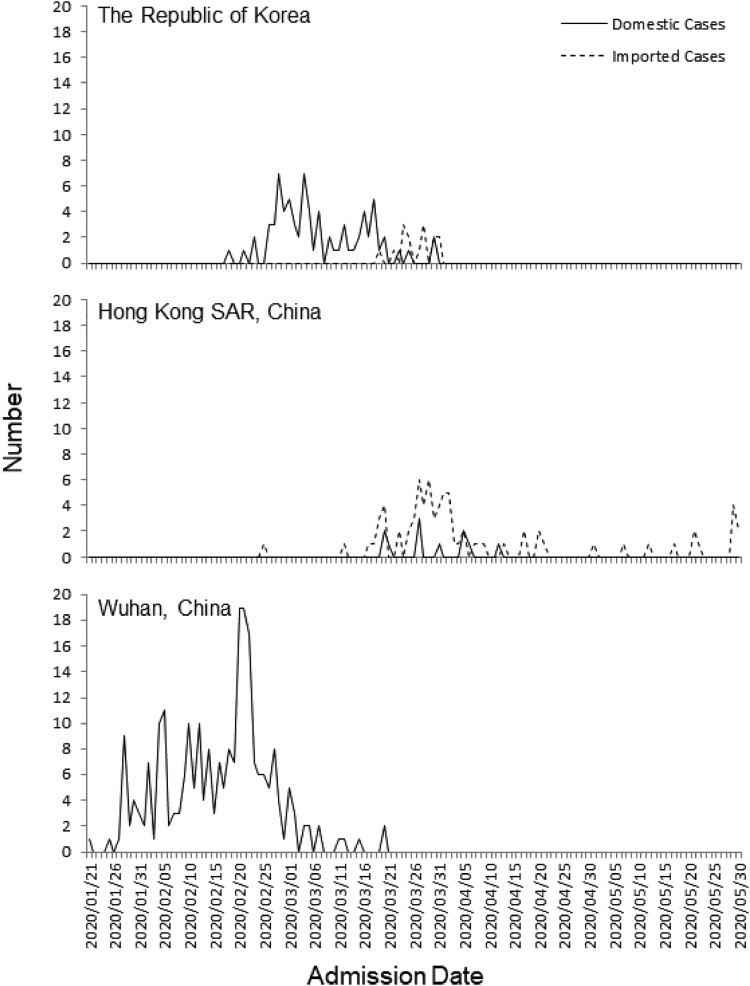
As another wave of COVID-19 outbreak has approached in July 2020, a larger scale COVID-19 pediatric Asian cohort summarizing the clinical observations is warranted. Children confirmed with COVID-19 infection from the Republic of Korea, the Hong Kong Special Administrative Region (HKSAR) and Wuhan, China, during their first waves of local outbreaks were included. Their clinical characteristics and the temporal sequences of the first waves of local paediatric outbreaks were compared. Four hundred and twenty three children with COVID-19 were analyzed. Wuhan had the earliest peak, followed by Korea and HKSAR. Compared with Korea and Wuhan, patients in HKSAR were significantly older (mean age: 12.9 vs. 10.8 vs. 6.6 years, < 0.001, respectively) and had more imported cases (87.5% vs. 16.5% vs. 0%, < 0.001, respectively). The imported cases were also older (13.4 vs. 7.6 years, < 0.001). More cases in HKSAR were asymptomatic compared to Korea and Wuhan (45.5% vs. 22.0% vs. 20.9%, < 0.001, respectively), and significantly more patients from Wuhan developed fever (40.6% vs. 29.7% vs. 21.6%, =0.003, respectively). There were significantly less imported cases than domestic cases developing fever after adjusting for age and region of origin ( = 0.046). 5.4% to 10.8% of patients reported anosmia and ageusia. None developed pediatric multisystem inflammatory syndrome temporally associated with SARS-CoV-2 (PMIS-TS). In general, adolescents were more likely to be asymptomatic and less likely to develop fever, but required longer hospital stays. In conclusion, majority patients in this pediatric Asian cohort had a mild disease. None developed PIMS-TS. Their clinical characteristics were influenced by travel history and age.
随着 2020 年 7 月又一波 COVID-19 疫情的到来,有必要对总结了临床观察结果的更大规模 COVID-19 儿科亚洲队列进行研究。本研究纳入了韩国、中国香港特别行政区(HKSAR)和中国武汉在当地疫情首次爆发期间确诊的 COVID-19 感染儿童。比较了当地儿科疫情首次爆发的临床特征和时间序列。共分析了 423 名 COVID-19 患儿。武汉的发病高峰最早,其次是韩国和 HKSAR。与韩国和武汉相比,HKSAR 的患者年龄明显较大(平均年龄:12.9 岁比 10.8 岁比 6.6 岁,均<0.001),输入性病例更多(87.5%比 16.5%比 0%,均<0.001)。输入性病例的年龄也较大(13.4 岁比 7.6 岁,均<0.001)。与韩国和武汉相比,HKSAR 的无症状病例更多(45.5%比 22.0%比 20.9%,均<0.001),武汉的发热患者明显更多(40.6%比 29.7%比 21.6%,=0.003)。调整年龄和原籍地区后,发热的输入性病例明显少于本地病例(=0.046)。5.4%至 10.8%的患者报告有嗅觉丧失和味觉丧失。没有患者出现与 SARS-CoV-2 相关的儿童多系统炎症综合征(PMIS-TS)。一般来说,青少年更有可能无症状,不太可能发热,但需要更长的住院时间。总之,本儿科亚洲队列的大多数患者疾病较轻,均未出现 PMIS-TS。他们的临床特征受到旅行史和年龄的影响。