Clinical Epidemiology Program, Ottawa Hospital Research Institute, Ottawa, Canada.
School of Epidemiology and Public Health, University of Ottawa, Ottawa, Canada.
BMC Gastroenterol. 2020 Nov 10;20(1):372. doi: 10.1186/s12876-020-01516-4.
Inflammatory bowel disease (IBD) is a debilitating chronic disease with limited treatment options. Resistant starches may represent a novel treatment for IBD. However, its efficacy and safety remain unclear. Our objective was to perform a systematic review to summarize the preclinical and clinical effects of resistant starch, which may help guide future studies.
Medline, EMBASE, and the Cochrane Central Register were searched. Included studies investigated the use of resistant starch therapy in in vivo animal models of IBD or human patients with IBD. Articles were screened, and data extracted, independently and in duplicate. The primary outcomes were clinical remission (clinical) and bowel mucosal damage (preclinical).
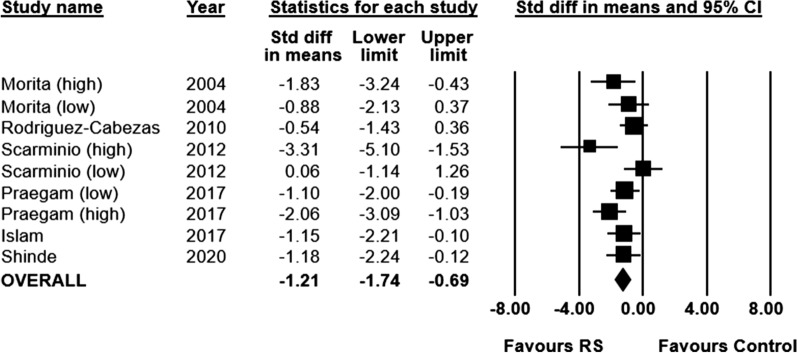
21 preclinical (n = 989 animals) and seven clinical (n = 164 patients) studies met eligibility. Preclinically, resistant starch was associated with a significant reduction in bowel mucosal damage compared to placebo (standardized mean difference - 1.83, 95% CI - 2.45 to - 1.20). Clinically, five studies reported data on clinical remission but clinical and methodological heterogeneity precluded pooling. In all five, a positive effect was seen in patients who consumed resistant starch supplemented diets. The majority of studies in both the preclinical and clinical settings were at a high or unclear risk of bias due to poor methodological reporting.
Our review demonstrates that resistant starch is associated with reduced histology damage in animal studies, and improvements in clinical remission in IBD patients. These results need to be tempered by the risk of bias of included studies. Rigorously designed preclinical and clinical studies are warranted. Trial registration The review protocols were registered on PROSPERO (preclinical: CRD42019130896; clinical: CRD42019129513).
炎症性肠病(IBD)是一种使人虚弱的慢性疾病,治疗选择有限。抗性淀粉可能代表了一种治疗 IBD 的新方法。然而,其疗效和安全性仍不清楚。我们的目的是进行系统评价,总结抗性淀粉的临床前和临床效果,这可能有助于指导未来的研究。
检索了 Medline、EMBASE 和 Cochrane 中央注册库。纳入的研究调查了抗性淀粉治疗在 IBD 动物模型或 IBD 人类患者中的应用。文章由两人独立筛选和提取数据。主要结果是临床缓解(临床)和肠黏膜损伤(临床前)。
21 项临床前(n=989 只动物)和 7 项临床(n=164 名患者)研究符合入选标准。在临床前研究中,与安慰剂相比,抗性淀粉与肠黏膜损伤显著减少相关(标准化均数差-1.83,95%CI-2.45 至-1.20)。在临床研究中,有 5 项研究报告了关于临床缓解的数据,但由于临床和方法学的异质性,无法进行汇总。在所有五项研究中,食用抗性淀粉补充饮食的患者均有积极效果。由于方法学报告不佳,大多数临床前和临床研究都存在高风险或不确定的偏倚。
我们的综述表明,抗性淀粉与动物研究中的组织学损伤减少有关,并改善 IBD 患者的临床缓解。这些结果需要考虑到纳入研究的偏倚风险。需要进行设计严谨的临床前和临床研究。
综述方案已在 PROSPERO 上注册(临床前:CRD42019130896;临床:CRD42019129513)。