Department of Global Public Health, Karolinska Institutet, Stockholm, Sweden.
Department of Public Health Sciences, Stockholm University, Stockholm, Sweden.
Drug Alcohol Rev. 2021 Mar;40(3):431-442. doi: 10.1111/dar.13217. Epub 2020 Nov 18.
The gender difference in alcohol use seems to have narrowed in the Nordic countries, but it is not clear to what extent this may have affected differences in levels of harm. We compared gender differences in all-cause and cause-specific alcohol-attributed disease burden, as measured by disability-adjusted life-years (DALY), in four Nordic countries in 2000-2017, to find out if gender gaps in DALYs had narrowed.
Alcohol-attributed disease burden by DALYs per 100 000 population with 95% uncertainty intervals were extracted from the Global Burden of Disease database.
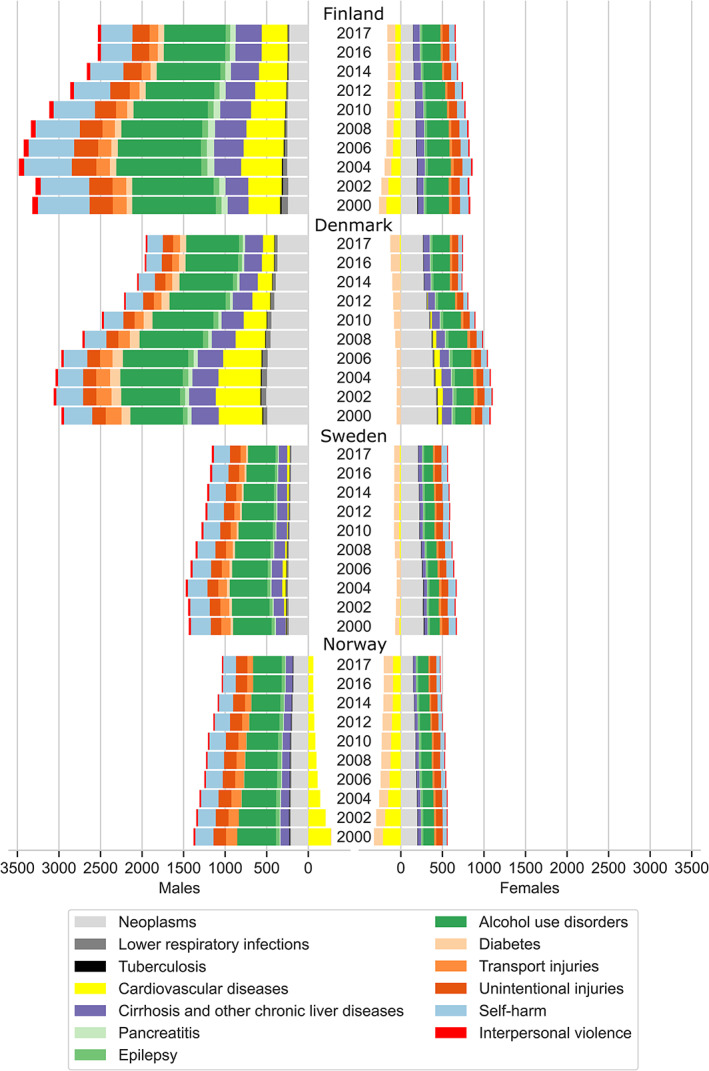
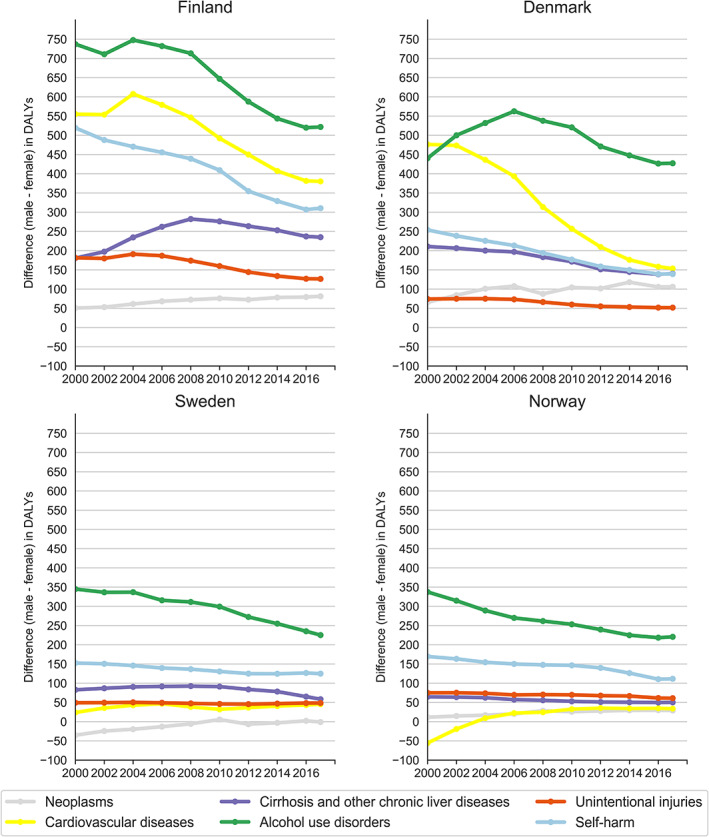
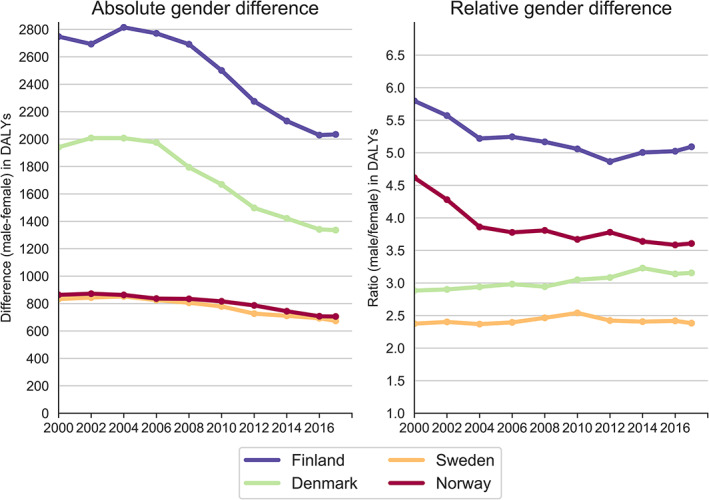
In 2017, all-cause DALYs in males varied between 2531 in Finland and 976 in Norway, and in females between 620 in Denmark and 270 in Norway. Finland had the largest gender differences and Norway the smallest, closely followed by Sweden. During 2000-2017, absolute gender differences in all-cause DALYs declined by 31% in Denmark, 26% in Finland, 19% in Sweden and 18% in Norway. In Finland, this was driven by a larger relative decline in males than females; in Norway, it was due to increased burden in females. In Denmark, the burden in females declined slightly more than in males, in relative terms, while in Sweden the relative decline was similar in males and females.
The gender gaps in harm narrowed to a different extent in the Nordic countries, with the differences driven by different conditions. Findings are informative about how inequality, policy and sociocultural differences affect levels of harm by gender.
北欧国家的饮酒性别差异似乎已经缩小,但尚不清楚这在多大程度上影响了伤害程度的差异。我们比较了 2000 年至 2017 年间四个北欧国家所有原因和特定原因归因于酒精的疾病负担(以残疾调整生命年衡量)的性别差异,以了解 DALY 中的性别差距是否缩小。
从全球疾病负担数据库中提取每 100000 人 95%不确定区间的归因于酒精的疾病负担 DALY。
2017 年,男性的全因 DALY 从芬兰的 2531 人到挪威的 976 人不等,女性从丹麦的 620 人到挪威的 270 人不等。芬兰的性别差异最大,挪威最小,紧随其后的是瑞典。在 2000 年至 2017 年期间,丹麦的全因 DALY 绝对性别差异下降了 31%,芬兰下降了 26%,瑞典下降了 19%,挪威下降了 18%。在芬兰,这是由于男性相对下降幅度大于女性;在挪威,这是由于女性的负担增加。在丹麦,女性的负担下降幅度略大于男性,相对而言,而在瑞典,男性和女性的相对下降幅度相似。
北欧国家的伤害性别差距缩小到不同程度,这些差异是由不同的情况驱动的。这些发现为了解不平等、政策和社会文化差异如何影响性别伤害水平提供了信息。