Health Service Division, Health Service Bureau, Ministry of Health, Labour and Welfare, Government of Japan, Tokyo 100-8916, Japan.
Center for Cancer Control and Information Services, National Cancer Center, Tokyo 104-0045, Japan.
Int J Environ Res Public Health. 2020 Nov 18;17(22):8536. doi: 10.3390/ijerph17228536.
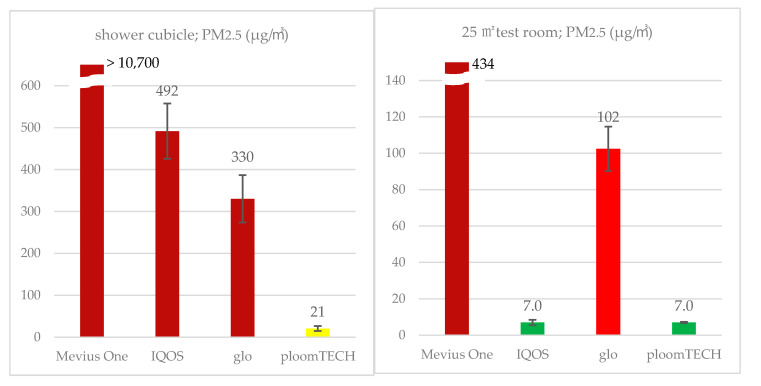
It is too early to provide a clear answer on the impact of exposure to the second-hand aerosol of heated tobacco products (HTPs) in the planning of policy for smoke-free indoors legislation. Here, we conducted a preliminary study to evaluate indoor air quality with the use of HTPs. We first measured the concentration of nicotine and particulate matter (PM) in the air following 50 puffs in the use of HTPs or cigarettes in a small shower cubicle. We then measured these concentrations in comparison with the use equivalent of smoking 5.4 cigarettes per hour in a 25 m room, as a typical indoor environment test condition. In the shower cubicle test, nicotine concentrations in indoor air using three types of HTP, namely IQOS, glo, and ploomTECH, were 25.9-257 μg/m. These values all exceed the upper bound of the range of tolerable concentration without health concerns, namely 3 µg/m. In particular, the indoor PM concentration of about 300 to 500 μg/m using IQOS or glo in the shower cubicle is hazardous. In the 25 m room test, in contrast, nicotine concentrations in indoor air with the three types of HTP did not exceed 3 μg/m. PM concentrations were below the standard value of 15 μg/m per year for IQOS and ploomTECH, but were slightly high for glo, with some measurements exceeding 100 μg/m. These results do not negate the inclusion of HTPs within a regulatory framework for indoor tolerable use from exposure to HTP aerosol, unlike cigarette smoke.
关于在制定无烟室内立法的政策中,暴露于加热烟草产品(HTP)二手气溶胶的影响,目前还无法提供明确的答案。在这里,我们进行了一项初步研究,评估使用 HTP 时的室内空气质量。我们首先在一个小淋浴房内使用 HTP 或香烟进行 50 次抽吸,测量空气中尼古丁和颗粒物(PM)的浓度。然后,我们将这些浓度与在 25 平方米的房间内每小时吸烟 5.4 支的等效浓度进行比较,这是一种典型的室内环境测试条件。在淋浴房测试中,使用三种 HTP,即 IQOS、glo 和 ploomTECH,空气中的尼古丁浓度分别为 25.9-257μg/m。这些值都超过了无健康担忧的可耐受浓度上限,即 3μg/m。特别是在淋浴房内使用 IQOS 或 glo 时,室内 PM 浓度约为 300-500μg/m,具有危害性。相比之下,在 25 平方米的房间测试中,三种 HTP 产生的室内空气中的尼古丁浓度未超过 3μg/m。PM 浓度低于 IQOS 和 ploomTECH 每年 15μg/m 的标准值,但 glo 的浓度略高,一些测量值超过 100μg/m。这些结果并不否定在监管框架内将 HTP 纳入室内可耐受使用的范围,与香烟烟雾不同,HTP 气溶胶暴露仍需受到监管。