College of Biosystems Engineering and Food Science, Zhejiang University, Hangzhou 310058, China; Ningbo Institute of Zhejiang University, Ningbo 315100, China.
College of Biosystems Engineering and Food Science, Zhejiang University, Hangzhou 310058, China; Ningbo Institute of Zhejiang University, Ningbo 315100, China.
Poult Sci. 2020 Dec;99(12):7122-7132. doi: 10.1016/j.psj.2020.07.049. Epub 2020 Sep 18.
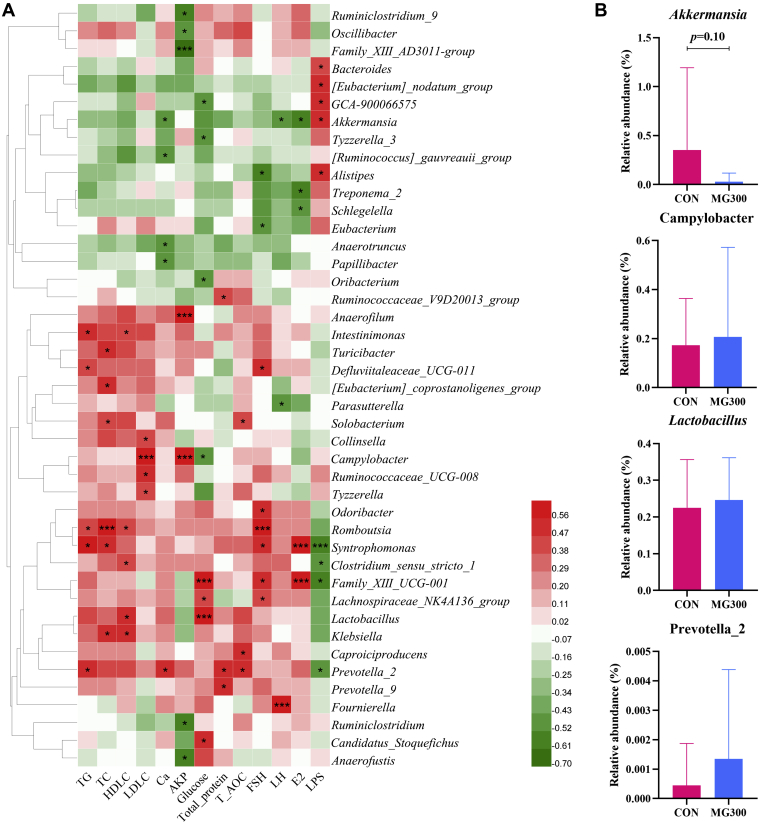
The present study aimed to evaluate the effects of medium-chain α-monoglycerides (MG) on productive performance, egg quality, serum biochemical indices, and gut microbiota in laying hens. A total of 252 40-wk-old Hy-Line Brown laying hens were randomly allotted into two groups (21 hens per replicate, 6 replicates per group) and fed with a basal diet (CON group) or a basal diet containing 300 mg/kg of MG (MG300 group). The eggs laid were recorded daily on a replicate basis, and egg quality was measured at 48, 56, and 64 wk of age. At the end of this trial, three randomly selected hens from each replicate were slaughtered, and the serum and cecal digesta were collected for analysis of serum biochemical indices and sex hormones and gut microbiota composition determination. The results revealed that the laying rate was significantly (P < 0.05) increased in the MG300 group, and the feed conversion ratio was decreased (P < 0.01) during 40-64 wk of age. The eggshell strength at 56 wk of age and eggshell thickness at 56 and 64 wk of age were significantly (P < 0.05) increased in the MG300 group. In addition, dietary MG significantly (P < 0.05) increased levels of serum follicle-stimulating hormone, luteinizing hormone, estradiol, glucose, Ca, serum total cholesterol, triglycerides, and high-density lipoprotein cholesterol, but decreased the lipopolysaccharide level. Notably, MG supplementation increased (P < 0.05) the relative abundance of genera Lachnospiraceae_NK4A136_group, Romboutsia, Syntrophomonas, Victivallis, Ruminiclostridium_6, and Family_XIII_UCG_001 (P < 0.01) and simultaneously decreased the abundances of Proteobacteria, Faecalibacterium, Alistipes, Cerasicoccus, Schlegelella, and Treponema_2. Spearman's correlation analysis indicated that the differentiated genera were significantly associated with the serum biochemical indices and sex hormone. In summary, the present study revealed that dietary supplementation with MG can improve productive performance and egg quality by modulating gut microbiota, suggested that MG may act as an efficient feed supplement in aged hens.
本研究旨在评估中链 α-单甘油酯(MG)对产蛋性能、蛋品质、血清生化指标和产蛋鸡肠道微生物群的影响。将 252 只 40 周龄海兰褐蛋鸡随机分为两组(每重复 21 只鸡,每组 6 个重复),分别饲喂基础日粮(CON 组)或基础日粮中添加 300mg/kg MG(MG300 组)。以重复为单位记录每天的产蛋量,在 48、56 和 64 周龄时测定蛋品质。试验结束时,每个重复随机选择 3 只母鸡屠宰,收集血清和盲肠内容物,用于分析血清生化指标和性激素以及肠道微生物群组成。结果表明,MG300 组产蛋率显著提高(P<0.05),40-64 周龄时饲料转化率降低(P<0.01)。56 周龄时蛋壳强度和 56、64 周龄时蛋壳厚度显著提高(P<0.05)。此外,日粮 MG 显著(P<0.05)提高了血清促卵泡激素、促黄体生成素、雌二醇、葡萄糖、Ca、血清总胆固醇、甘油三酯和高密度脂蛋白胆固醇水平,但降低了脂多糖水平。值得注意的是,MG 补充剂增加了(P<0.05)Lachnospiraceae_NK4A136_group、Romboutsia、Syntrophomonas、Victivallis、Ruminiclostridium_6 和 Family_XIII_UCG_001 的相对丰度(P<0.01),同时降低了变形菌门、Faecalibacterium、Alistipes、Cerasicoccus、Schlegelella 和 Treponema_2 的丰度。Spearman 相关性分析表明,差异丰度的属与血清生化指标和性激素显著相关。综上所述,本研究表明,日粮中添加 MG 可以通过调节肠道微生物群来提高产蛋性能和蛋品质,表明 MG 可能是老龄母鸡的一种有效饲料添加剂。