Mutambudzi Miriam, Niedwiedz Claire, Macdonald Ewan Beaton, Leyland Alastair, Mair Frances, Anderson Jana, Celis-Morales Carlos, Cleland John, Forbes John, Gill Jason, Hastie Claire, Ho Frederick, Jani Bhautesh, Mackay Daniel F, Nicholl Barbara, O'Donnell Catherine, Sattar Naveed, Welsh Paul, Pell Jill P, Katikireddi Srinivasa Vittal, Demou Evangelia
MRC/CSO Social and Public Health Sciences Unit, Institute of Health and Wellbeing, University of Glasgow, Glasgow, UK.
Department of Public Health, Syracuse University, Syracuse, New York, USA.
Occup Environ Med. 2020 Dec 9;78(5):307-14. doi: 10.1136/oemed-2020-106731.
To investigate severe COVID-19 risk by occupational group.
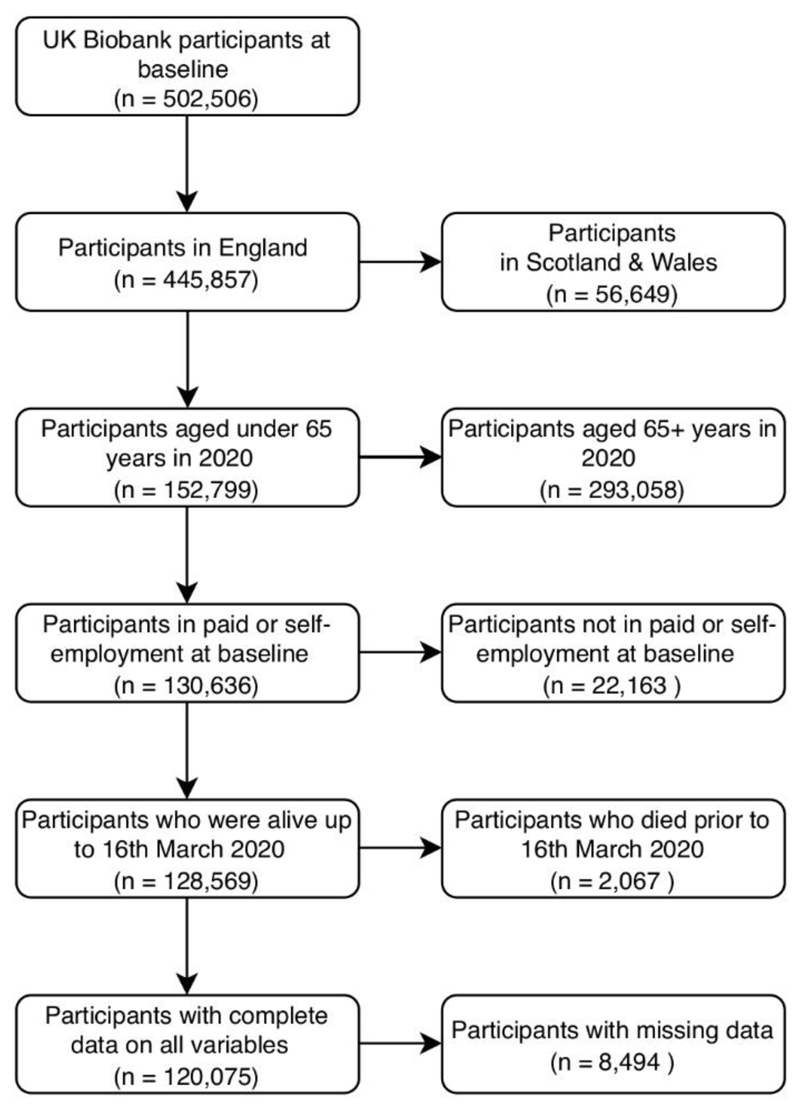
Baseline UK Biobank data (2006-10) for England were linked to SARS-CoV-2 test results from Public Health England (16 March to 26 July 2020). Included participants were employed or self-employed at baseline, alive and aged <65 years in 2020. Poisson regression models were adjusted sequentially for baseline demographic, socioeconomic, work-related, health, and lifestyle-related risk factors to assess risk ratios (RRs) for testing positive in hospital or death due to COVID-19 by three occupational classification schemes (including Standard Occupation Classification (SOC) 2000).
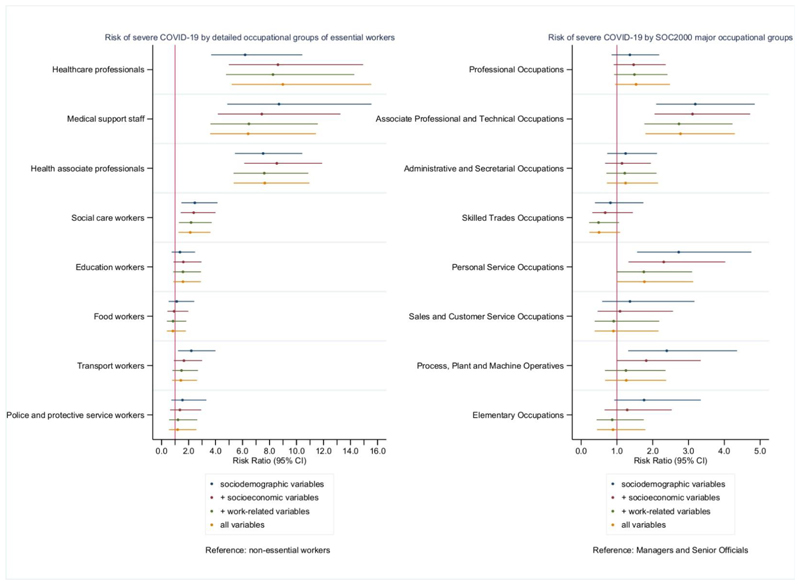
Of 120 075 participants, 271 had severe COVID-19. Relative to non-essential workers, healthcare workers (RR 7.43, 95% CI 5.52 to 10.00), social and education workers (RR 1.84, 95% CI 1.21 to 2.82) and other essential workers (RR 1.60, 95% CI 1.05 to 2.45) had a higher risk of severe COVID-19. Using more detailed groupings, medical support staff (RR 8.70, 95% CI 4.87 to 15.55), social care (RR 2.46, 95% CI 1.47 to 4.14) and transport workers (RR 2.20, 95% CI 1.21 to 4.00) had the highest risk within the broader groups. Compared with white non-essential workers, non-white non-essential workers had a higher risk (RR 3.27, 95% CI 1.90 to 5.62) and non-white essential workers had the highest risk (RR 8.34, 95% CI 5.17 to 13.47). Using SOC 2000 major groups, associate professional and technical occupations, personal service occupations and plant and machine operatives had a higher risk, compared with managers and senior officials.
Essential workers have a higher risk of severe COVID-19. These findings underscore the need for national and organisational policies and practices that protect and support workers with an elevated risk of severe COVID-19.
按职业群体调查重症新型冠状病毒肺炎(COVID-19)风险。
将英国生物银行针对英格兰地区的基线数据(2006 - 2010年)与英国公共卫生部门的严重急性呼吸综合征冠状病毒2(SARS-CoV-2)检测结果(2020年3月16日至7月26日)相关联。纳入的参与者在基线时为受雇或自雇状态,于2020年存活且年龄小于65岁。采用泊松回归模型,依次对基线人口统计学、社会经济、工作相关、健康及生活方式相关的风险因素进行调整,以通过三种职业分类方案(包括2000年标准职业分类(SOC))评估因COVID-19住院检测呈阳性或死亡的风险比(RRs)。
在120075名参与者中,271人患有重症COVID-19。相对于非必要工作人员,医护人员(RR 7.43,95%置信区间5.52至10.00)、社会和教育工作者(RR 1.84,95%置信区间1.21至2.82)以及其他必要工作人员(RR 1.60,95%置信区间1.05至2.45)患重症COVID-19的风险更高。采用更详细的分组,医疗辅助人员(RR 8.70,95%置信区间4.87至15.55)、社会护理人员(RR 2.46,95%置信区间1.47至4.14)和运输工人(RR 2.20,95%置信区间1.21至4.00)在更广泛的群体中风险最高。与非必要工作的白人相比,非必要工作的非白人风险更高(RR 3.27,95%置信区间1.90至5.62),非必要工作的白人风险最高(RR 8.34,95%置信区间5.17至13.47)。使用SOC 2000主要职业分组,与经理和高级官员相比,准专业及技术职业、个人服务职业以及工厂和机器操作人员的风险更高。
必要工作人员患重症COVID-19的风险更高。这些发现强调了制定国家和组织政策及措施的必要性,以保护和支持患重症COVID-19风险较高的工作人员。