Chaniad Prapaporn, Tewtrakul Supinya, Sudsai Teeratad, Langyanai Supat, Kaewdana Kantarakorn
School of Medicine, Walailak University, Nakhon Si Thammarat, Thailand.
Faculty of Pharmaceutical Sciences, Prince of Songkla University, Hat-Yai, Songkhla, Thailand.
PLoS One. 2020 Dec 11;15(12):e0243632. doi: 10.1371/journal.pone.0243632. eCollection 2020.
Dioscorea bulbifera L. (Dioscoreaceae) has been traditionally used in Thai folk medicine as a diuretic and anthelmintic, for longevity preparations, and for wound and inflammation treatment. This plant is also commonly used in traditional Indian and Chinese medicines in the treatment of sore throat, gastric cancer, rectal carcinoma and goiters. However, the wound healing effects of the active compounds in this plant have not been investigated.
This study aimed to identify compounds responsible for the wound healing activity of D. bulbifera and determine their potential anti-inflammatory and antioxidant activities.
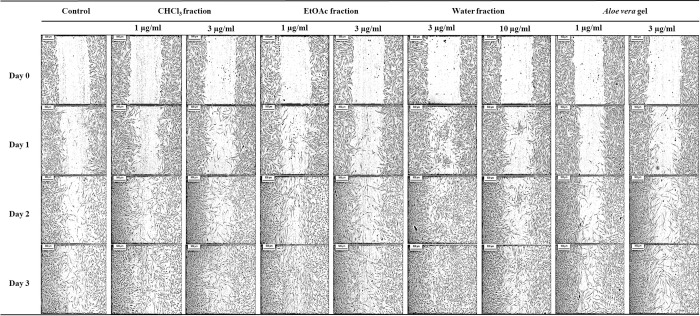
Crude extracts of D. bulbifera bulbils, their derived fractions and eleven purified compounds were tested for anti-inflammatory activity against LPS-induced NO production in RAW264.7 macrophages. The wound healing effects were evaluated via cell proliferation and migration assays using human dermal fibroblasts (HDFs), and the antioxidant effects were determined using 2,2-diphenyl-1-picrylhydrazyl (DPPH) and hydroxyl radical (•OH) scavenging activity assays.
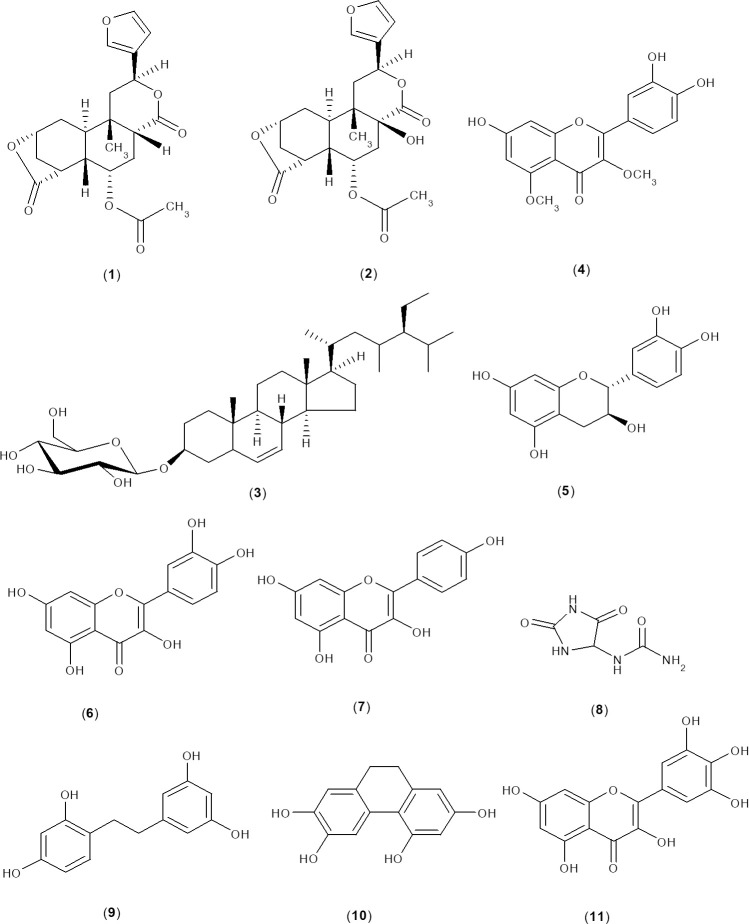
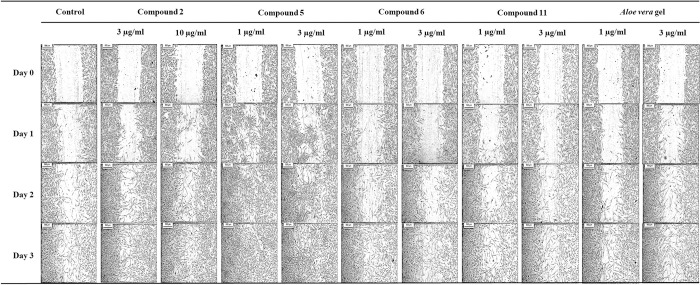
15,16-Epoxy-6α-O-acetyl-8β-hydroxy-19-nor-clero-13(16),14-diene-17,12;18,2-diolide (2), (+)-catechin (5), quercetin (6) and myricetin (11) exhibited significantly potent wound healing effects and promoted marked cell proliferation, resulting in % viabilities of 107.4-137.6, 121.1-151.9, 98.0-131.9, 90.9-115.9, respectively. Among them, (+)-catechin produced the highest % cell migration, resulting in 100.0% wound closure sooner (at day 2) than the other compounds. In addition, 1 μg/ml (+)-catechin significantly increased fibroblast migration by 2.4-fold compared to that in the control after 24 h. Regarding anti-inflammatory properties, kaempferol (7) and quercetin (6) decreased (p < 0.005) NO production, with IC50 values of 46.6 and 56.2 μM, respectively. In addition, the crude extracts, solvent fractions and flavonoid compounds were also found to possess marked antioxidant activity in both DPPH and •OH radical scavenging assays.
These findings provide more evidence to support the traditional use of D. bulbifera for the treatment of wounds and inflammation.
薯蓣科植物黄独在泰国传统医学中一直被用作利尿剂和驱虫剂,用于长寿制剂以及伤口和炎症治疗。这种植物在传统印度和中国医学中也常用于治疗喉咙痛、胃癌、直肠癌和甲状腺肿。然而,该植物中活性化合物的伤口愈合作用尚未得到研究。
本研究旨在鉴定黄独中具有伤口愈合活性的化合物,并确定其潜在的抗炎和抗氧化活性。
测试了黄独珠芽的粗提物、其衍生馏分和11种纯化化合物对RAW264.7巨噬细胞中脂多糖诱导的一氧化氮产生的抗炎活性。通过使用人皮肤成纤维细胞(HDFs)的细胞增殖和迁移试验评估伤口愈合效果,并使用2,2-二苯基-1-苦基肼(DPPH)和羟基自由基(•OH)清除活性试验确定抗氧化效果。
15,16-环氧-6α-O-乙酰基-8β-羟基-19-降-克罗-13(16),14-二烯-17,12;18,2-二内酯(2)、(+)-儿茶素(5)、槲皮素(6)和杨梅素(11)表现出显著有效的伤口愈合作用,并促进明显的细胞增殖,其活力百分比分别为107.4-137.6、121.1-151.9、98.0-131.9、90.9-115.9。其中,(+)-儿茶素产生的细胞迁移百分比最高,导致伤口闭合比其他化合物更快(在第2天达到100.0%)。此外,与对照组相比,1μg/ml(+)-儿茶素在24小时后显著增加成纤维细胞迁移2.4倍。关于抗炎特性,山奈酚(7)和槲皮素(6)降低(p<0.005)一氧化氮产生,IC50值分别为46.6和56.2μM。此外,在DPPH和•OH自由基清除试验中还发现粗提物、溶剂馏分和黄酮类化合物具有显著的抗氧化活性。
这些发现为支持黄独用于治疗伤口和炎症的传统用途提供了更多证据。