Department of Economics and Management, University of Parma, Via J. Kennedy, 6, 43125 Parma, Italy.
Department of Economics and Finance, Università Cattolica del Sacro Cuore, Via Necchi, 5, 20123, Milano, Italy.
Health Policy. 2021 Feb;125(2):141-147. doi: 10.1016/j.healthpol.2020.10.017. Epub 2020 Nov 8.
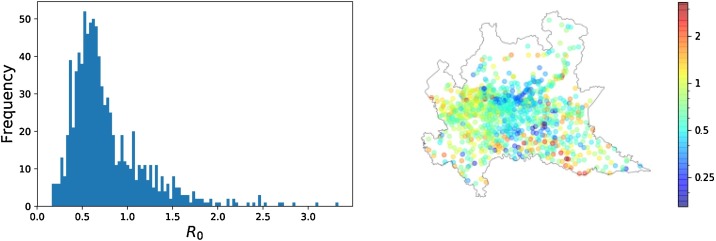
We use daily data from Lombardy, the Italian region most affected by the COVID-19 outbreak, to calibrate a SIR model on each municipality. Municipalities with a higher initial number of cases feature a lower rate of diffusion, not attributable to herd immunity: there is a robust and strongly significant negative correlation between the estimated basic reproduction number (R) and the initial outbreak size. This represents novel evidence of the prevalence-response elasticity in a cross-sectional setting, characterized by a same health system and homogeneous social distancing regulations. By ruling out alternative explanations, we conclude that a higher number of cases causes changes of behavior, such as a more strict adoption of social distancing measures among the population, that reduce the spread. This finding calls for the distribution of detailed epidemiological data to populations affected by COVID-19 outbreaks.
我们利用意大利受 COVID-19 疫情影响最严重的伦巴第大区的日常数据,为每个自治市校准 SIR 模型。初始病例数较高的自治市扩散率较低,这并非归因于群体免疫:估计的基本繁殖数 (R) 与初始疫情规模之间存在稳健且具有统计学显著意义的负相关关系。这在具有相同卫生系统和同质化社会隔离规定的横截面上,代表了流行-反应弹性的新证据。通过排除其他解释,我们得出结论,更多的病例会导致行为的改变,例如人口中更严格地采取社会隔离措施,从而减少传播。这一发现呼吁向受 COVID-19 疫情影响的人群分发详细的流行病学数据。