Federal Department of Economic Affairs, Education and Research EAER, Agroscope, Schwarzenburgstrasse 161, Bern, 3003, Switzerland.
UCD Institute of Food and Health, School of Public Health, Physiotherapy, and Sports Science, University College Dublin, Belfield, Dublin 4, D04 C7X2, Ireland.
Mol Nutr Food Res. 2021 Feb;65(4):e2000647. doi: 10.1002/mnfr.202000647. Epub 2021 Jan 29.
Combining different "omics" data types in a single, integrated analysis may better characterize the effects of diet on human health.
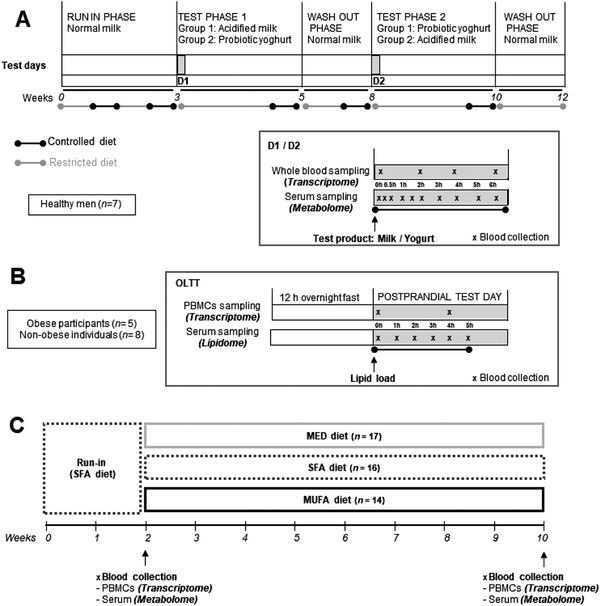
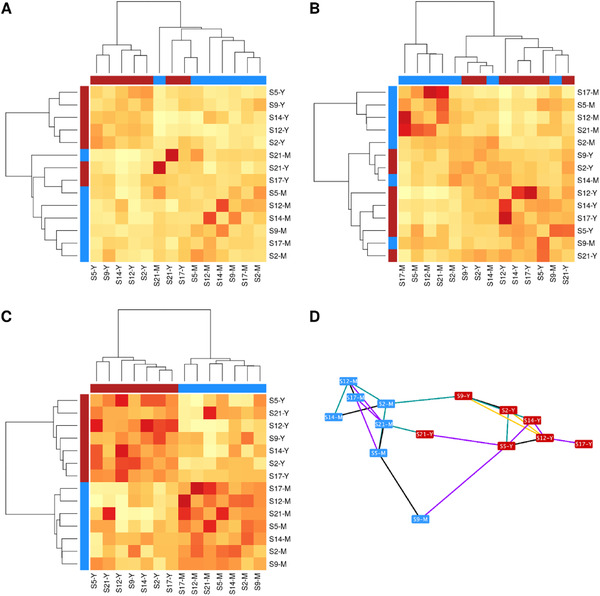
The performance of two data integration tools, similarity network fusion tool (SNFtool) and Data Integration Analysis for Biomarker discovery using Latent variable approaches for "Omics" (DIABLO; MixOmics), in discriminating responses to diet and metabolic phenotypes is investigated by combining transcriptomics and metabolomics datasets from three human intervention studies: a postprandial crossover study testing dairy foods (n = 7; study 1), a postprandial challenge study comparing obese and non-obese subjects (n = 13; study 2); and an 8-week parallel intervention study that assessed three diets with variable lipid content on fasting parameters (n = 39; study 3). In study 1, combining datasets using SNF or DIABLO significantly improve sample classification. For studies 2 and 3, the value of SNF integration depends on the dietary groups being compared, while DIABLO discriminates samples well but does not perform better than transcriptomic data alone.
The integration of associated "omics" datasets can help clarify the subtle signals observed in nutritional interventions. The performance of each integration tool is differently influenced by study design, size of the datasets, and sample size.
将不同的“组学”数据类型结合在单个综合分析中,可能更能描述饮食对人体健康的影响。
通过结合来自三项人类干预研究的转录组学和代谢组学数据集,研究了两种数据集成工具(相似网络融合工具(SNFtool)和基于潜在变量方法的用于“组学”的生物标志物发现的数据集成分析(DIABLO;MixOmics)在区分饮食和代谢表型反应方面的性能:一项测试乳制品的餐后交叉研究(n=7;研究 1),一项比较肥胖和非肥胖受试者的餐后挑战研究(n=13;研究 2);以及一项评估三种不同脂肪含量的饮食对空腹参数影响的 8 周平行干预研究(n=39;研究 3)。在研究 1 中,使用 SNF 或 DIABLO 组合数据集可显著改善样本分类。对于研究 2 和 3,SNF 集成的价值取决于正在比较的饮食组,而 DIABLO 可以很好地区分样本,但不如转录组学数据单独使用效果好。
相关“组学”数据集的集成可以帮助阐明营养干预中观察到的微妙信号。每个集成工具的性能受到研究设计、数据集大小和样本量的不同影响。