Poussel Mathias, Touzé Charlie, Allado Edem, Frimat Luc, Hily Oriane, Thilly Nathalie, Rousseau Hélène, Vauthier Jean-Charles, Chenuel Bruno
Center of Sports Medicine and Adapted Physical Activity, University Hospital of Nancy, Vandoeuvre-lès-Nancy, France.
EA 3450 DevAH-Development, Adaptation and Disadvantage, Cardiorespiratory Regulations and Motor Control, Université de Lorraine, Nancy, France.
Front Sports Act Living. 2020 Jan 21;1:71. doi: 10.3389/fspor.2019.00071. eCollection 2019.
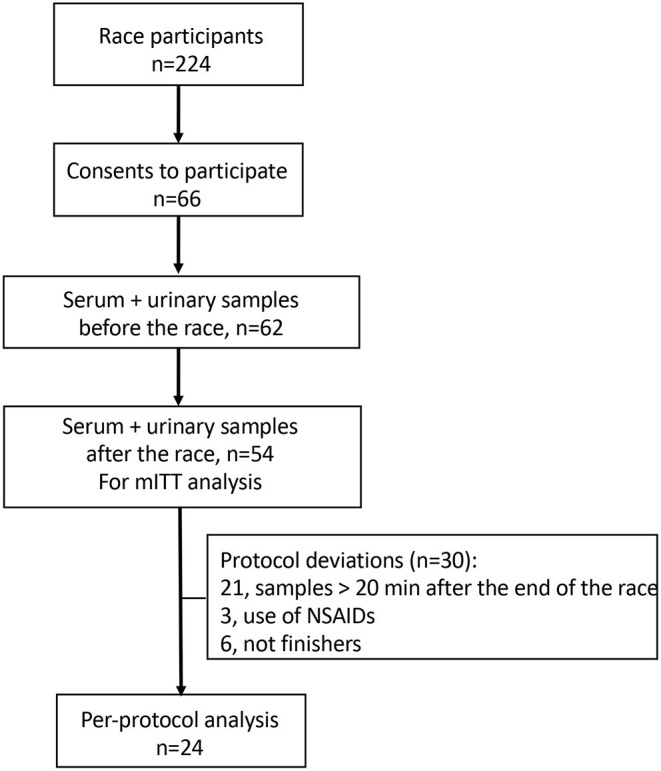
Increasing ultramarathons participation, investigation into strenuous exercise and kidney function has to be clarified. Prospective observational study. The study used data collected among ultra-marathon runners completing the 2017 edition of the 120 km "Infernal trail" race. Samples were collected within 2 h pre-race (start) and immediately post-race (finish). Measurements of serum creatinine (sCr), cystatin C (Cys), creatine kinase, and urine albumin were completed. Acute Kidney Injury (AKI) as defined by the RIFLE criteria. "Risk" of injury was defined as increased serum Creatinine (sCr) × 1.5 or Glomerular Filtration Rate (GFR) decrease >25%. Injury was defined as 2 × sCr or GFR decrease >50%. These two categories of AKI were combined to calculate total incidence at the finish line. GFR was estimated by two methods, using measure of sCr and using measure of cystatin C. Urinary biomarkers [neutrophil gelatinase-associated lipocalin (NGAL)] were also used to define AKI. Outcome results before and after the race were compared by using McNemar test for qualitative data and Wilcoxon signed-rank test for quantitative data, in modified intent-to-treat and per-protocol analyses. A sample of 24 included finishers, with no use of non-steroidal anti-inflammatory drugs (NSAIDs) was studied. Depending the methodology used to calculate GFR, the prevalence of AKI was observed from 0 to 12.5%. Urinary biomarkers of kidney damage were increased following the race but with no significant decrease in GFR. Our study showed a very low prevalence of AKI and no evidence that ultra-endurance running can cause important kidney damage in properly hydrated subjects with no use of NSAIDs. Whether the increase in urinary biomarkers of kidney damage following the race reflects structural kidney injury or a simple metabolic adaptation to strenuous exercise needs to be clarified.
随着超级马拉松参赛人数的增加,有必要对高强度运动与肾功能之间的关系进行研究。前瞻性观察性研究。本研究使用了在完成2017年120公里“地狱小径”比赛的超级马拉松运动员中收集的数据。在比赛前2小时(起跑时)和比赛后立即(结束时)采集样本。完成血清肌酐(sCr)、胱抑素C(Cys)、肌酸激酶和尿白蛋白的测量。根据RIFLE标准定义急性肾损伤(AKI)。损伤“风险”定义为血清肌酐(sCr)升高×1.5或肾小球滤过率(GFR)降低>25%。损伤定义为2×sCr或GFR降低>50%。将这两类AKI合并计算终点线处的总发病率。通过两种方法估算GFR,一种使用sCr测量值,另一种使用胱抑素C测量值。还使用尿生物标志物[中性粒细胞明胶酶相关脂质运载蛋白(NGAL)]来定义AKI。在改良意向性分析和符合方案分析中,使用McNemar检验对定性数据进行组内前后比较,使用Wilcoxon符号秩检验对定量数据进行组内前后比较。对24名完赛者且未使用非甾体抗炎药(NSAIDs)的样本进行了研究。根据用于计算GFR的方法,观察到AKI的患病率为0%至12.5%。赛后肾脏损伤的尿生物标志物增加,但GFR无显著下降。我们的研究表明,AKI的患病率非常低,且没有证据表明在未使用NSAIDs且水分充足的受试者中,超长耐力跑步会导致严重的肾脏损伤。赛后肾脏损伤尿生物标志物的增加是反映肾脏结构损伤还是仅仅是对剧烈运动的简单代谢适应,这一问题仍有待明确。