Department of Radiology and Biomedical Imaging, Yale University School of Medicine, New Haven, Connecticut, USA.
The Clinical Hospital of Chengdu Brain Science Institute, MOE Key Laboratory for Neuroinformation, High-Field Magnetic Resonance Brain Imaging Key Laboratory of Sichuan Province, University of Electronic Science and Technology of China, Chengdu, China.
Hum Brain Mapp. 2021 Apr 15;42(6):1879-1887. doi: 10.1002/hbm.25336. Epub 2021 Jan 5.
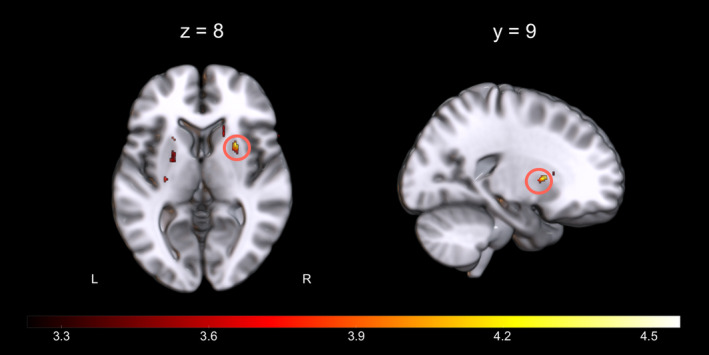
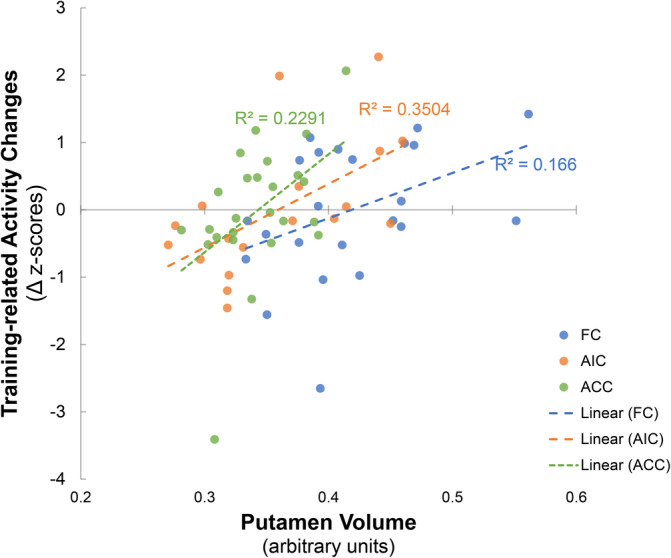
Real-time fMRI guided neurofeedback training has gained increasing interest as a noninvasive brain regulation technique with the potential to modulate functional brain alterations in therapeutic contexts. Individual variations in learning success and treatment response have been observed, yet the neural substrates underlying the learning of self-regulation remain unclear. Against this background, we explored potential brain structural predictors for learning success with pooled data from three real-time fMRI data sets. Our analysis revealed that gray matter volume of the right putamen could predict neurofeedback learning success across the three data sets (n = 66 in total). Importantly, the original studies employed different neurofeedback paradigms during which different brain regions were trained pointing to a general association with learning success independent of specific aspects of the experimental design. Given the role of the putamen in associative learning this finding may reflect an important role of instrumental learning processes and brain structural variations in associated brain regions for successful acquisition of fMRI neurofeedback-guided self-regulation.
实时功能磁共振成像引导的神经反馈训练作为一种非侵入性的大脑调节技术,具有在治疗环境中调节功能大脑改变的潜力,越来越受到关注。已经观察到学习成功和治疗反应的个体差异,但自我调节学习的神经基础仍不清楚。在此背景下,我们使用来自三个实时 fMRI 数据集的汇总数据,探讨了学习成功的潜在大脑结构预测因子。我们的分析表明,右侧壳核的灰质体积可以预测三个数据集(总共 66 名)的神经反馈学习成功。重要的是,原始研究在不同的神经反馈范式中使用了不同的大脑区域进行训练,这表明与学习成功相关,与实验设计的具体方面无关。鉴于壳核在联想学习中的作用,这一发现可能反映了工具学习过程和相关大脑区域的大脑结构变化在成功获得 fMRI 神经反馈引导的自我调节方面的重要作用。