Department of Biomedical Sciences, University of Padova, 35121 Padova, Italy.
Department of Molecular Biotechnology and Health Sciences, University of Torino, 10126 Torino, Italy.
Cells. 2021 Jan 3;10(1):61. doi: 10.3390/cells10010061.
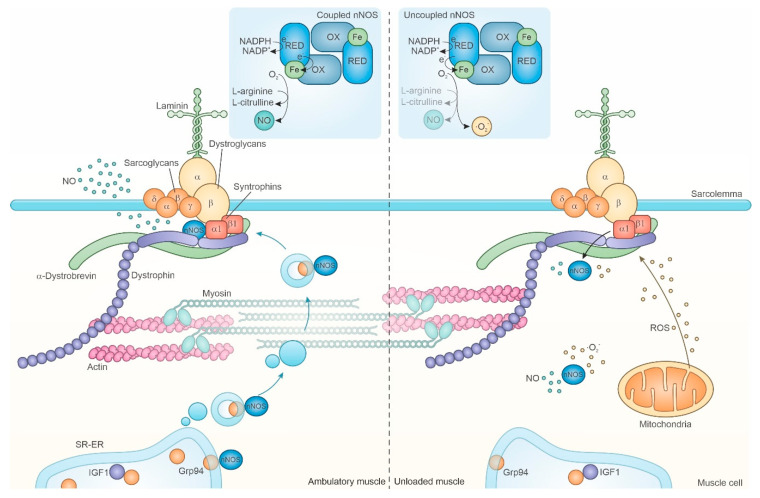
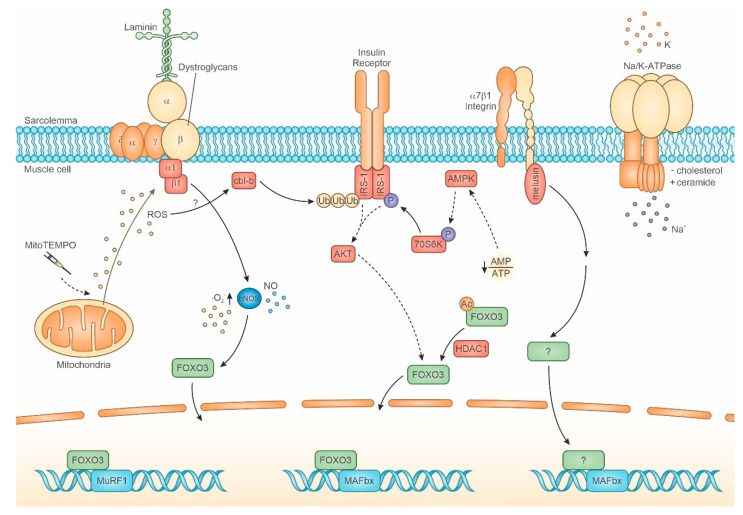
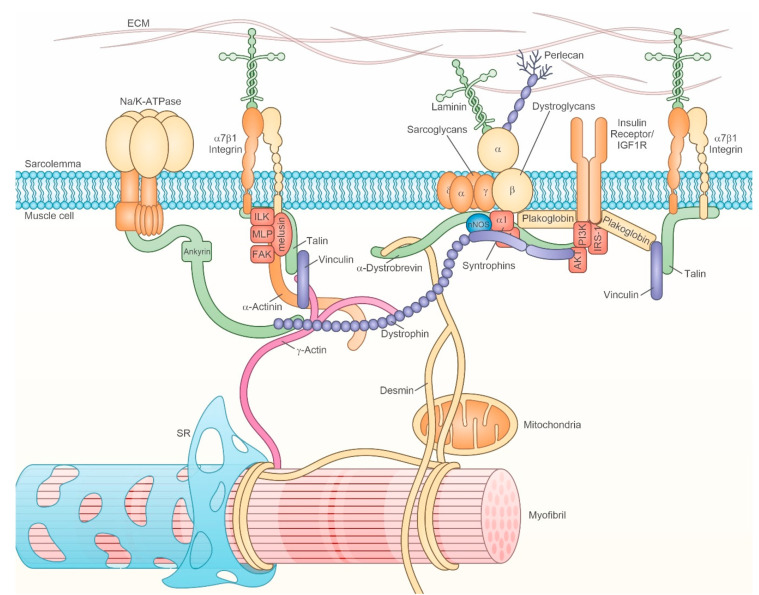
The loss of muscle mass and force characterizes muscle atrophy in several different conditions, which share the expression of atrogenes and the activation of their transcriptional regulators. However, attempts to antagonize muscle atrophy development in different experimental contexts by targeting contributors to the atrogene pathway showed partial effects in most cases. Other master regulators might independently contribute to muscle atrophy, as suggested by our recent evidence about the co-requirement of the muscle-specific chaperone protein melusin to inhibit unloading muscle atrophy development. Furthermore, melusin and other muscle mass regulators, such as nNOS, belong to costameres, the macromolecular complexes that connect sarcolemma to myofibrils and to the extracellular matrix, in correspondence with specific sarcomeric sites. Costameres sense a mechanical load and transduce it both as lateral force and biochemical signals. Recent evidence further broadens this classic view, by revealing the crucial participation of costameres in a sarcolemmal "signaling hub" integrating mechanical and humoral stimuli, where mechanical signals are coupled with insulin and/or insulin-like growth factor stimulation to regulate muscle mass. Therefore, this review aims to enucleate available evidence concerning the early involvement of costamere components and additional putative master regulators in the development of major types of muscle atrophy.
肌肉质量和力量的丧失是几种不同情况下的肌肉萎缩的特征,这些情况都有抗肌萎缩基因的表达和其转录调节剂的激活。然而,在不同的实验环境中,通过靶向抗肌萎缩基因途径的贡献者来拮抗肌肉萎缩的发展,大多数情况下只显示出部分效果。其他主要调节剂可能独立地促进肌肉萎缩,正如我们最近关于肌肉特异性伴侣蛋白梅尔苏林(melusin)抑制非负荷性肌肉萎缩发展的共同要求的证据所表明的那样。此外,梅尔苏林和其他肌肉质量调节剂,如 nNOS,属于肌节周围,这是将肌膜连接到肌原纤维和细胞外基质的大分子复合物,与特定的肌节部位相对应。肌节周围感知机械负荷,并将其转化为侧向力和生化信号。最近的证据进一步扩展了这一经典观点,揭示了肌节周围在整合机械和体液刺激的肌膜“信号枢纽”中至关重要的参与,其中机械信号与胰岛素和/或胰岛素样生长因子刺激相耦合,以调节肌肉质量。因此,本综述旨在阐明有关肌节周围成分和其他潜在主要调节剂在主要类型肌肉萎缩发展中的早期参与的现有证据。