Sports Performance Research Institute New Zealand (SPRINZ), Auckland University of Technology, 17 Antares Place, Rosedale, Auckland, 0632, New Zealand.
School of Physical Education, Sport and Exercise Sciences, University of Otago, 55/47 Union Street W, North Dunedin, Dunedin, 9016, New Zealand.
Eur J Appl Physiol. 2021 Apr;121(4):1061-1071. doi: 10.1007/s00421-020-04591-3. Epub 2021 Jan 11.
Cognition can be impaired during exercise in the heat, potentially contributing to military casualties. To our knowledge, the independent role of elevated core temperature during exercise has not been determined. The aim of the current study was to evaluate effects of elevated core temperature on cognition during physically encumbering, heated exercise, and to determine whether the perceptual cooling effects of menthol preserves cognition.
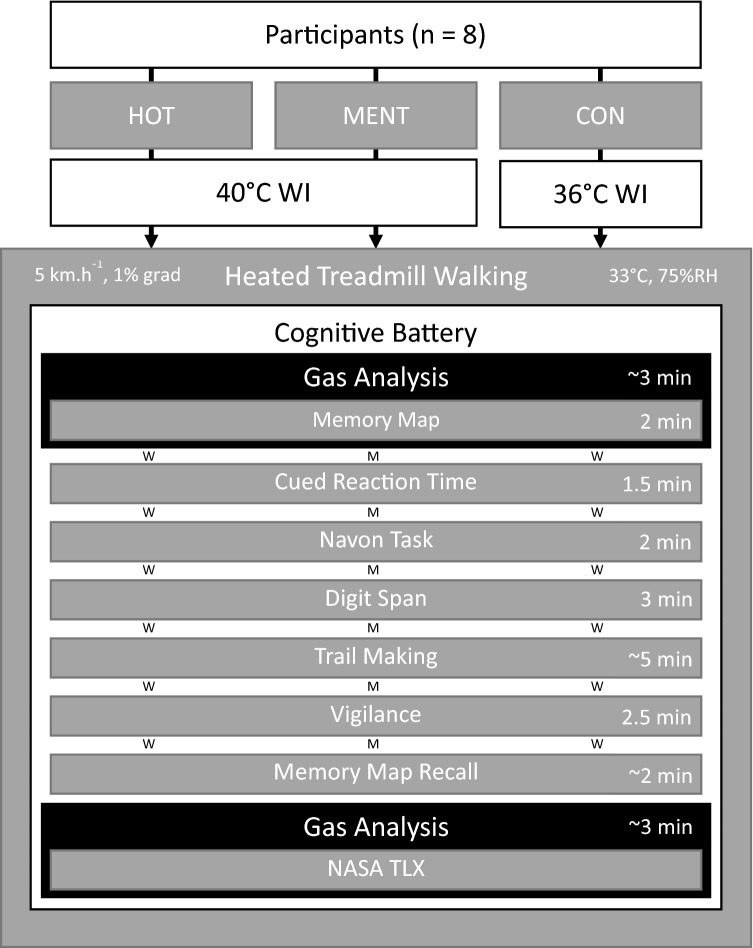
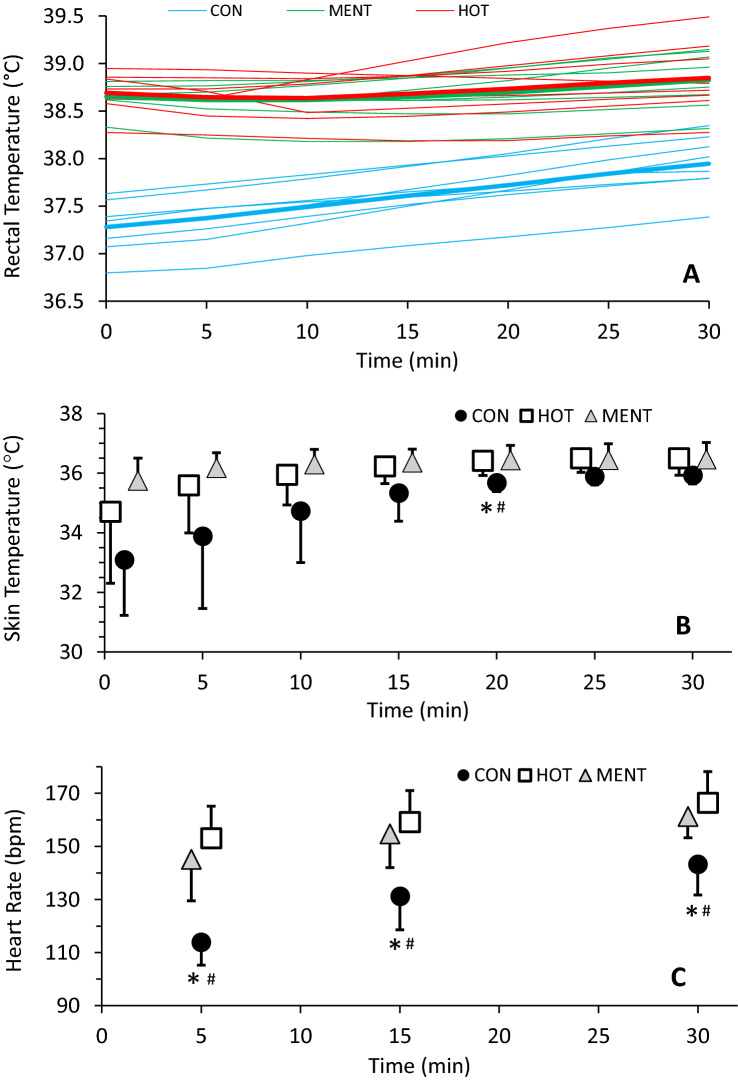
Eight participants complete three trials in randomised order: one normothermic (CON) and two with elevated (38.5°C) core temperature, induced by prior immersion in neutral versus hot water The CON trial and one hot trial (HOT) used a water mouth-rinse following each cognitive task of the trial, (HOT) while the other used a menthol mouth-rinse (MENT). Participants walked in humid heat (33°C, 75% relative humidity) in military clothing, completing a cognitive battery of reaction time, perceptual processing, working memory, executive function, cognitive flexibility, vigilance, and declarative memory.
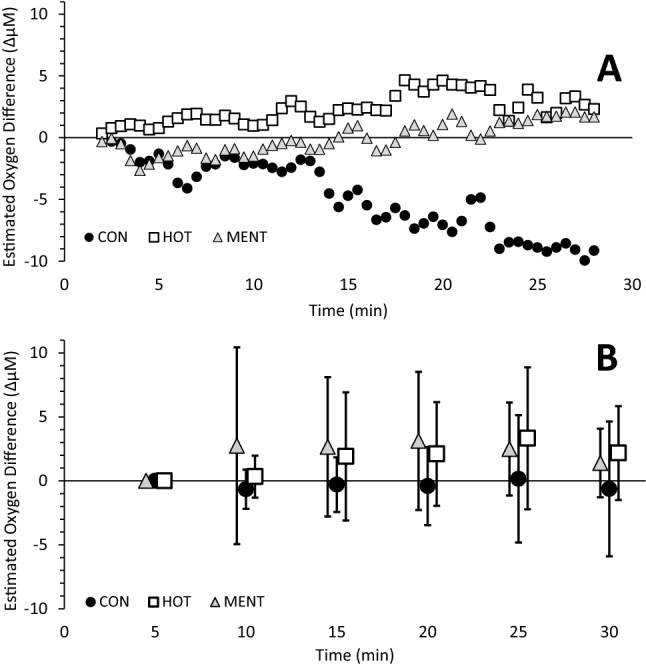
No differences in cognitive performance were observed between any conditions. Near-infrared spectroscopy showed greater oxygenated haemoglobin tissue content in HOT and MENT compared to CON (ΔOHb-deOHb: 2.3 ± 4.5 µM, p < .024), and lower deoxygenated haemoglobin in MENT than in CON or HOT (p = .017), suggesting higher brain metabolism during the more stressful conditions.
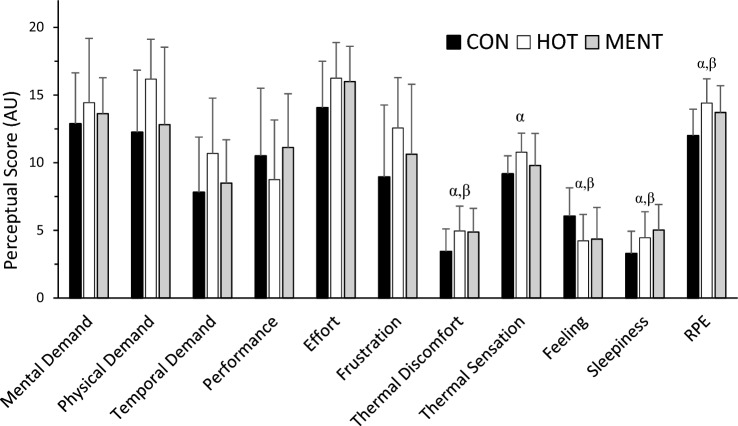
Moderately elevated core (38.5°C) and skin temperature does not appear to impair cognitive performance during exercise despite mildly elevated cerebral metabolism. The effects of menthol remain undetermined due to the lack of heat-mediated cognitive impairment.
在热环境下运动时认知能力可能会受到损害,这可能导致军事人员伤亡。据我们所知,运动期间核心温度升高对认知的独立作用尚未确定。本研究的目的是评估在身体负担加重、加热运动期间升高的核心温度对认知的影响,并确定薄荷醇的感知冷却作用是否能保持认知能力。
8 名参与者以随机顺序完成三项试验:一项常温(CON)和两项高温(38.5°C),分别通过中性和热水浸泡来诱导。CON 试验和一项热试验(HOT)在每次试验的认知任务后使用水漱口,而另一项使用薄荷醇漱口(MENT)。参与者穿着军用服装在湿热环境(33°C,75%相对湿度)中行走,完成反应时间、感知处理、工作记忆、执行功能、认知灵活性、警觉性和陈述性记忆的认知测试。
在任何条件下,认知表现均无差异。近红外光谱显示,与 CON 相比,HOT 和 MENT 条件下的氧合血红蛋白组织含量增加(ΔOHb-deOHb:2.3±4.5µM,p<.024),而 MENT 条件下的去氧血红蛋白含量低于 CON 或 HOT(p=.017),提示在更具应激性的条件下大脑代谢更高。
尽管大脑代谢略有升高,但中度升高的核心(38.5°C)和皮肤温度似乎不会在运动期间损害认知表现。由于缺乏热介导的认知障碍,薄荷醇的影响仍不确定。