Department of Mathematics, Faculty of Science, University of Split, Split, Croatia.
Department of Public Health, University of Split School of Medicine, Split, Croatia.
J Glob Health. 2020 Dec;10(2):020515. doi: 10.7189/jogh.10.020515. Epub 2020 Dec 30.
To compare different pooling methods in an attempt to improve the COVID-19 PCR diagnostic capacities.
We developed a novel information-dependent pooling protocol (), based on transmission of less informative sequential pools on to the next pooling cycle to maximize savings. We then compared it to the , , and protocols in a simulation study, across variety of scenarios.
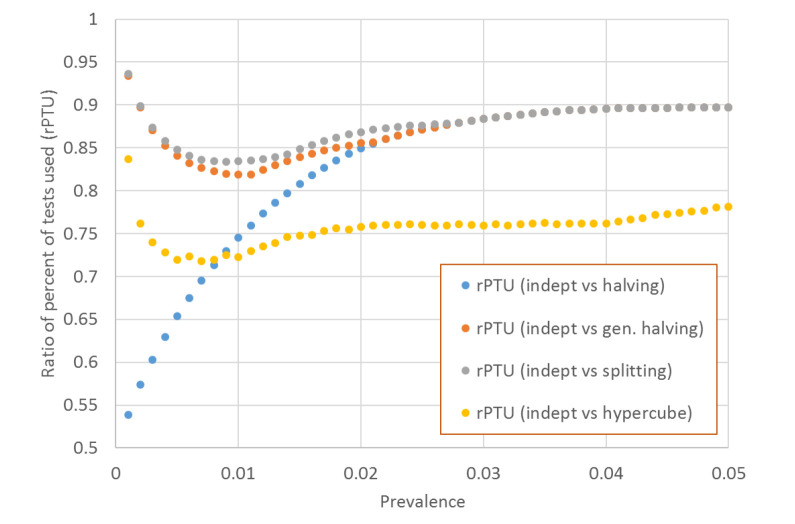
All five methods yielded various amount of test savings, which mostly depended on the virus prevalence in the population. In situations of low prevalence (up to 5%), had the best performance, requiring on average 20% of tests needed for singular testing across scenarios that were analyzed. Nevertheless, this comes at the expense of speed, with the worst-case scenario of protocol requiring up to twice the time needed to test the same number of samples in comparison to the protocol. In order to offset this, we developed a faster version of the protocol (), which minimizes the number of terminal pools and manages to retain savings compared to other protocols, despite marginally longer processing times.
The increasing demand for more testing globally can benefit from application of pooling, especially in resource-restrained situations of the low- and middle-income countries or situations of high testing demand. Singular testing in situations of low prevalence should be systematically discouraged.
比较不同的合并方法,以提高 COVID-19 PCR 诊断能力。
我们开发了一种新的基于信息的合并方案(),该方案基于将信息量较少的连续合并传输到下一个合并周期,以实现最大的节省。然后,我们在模拟研究中对其与、、和 方案进行了比较,涵盖了各种场景。
所有五种方法都产生了不同程度的测试节省,这主要取决于人群中病毒的流行率。在低流行率(高达 5%)的情况下,表现最佳,在分析的各种情况下,平均需要 20%的单次检测所需的测试。然而,这是以速度为代价的,最坏情况下的 方案需要比 方案测试相同数量的样本多两倍的时间。为了弥补这一点,我们开发了该方案的更快版本(),它最大限度地减少了终端池的数量,并设法保留了与其他方案相比的节省,尽管处理时间略有延长。
全球对更多检测的需求不断增加,可以受益于合并的应用,特别是在资源有限的中低收入国家或高检测需求的情况下。在低流行率的情况下,应系统地劝阻单独检测。