Emotion and Development Branch, National Institute of Mental Health, Bethesda, Maryland.
Emotion and Development Branch, National Institute of Mental Health, Bethesda, Maryland.
J Am Acad Child Adolesc Psychiatry. 2021 Dec;60(12):1513-1523. doi: 10.1016/j.jaac.2020.11.022. Epub 2021 Jan 10.
Irritability is a multifaceted construct in pediatric psychopathology. It has been conceptualized as having a phasic dimension and a tonic dimension. Disruptive mood dysregulation disorder is defined by the presence of both dimensions. Severe irritability, or disruptive mood dysregulation disorder, is highly comorbid with attention-deficit/hyperactivity disorder (ADHD). However, it is unknown whether the presence of ADHD modulates the expression of phasic and tonic irritability.
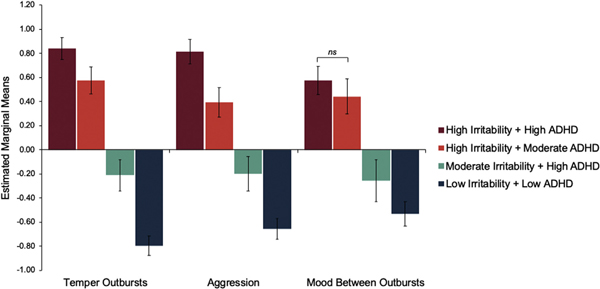
A data-driven, latent variable approach was used to examine irritability and ADHD symptoms in a transdiagnostic pediatric sample (N = 489) with primary disruptive mood dysregulation disorder, ADHD, subclinical irritability symptoms, or no diagnosis. Using latent profile analyses, we identified 4 classes: high levels of both irritability and ADHD symptoms, high levels of irritability and moderate levels of ADHD symptoms, moderate levels of irritability and high levels of ADHD symptoms, and low levels of both irritability and ADHD symptoms. Confirmatory factor analysis operationalized phasic irritability and tonic irritability.
As expected, the 2 latent classes characterized by high overall irritability exhibited the highest levels of both phasic and tonic irritability. However, between these 2 high irritability classes, highly comorbid ADHD symptoms were associated with significantly greater phasic irritability than were moderately comorbid ADHD symptoms. In contrast, the 2 high irritability groups did not differ on levels of tonic irritability.
These findings suggest that phasic, but not tonic, irritability has a significant association with ADHD symptoms and that phasic and tonic might be distinct, though highly related, irritability dimensions. Future research should investigate potential mechanisms underlying this differential association.
易激惹是儿科精神病理学中的一个多方面的概念。它被概念化为具有阶段性和紧张性两个维度。破坏性心境失调障碍的定义是同时存在这两个维度。严重的易激惹或破坏性心境失调障碍与注意力缺陷/多动障碍(ADHD)高度共病。然而,目前尚不清楚 ADHD 的存在是否会调节阶段性和紧张性易激惹的表达。
使用数据驱动的潜在变量方法,对患有原发性破坏性心境失调障碍、ADHD、亚临床易激惹症状或无诊断的共患儿科样本(N=489)进行易激惹和 ADHD 症状的研究。使用潜在剖面分析,我们确定了 4 个类别:易激惹和 ADHD 症状水平均高、易激惹水平高但 ADHD 症状水平中等、ADHD 症状水平高但易激惹水平中等、易激惹和 ADHD 症状水平均低。验证性因子分析将阶段性易激惹和紧张性易激惹进行了操作化。
正如预期的那样,以总体易激惹水平高为特征的两个潜在类别表现出最高水平的阶段性和紧张性易激惹。然而,在这两个高易激惹类别之间,高度共患 ADHD 症状与明显更高的阶段性易激惹相关,而中度共患 ADHD 症状则与之不同。相比之下,这两个高易激惹组在紧张性易激惹水平上没有差异。
这些发现表明,阶段性而非紧张性易激惹与 ADHD 症状有显著关联,并且阶段性和紧张性可能是不同的,但高度相关的易激惹维度。未来的研究应该调查这种差异关联的潜在机制。