Department of Plastic and Reconstructive Surgery Research, Wake Forest School of Medicine, Winston Salem, NC, USA.
Virginia Tech-Wake Forest School of Biomedical Engineering and Sciences, Wake Forest School of Medicine, Medical Center Boulevard, Winston-Salem, NC, USA.
Sci Rep. 2021 Jan 15;11(1):1532. doi: 10.1038/s41598-021-81122-w.
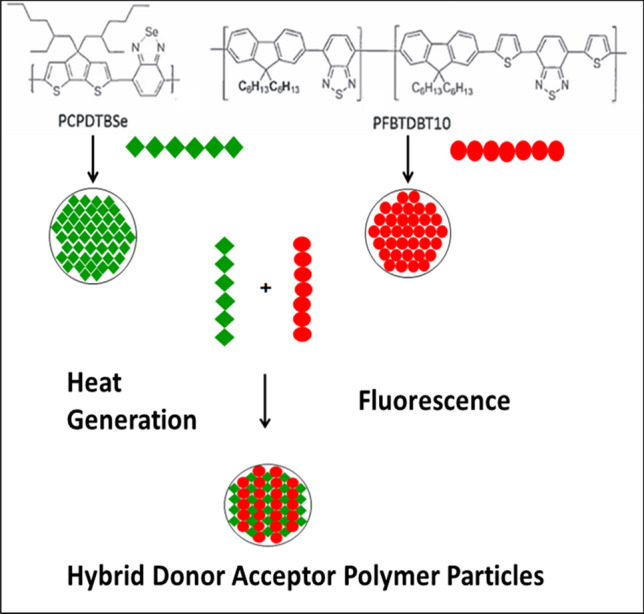
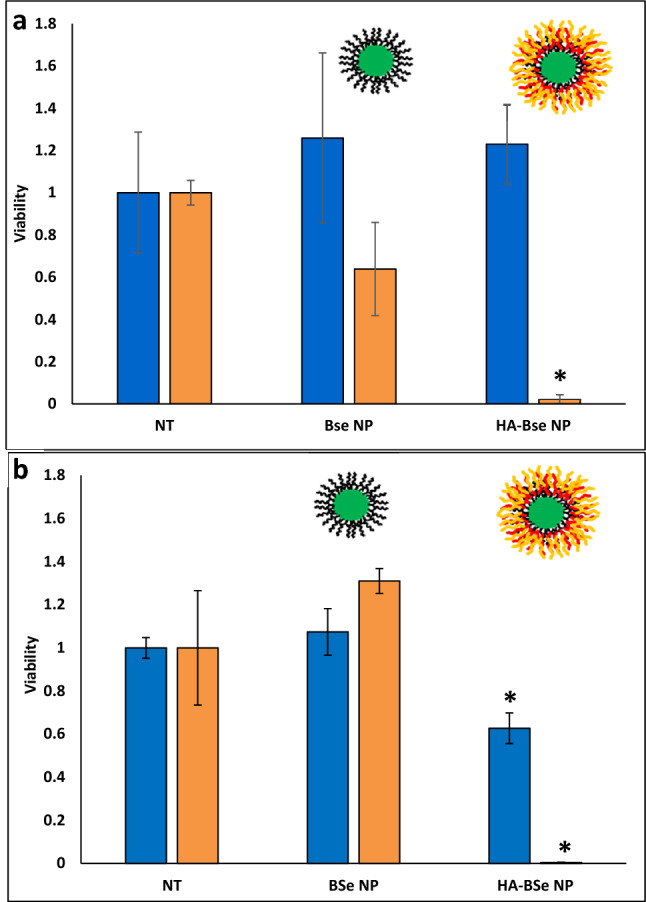
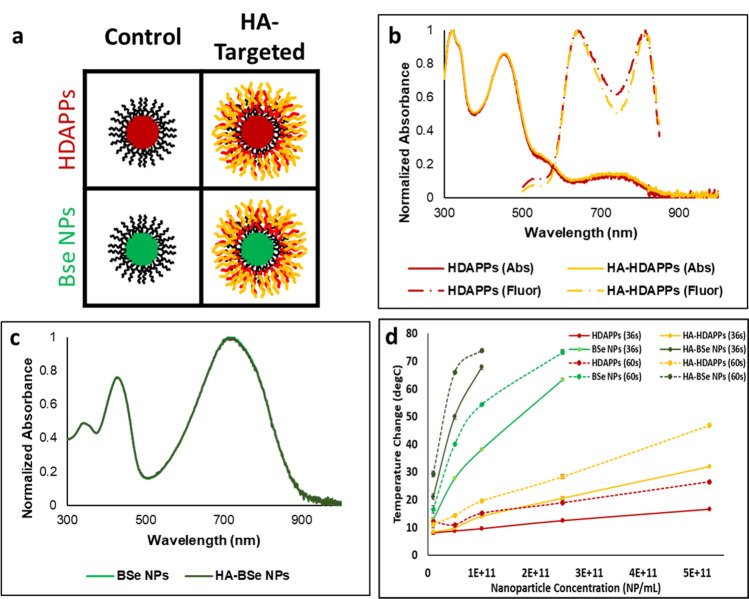
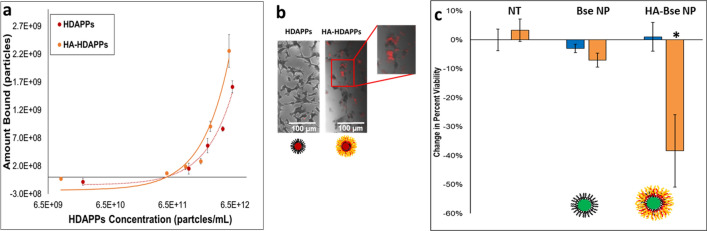
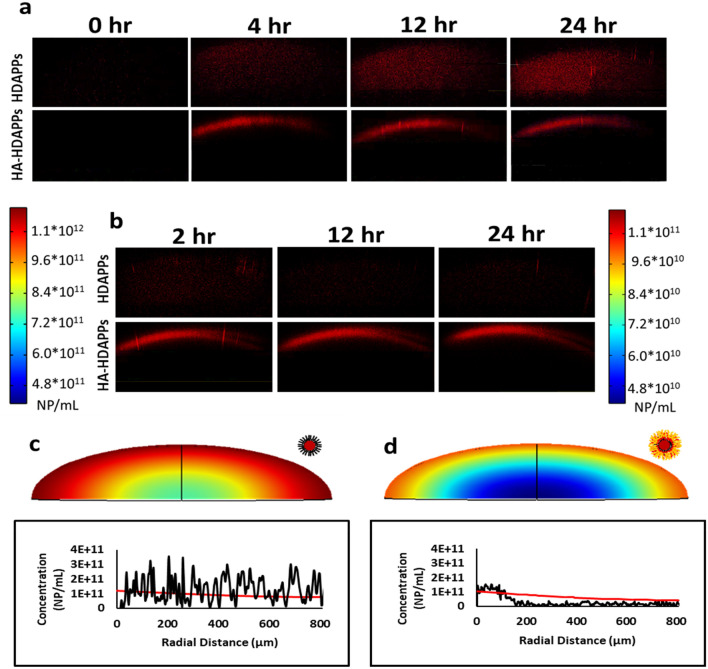
Colorectal cancer (CRC) treatment is currently hindered by micrometastatic relapse that cannot be removed completely during surgery and is often chemotherapy resistant. Targeted theranostic nanoparticles (NPs) that can produce heat for ablation and enable tumor visualization via their fluorescence offer advantages for detection and treatment of disseminated small nodules. A major hurdle in clinical translation of nanoparticles is their interaction with the 3D tumor microenvironment. To address this problem tumor organoid technology was used to evaluate the ablative potential of CD44-targeted polymer nanoparticles using hyaluronic acid (HA) as the targeting agent and coating it onto hybrid donor acceptor polymer particles (HDAPPs) to form HA-HDAPPs. Additionally, nanoparticles composed from only the photothermal polymer, poly[4,4-bis(2-ethylhexyl)-cyclopenta[2,1-b;3,4-b']dithiophene-2,6-diyl-alt-2,1,3-benzoselenadiazole-4,7-diyl] (PCPDTBSe), were also coated with HA, to form HA-BSe NPs, and evaluated in 3D. Monitoring of nanoparticle transport in 3D organoids revealed uniform diffusion of non-targeted HDAPPs in comparison to attenuated diffusion of HA-HDAPPs due to nanoparticle-matrix interactions. Computational diffusion profiles suggested that HA-HDAPPs transport may not be accounted for by diffusion alone, which is indicative of nanoparticle/cell matrix interactions. Photothermal activation revealed that only HA-BSe NPs were able to significantly reduce tumor cell viability in the organoids. Despite limited transport of the CD44-targeted theranostic nanoparticles, their targeted retention provides increased heat for enhanced photothermal ablation in 3D, which is beneficial for assessing nanoparticle therapies prior to in vivo testing.
结直肠癌 (CRC) 的治疗目前受到手术中无法完全清除的微转移复发和经常发生的化疗耐药的阻碍。能够产生热量用于消融并通过荧光实现肿瘤可视化的靶向治疗纳米粒子 (NPs) 为检测和治疗弥散性小结节提供了优势。纳米粒子临床转化的一个主要障碍是它们与 3D 肿瘤微环境的相互作用。为了解决这个问题,使用肿瘤类器官技术来评估 CD44 靶向聚合物纳米粒子的消融潜力,使用透明质酸 (HA) 作为靶向剂并将其涂覆到杂化给体-受体聚合物粒子 (HDAPPs) 上形成 HA-HDAPPs。此外,仅由光热聚合物聚[4,4-双(2-乙基己基)环戊[2,1-b;3,4-b']二噻吩-2,6-二基-alt-2,1,3-苯并硒二唑-4,7-二基] (PCPDTBSe) 组成的纳米粒子也被涂覆有 HA,形成 HA-BSe NPs,并在 3D 中进行评估。在 3D 类器官中监测纳米粒子的转运显示,与由于纳米粒子-基质相互作用导致的 HA-HDAPPs 扩散减弱相比,非靶向 HDAPPs 的扩散均匀。计算扩散曲线表明,HA-HDAPPs 的运输可能不仅仅是扩散,这表明纳米粒子/细胞基质相互作用。光热激活表明,只有 HA-BSe NPs 能够显著降低类器官中的肿瘤细胞活力。尽管 CD44 靶向治疗纳米粒子的转运有限,但它们的靶向保留提供了增加的热量,以增强 3D 中的光热消融,这有利于在体内测试之前评估纳米粒子疗法。