Yue Tao, Zhao Da, Phan Duc T T, Wang Xiaolin, Park Joshua Jonghyun, Biviji Zayn, Hughes Christopher C W, Lee Abraham P
Department of Biomedical Engineering, University of California, Irvine, CA USA.
School of Mechatronic Engineering and Automation, Shanghai University, Shanghai, China.
Microsyst Nanoeng. 2021 Jan 6;7:4. doi: 10.1038/s41378-020-00229-8. eCollection 2021.
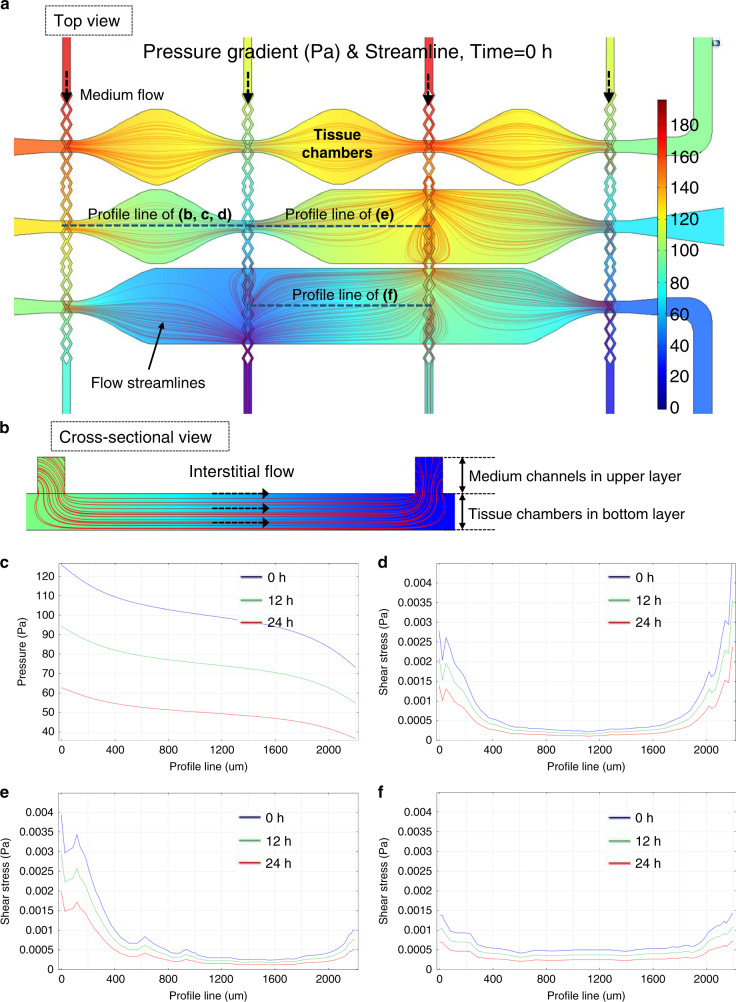
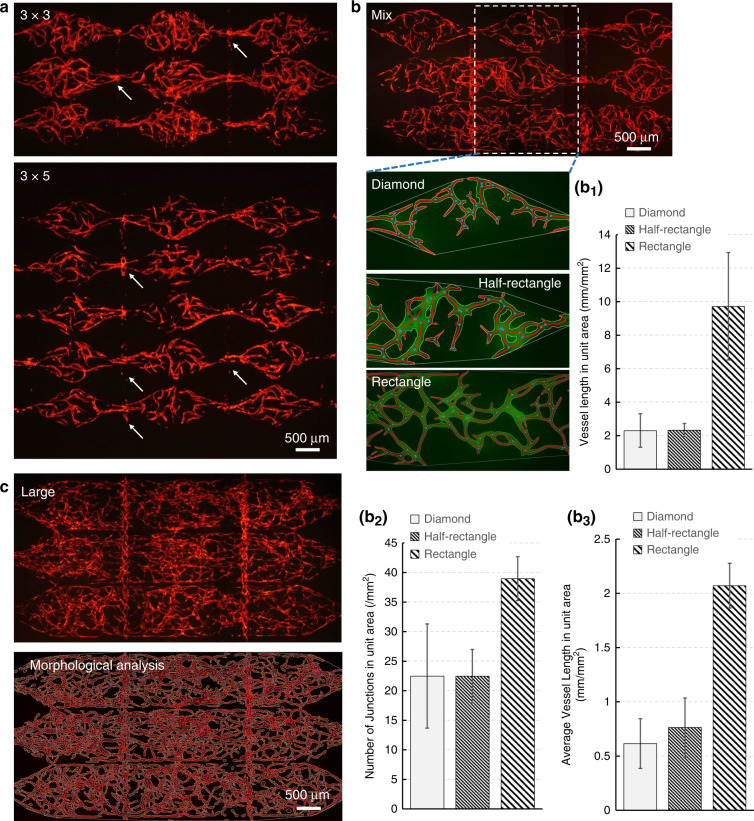
The vascular network of the circulatory system plays a vital role in maintaining homeostasis in the human body. In this paper, a novel modular microfluidic system with a vertical two-layered configuration is developed to generate large-scale perfused microvascular networks in vitro. The two-layer polydimethylsiloxane (PDMS) configuration allows the tissue chambers and medium channels not only to be designed and fabricated independently but also to be aligned and bonded accordingly. This method can produce a modular microfluidic system that has high flexibility and scalability to design an integrated platform with multiple perfused vascularized tissues with high densities. The medium channel was designed with a rhombic shape and fabricated to be semiclosed to form a capillary burst valve in the vertical direction, serving as the interface between the medium channels and tissue chambers. Angiogenesis and anastomosis at the vertical interface were successfully achieved by using different combinations of tissue chambers and medium channels. Various large-scale microvascular networks were generated and quantified in terms of vessel length and density. Minimal leakage of the perfused 70-kDa FITC-dextran confirmed the lumenization of the microvascular networks and the formation of tight vertical interconnections between the microvascular networks and medium channels in different structural layers. This platform enables the culturing of interconnected, large-scale perfused vascularized tissue networks with high density and scalability for a wide range of multiorgan-on-a-chip applications, including basic biological studies and drug screening.
循环系统的血管网络在维持人体稳态中起着至关重要的作用。在本文中,开发了一种具有垂直双层结构的新型模块化微流控系统,以在体外生成大规模灌注微血管网络。双层聚二甲基硅氧烷(PDMS)结构不仅允许组织腔室和培养基通道独立设计和制造,还能相应地对齐和键合。这种方法可以生产一种模块化微流控系统,该系统具有高度的灵活性和可扩展性,能够设计一个集成平台,用于高密度的多个灌注血管化组织。培养基通道设计为菱形,并制造成半封闭状态,以在垂直方向形成毛细血管破裂阀,作为培养基通道和组织腔室之间的界面。通过使用不同组合的组织腔室和培养基通道,成功实现了垂直界面处的血管生成和吻合。生成了各种大规模微血管网络,并根据血管长度和密度进行了量化。灌注的70 kDa FITC - 葡聚糖的最小泄漏证实了微血管网络的管腔化以及不同结构层中微血管网络与培养基通道之间紧密垂直互连的形成。该平台能够培养相互连接、大规模、灌注的高密度血管化组织网络,并具有广泛的可扩展性,适用于包括基础生物学研究和药物筛选在内的多种多器官芯片应用。