Gobbo Stefano, Bullo Valentina, Roma Enrico, Duregon Federica, Bocalini Danilo Sales, Rica Roberta Luksevicius, Di Blasio Andrea, Cugusi Lucia, Vendramin Barbara, Bergamo Manuele, Cruz-Diaz David, Alberton Cristine Lima, Ermolao Andrea, Bergamin Marco
Sport and Exercise Medicine Division, Department of Medicine, University of Padova, Via Giustiniani, 2, 35128 Padova, Italy.
Laboratorio de Fisiologia e Bioquimica Experimental, Centro de Educacao Fisica e Deportos, Universidade Federal do Espirito Santo (UFES), Vitoria, ES, Rua Vergueiro, 235, Liberdade, Sao Paulo, SP 01504-00, Brazil.
J Funct Morphol Kinesiol. 2019 Jun 18;4(2):36. doi: 10.3390/jfmk4020036.
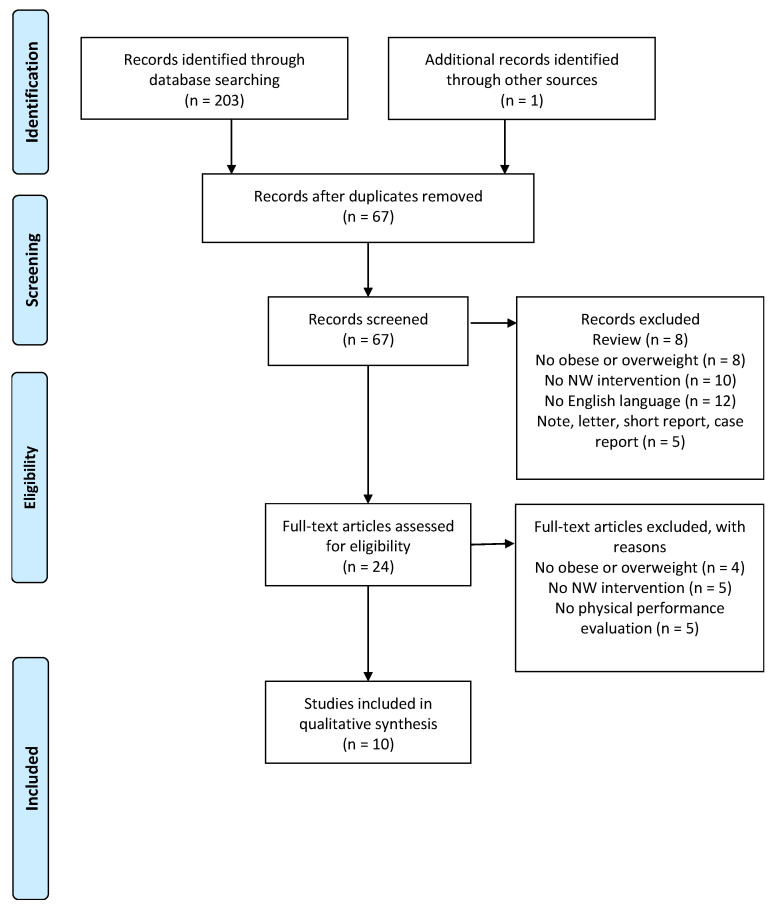
The aim of this systematic review was to analyze the effect of Nordic Walking (NW) on anthropometric parameters, body composition, cardiovascular parameters, aerobic capacity, blood sample, and glucose tolerance in overweight and obese subjects. The main keywords "Nordic Walking" or "Pole Walking", associated with either "obese", "obesity", "overweight", or "weight loss" were used on the online database MEDLINE, PubMed, SPORTDiscus and Scopus. Additionally, references of the studies included were screened to identify eligible articles. Applying the inclusion and exclusion criteria, ten manuscripts were considered as eligible for this review. The results of the studies were categorized in several domains with regard to "anthropometric parameters and body composition", "cardiovascular parameters and aerobic capacity", and "blood sample and glucose tolerance". The results showed positive effects on the anthropometric parameters, body composition, cardiovascular parameters, blood sample, and glucose tolerance. The greatest improvements were observed in supervised and high weekly frequency of NW interventions. NW could be considered as an effective modality through which to involve the obese in physical activity. For weight loss, NW should be prescribed 4-5 times per week, at least 60 min per session, preferably combined with diet control.
本系统评价的目的是分析越野行走(NW)对超重和肥胖受试者的人体测量参数、身体成分、心血管参数、有氧能力、血液样本及葡萄糖耐量的影响。在在线数据库MEDLINE、PubMed、SPORTDiscus和Scopus上使用了主要关键词“越野行走”或“持杖行走”,并与“肥胖”“肥胖症”“超重”或“体重减轻”相关联。此外,对纳入研究的参考文献进行筛选以确定符合条件的文章。应用纳入和排除标准,十篇手稿被认为符合本评价的要求。研究结果在“人体测量参数和身体成分”“心血管参数和有氧能力”以及“血液样本和葡萄糖耐量”等几个领域进行了分类。结果显示,越野行走对人体测量参数、身体成分、心血管参数、血液样本和葡萄糖耐量有积极影响。在有监督且每周越野行走干预频率较高的情况下观察到了最大的改善。越野行走可被视为一种让肥胖者参与体育活动的有效方式。对于减肥而言,应每周进行4 - 5次越野行走,每次至少60分钟,最好结合饮食控制。