Scottish Photobiology Service, Photobiology Unit, NHS Tayside, Ninewells Hospital and Medical School, Dundee, UK.
SUPA, School of Physics & Astronomy, University of St Andrews, St Andrews, UK.
Photochem Photobiol. 2021 May;97(3):527-531. doi: 10.1111/php.13385. Epub 2021 Feb 3.
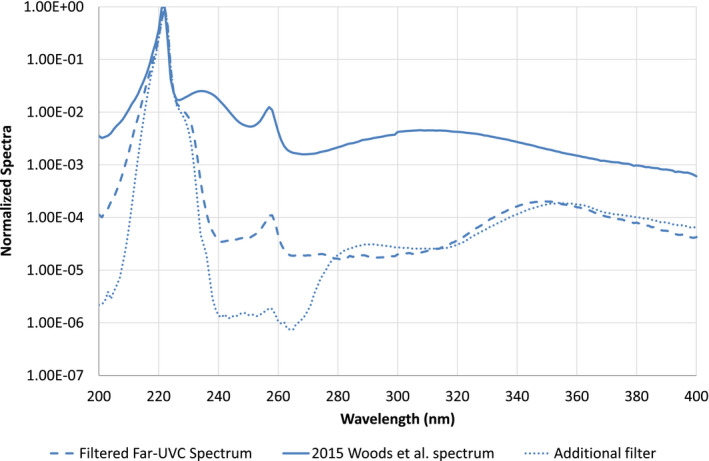
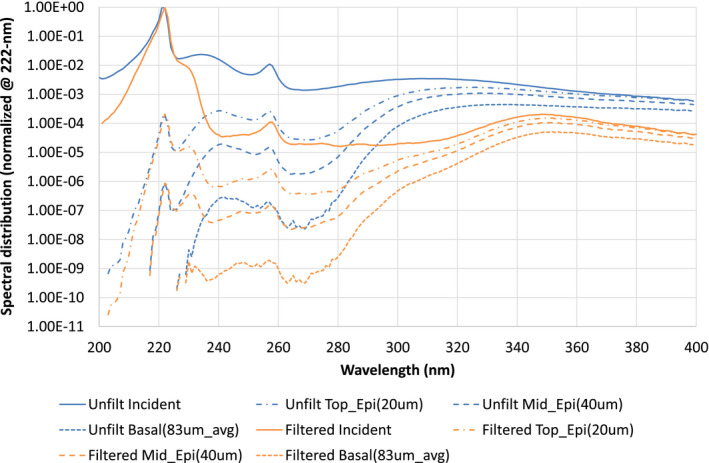
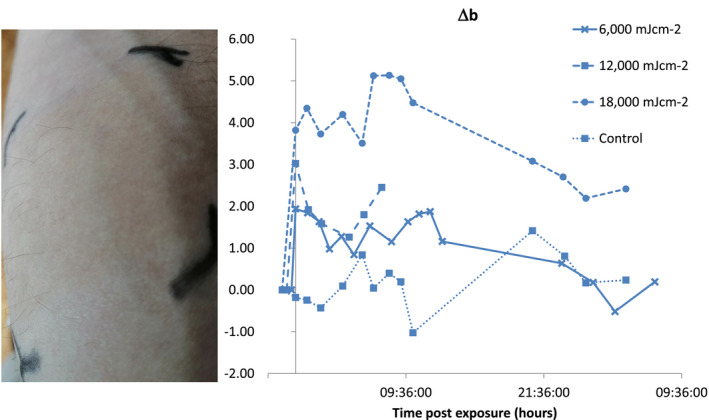
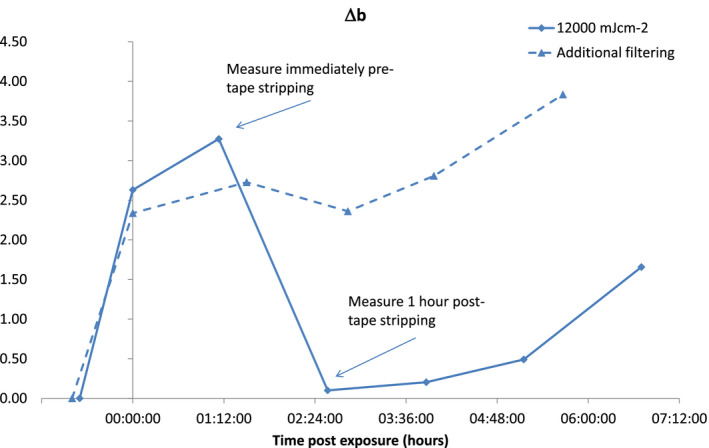
Far-UVC devices are being commercially sold as "safe for humans" for the inactivation of SARS-CoV-2, without supporting human safety data. We felt there was a need for rapid proof-of-concept human self-exposure, to inform future controlled research and promote informed discussion. A Fitzpatrick Skin Type II individual exposed their inner forearms to large radiant exposures from a filtered Krypton-Chloride (KrCl) far-UVC system (SafeZoneUVC, Ushio Inc., Tokyo, Japan) with peak emission at 222 nm. No visible skin changes were observed at 1500 mJ cm ; whereas, skin yellowing that appeared immediately and resolved within 24 h occurred with a 6000 mJ cm exposure. No erythema was observed at any time point with exposures up to 18 000 mJ cm . These results combined with Monte Carlo Radiative Transfer computer modeling suggest that filtering longer ultraviolet wavelengths is critical for the human skin safety of far-UVC devices. This work also contributes to growing arguments for the exploration of exposure limit expansion, which would subsequently enable faster inactivation of viruses.
远紫外线 C 设备被商业宣传为可安全灭活 SARS-CoV-2,但没有提供支持人体安全性的数据。我们认为有必要迅速进行人体自我暴露的概念验证,为未来的对照研究提供信息,并促进知情讨论。一名 Fitzpatrick II 型个体将其前臂内侧暴露于经过滤的氪-氯(KrCl)远紫外线 C 系统(SafeZoneUVC,Ushio Inc.,东京,日本)的大辐射暴露下,峰值发射波长为 222nm。在 1500mJ/cm 时没有观察到可见的皮肤变化;而在 6000mJ/cm 时则立即出现皮肤发黄,24 小时内消退。在高达 18000mJ/cm 的暴露下,任何时间点均未观察到红斑。这些结果结合蒙特卡罗辐射传输计算机建模表明,过滤更长的紫外线波长对于远紫外线 C 设备的人体皮肤安全至关重要。这项工作也为探索暴露限值扩展提供了依据,这将使病毒更快灭活成为可能。