MRC Cognition and Brain Sciences Unit, University of Cambridge, United Kingdom.
MRC Cognition and Brain Sciences Unit, University of Cambridge, United Kingdom; Department of Psychiatry, University of Cambridge, United Kingdom.
Neurobiol Learn Mem. 2021 Mar;179:107382. doi: 10.1016/j.nlm.2021.107382. Epub 2021 Jan 18.
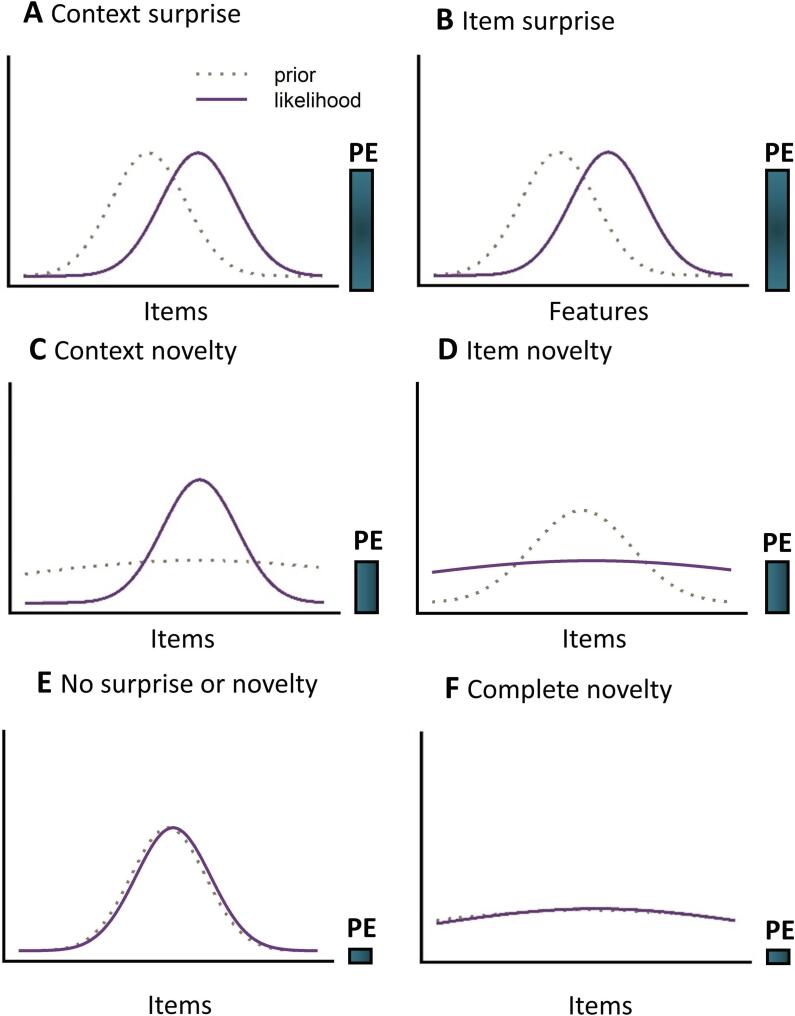
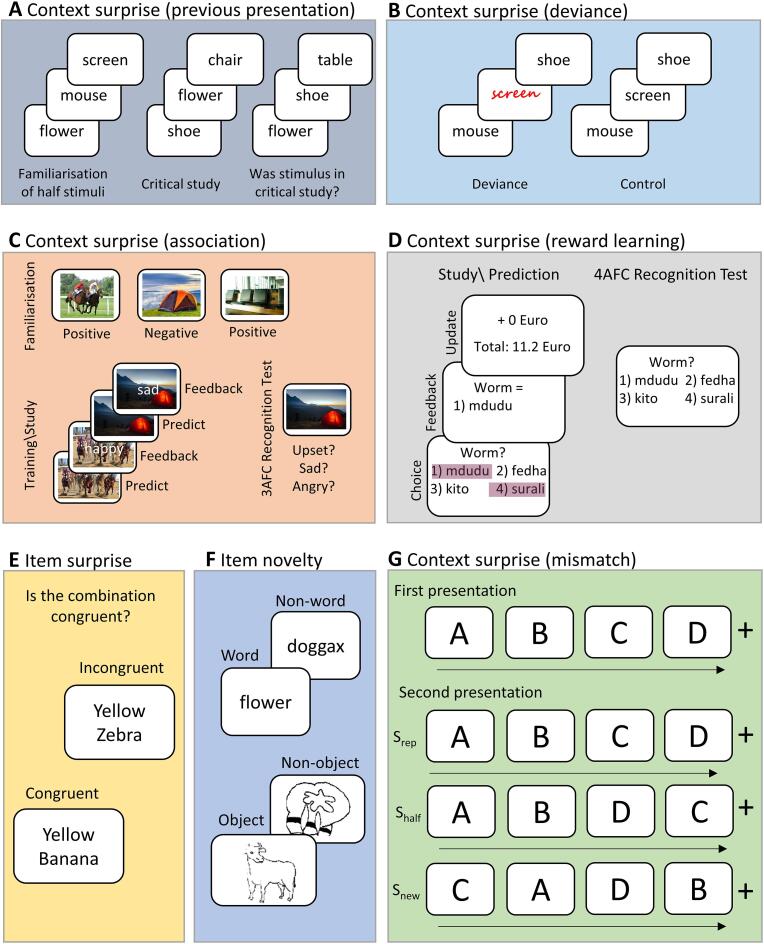
A rich body of studies in the human and non-human literature has examined the question how novelty influences memory. For a variety of different stimuli, ranging from simple objects and words to vastly complex scenarios, the literature reports that novelty improves memory in some cases, but impairs memory in other cases. In recent attempts to reconcile these conflicting findings, novelty has been divided into different subtypes, such as relative versus absolute novelty, or stimulus versus contextual novelty. Nevertheless, a single overarching theory of novelty and memory has been difficult to attain, probably due to the complexities in the interactions among stimuli, environmental factors (e.g., spatial and temporal context) and level of prior knowledge (but see Duszkiewicz et al., 2019; Kafkas & Montaldi, 2018b; Schomaker & Meeter, 2015). Here we describe how a predictive coding framework might be able to shed new light on different types of novelty and how they affect declarative memory in humans. More precisely, we consider how prior expectations modulate the influence of novelty on encoding episodes into memory, e.g., in terms of surprise, and how novelty/surprise affect memory for surrounding information. By reviewing a range of behavioural findings and their possible underlying neurobiological mechanisms, we highlight where a predictive coding framework succeeds and where it appears to struggle.
大量的人类和非人类文献研究都探讨了新颖性如何影响记忆的问题。对于各种不同的刺激,从简单的物体和单词到非常复杂的场景,文献报告说新颖性在某些情况下可以改善记忆,但在其他情况下则会损害记忆。最近,人们试图调和这些相互矛盾的发现,将新颖性分为不同的亚型,例如相对新颖性和绝对新颖性,或者刺激新颖性和情境新颖性。然而,由于刺激、环境因素(例如空间和时间背景)和先前知识水平之间的相互作用的复杂性,很难形成一个单一的新颖性和记忆的总体理论(但请参见 Duszkiewicz 等人,2019;Kafkas 和 Montaldi,2018b;Schomaker 和 Meeter,2015)。在这里,我们描述了预测编码框架如何能够为不同类型的新颖性及其如何影响人类的陈述性记忆提供新的视角。更确切地说,我们考虑了先前的期望如何调节新颖性对将编码事件纳入记忆的影响,例如在惊讶方面,以及新颖性/惊讶如何影响周围信息的记忆。通过回顾一系列行为发现及其可能的潜在神经生物学机制,我们强调了预测编码框架在哪些方面成功,以及在哪些方面似乎存在困难。