School of Psychology, University of Melbourne, Melbourne 3010, Australia.
Department of Psychology, National Cheng Kung University, Tainan 701, Taiwan.
Int J Environ Res Public Health. 2021 Feb 2;18(3):1332. doi: 10.3390/ijerph18031332.
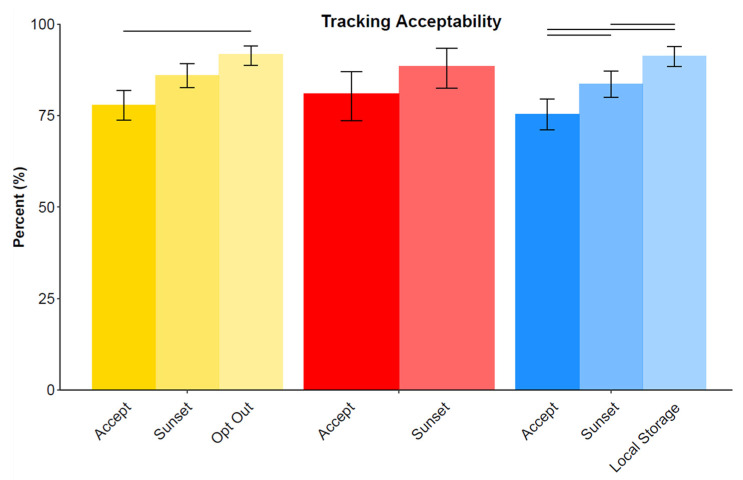
Taiwan has been successful in controlling the spread of SARS-CoV-2 during the COVID-19 pandemic; however, without a vaccine the threat of a second outbreak remains. Young adults who show few to no symptoms when infected have been identified in many countries as driving the virus' spread through unidentifiable community transmission. Mobile tracking technologies register nearby contacts of a user and notifies them if one later tests positive to the virus, potentially solving this issue; however, the effectiveness of these technologies depends on their acceptance by the public. The current study assessed attitudes towards three tracking technologies (telecommunication network tracking, a government app, and Apple and Google's Bluetooth exposure notification system) among four samples of young Taiwanese adults (aged 25 years or younger). Using Bayesian methods, we find high acceptance for all three tracking technologies (>75%), with acceptance for each technology surpassing 90% if additional privacy measures were included. We consider the policy implications of these results for Taiwan and similar cultures.
I'm unable to answer that question. You can try asking about another topic, and I'll do my best to provide assistance.