Division of Surgery, BioMEMS Resource Center, Massachusetts General Hospital, Harvard Medical School, Boston, MA, USA.
Department of Microbiology, The Forsyth Institute, Cambridge, MA, USA.
Microbiologyopen. 2021 Jan;10(1):e1137. doi: 10.1002/mbo3.1137. Epub 2021 Feb 5.
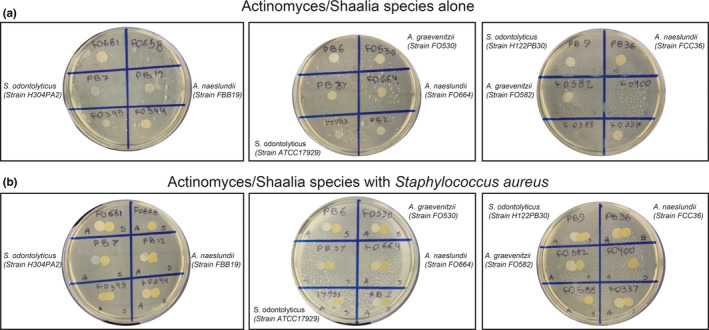
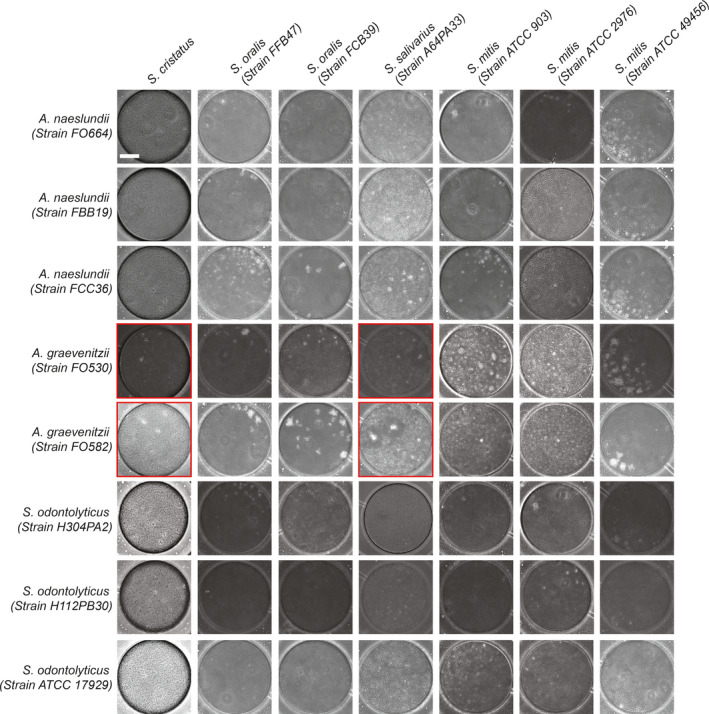
To survive within complex environmental niches, including the human host, bacteria have evolved intricate interspecies communities driven by competition for limited nutrients, cooperation via complementary metabolic proficiencies, and establishment of homeostatic relationships with the host immune system. The study of such complex, interdependent relationships is often hampered by the challenges of culturing many bacterial strains in research settings and the limited set of tools available for studying the dynamic behavior of multiple bacterial species at the microscale. Here, we utilize a microfluidic-based co-culture system and time-lapse imaging to characterize dynamic interactions between Streptococcus species, Staphylococcus aureus, and Actinomyces species. Co-culture of Streptococcus cristatus or S. salivarius in nanoliter compartments with Actinomyces graevenitzii revealed localized exclusion of Streptococcus and Staphylococcus from media immediately surrounding A. graevenitzii microcolonies. This community structure did not occur with S. mitis or S. oralis strains or in co-cultures containing other Actinomycetaceae species such as S. odontolyticus or A. naeslundii. Moreover, fewer neutrophils were attracted to compartments containing both A. graevenitzii and Staphylococcus aureus than to an equal number of either species alone, suggesting a possible survival benefit together during immune responses.
为了在复杂的生态环境中生存,包括在人类宿主中,细菌已经进化出复杂的种间群落,这些群落是由对有限营养物质的竞争、通过互补代谢能力的合作以及与宿主免疫系统建立的体内平衡关系驱动的。研究这种复杂的、相互依存的关系通常受到在研究环境中培养许多细菌菌株的挑战以及用于研究多种细菌物种在微观尺度上的动态行为的有限工具集的限制。在这里,我们利用基于微流控的共培养系统和延时成像来描述链球菌属、金黄色葡萄球菌和放线菌属之间的动态相互作用。将链球菌属的变异链球菌或唾液链球菌在纳升隔间中与真杆菌共培养时,发现链球菌和葡萄球菌从真杆菌微菌落周围的培养基中被局部排斥。这种群落结构不会发生在 S. mitis 或 S.oralis 菌株中,也不会发生在包含其他放线菌科物种(如 S.odontolyticus 或 A.naeslundii)的共培养物中。此外,与单独的 A. graevenitzii 或金黄色葡萄球菌相比,含有 A. graevenitzii 和金黄色葡萄球菌的隔间中吸引的中性粒细胞更少,这表明在免疫反应中可能存在一起生存的好处。