• 文献检索
  • 文档翻译
  • 深度研究
  • 学术资讯
  • Suppr Zotero 插件Zotero 插件
  • 邀请有礼
  • 套餐&价格
  • 历史记录
应用&插件
Suppr Zotero 插件Zotero 插件浏览器插件Mac 客户端Windows 客户端微信小程序
定价
高级版会员购买积分包购买API积分包
服务
文献检索文档翻译深度研究API 文档MCP 服务
关于我们
关于 Suppr公司介绍联系我们用户协议隐私条款
关注我们

Suppr 超能文献

核心技术专利:CN118964589B侵权必究
粤ICP备2023148730 号-1Suppr @ 2026

文献检索

告别复杂PubMed语法,用中文像聊天一样搜索,搜遍4000万医学文献。AI智能推荐,让科研检索更轻松。

立即免费搜索

文件翻译

保留排版,准确专业,支持PDF/Word/PPT等文件格式,支持 12+语言互译。

免费翻译文档

深度研究

AI帮你快速写综述,25分钟生成高质量综述,智能提取关键信息,辅助科研写作。

立即免费体验

佩戴最少数量的可穿戴传感器收集到的帕金森病患者的加速计数据。

Accelerometer data collected with a minimum set of wearable sensors from subjects with Parkinson's disease.

机构信息

Department of Physical Medicine and Rehabilitation, Harvard Medical School, Spaulding Rehabilitation Hospital, Boston, Massachusetts, USA.

Department of Rehabilitation and Movement Sciences, Rutgers University, Newark, New Jersey, USA.

出版信息

Sci Data. 2021 Feb 5;8(1):48. doi: 10.1038/s41597-021-00830-0.

DOI:10.1038/s41597-021-00830-0
PMID:33547309
原文链接:https://pmc.ncbi.nlm.nih.gov/articles/PMC7865022/
Abstract

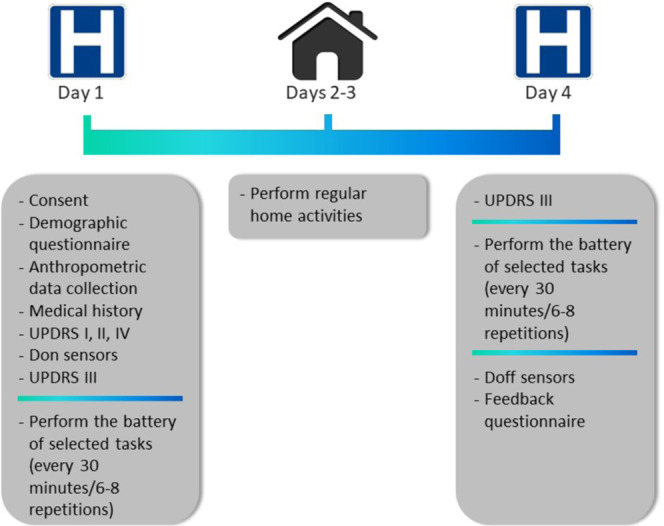
Parkinson's disease (PD) is a neurodegenerative disorder associated with motor and non-motor symptoms. Current treatments primarily focus on managing motor symptom severity such as tremor, bradykinesia, and rigidity. However, as the disease progresses, treatment side-effects can emerge such as on/off periods and dyskinesia. The objective of the Levodopa Response Study was to identify whether wearable sensor data can be used to objectively quantify symptom severity in individuals with PD exhibiting motor fluctuations. Thirty-one subjects with PD were recruited from 2 sites to participate in a 4-day study. Data was collected using 2 wrist-worn accelerometers and a waist-worn smartphone. During Days 1 and 4, a portion of the data was collected in the laboratory while subjects performed a battery of motor tasks as clinicians rated symptom severity. The remaining of the recordings were performed in the home and community settings. To our knowledge, this is the first dataset collected using wearable accelerometers with specific focus on individuals with PD experiencing motor fluctuations that is made available via an open data repository.

摘要

帕金森病(PD)是一种与运动和非运动症状相关的神经退行性疾病。目前的治疗方法主要集中在管理运动症状的严重程度,如震颤、运动迟缓以及僵硬。然而,随着疾病的进展,治疗的副作用也会出现,如开-关期和运动障碍。左旋多巴反应研究的目的是确定可穿戴传感器数据是否可用于客观量化表现出运动波动的 PD 个体的症状严重程度。从 2 个地点招募了 31 名 PD 患者参加为期 4 天的研究。使用 2 个腕戴式加速度计和 1 个腰戴式智能手机来收集数据。在第 1 天和第 4 天,一部分数据在实验室中收集,同时患者在临床医生评估症状严重程度时执行一系列运动任务。其余的记录则在家庭和社区环境中进行。据我们所知,这是第一个使用可穿戴式加速度计收集的数据集,专门针对经历运动波动的 PD 患者,通过开放数据存储库提供。
https://cdn.ncbi.nlm.nih.gov/pmc/blobs/59f2/7865022/b1162903de5a/41597_2021_830_Fig5_HTML.jpg
https://cdn.ncbi.nlm.nih.gov/pmc/blobs/59f2/7865022/295cae5cc319/41597_2021_830_Fig1_HTML.jpg
https://cdn.ncbi.nlm.nih.gov/pmc/blobs/59f2/7865022/3b47bea7f13a/41597_2021_830_Fig2_HTML.jpg
https://cdn.ncbi.nlm.nih.gov/pmc/blobs/59f2/7865022/6708e3d02443/41597_2021_830_Fig3_HTML.jpg
https://cdn.ncbi.nlm.nih.gov/pmc/blobs/59f2/7865022/b96d224e5826/41597_2021_830_Fig4_HTML.jpg
https://cdn.ncbi.nlm.nih.gov/pmc/blobs/59f2/7865022/b1162903de5a/41597_2021_830_Fig5_HTML.jpg
https://cdn.ncbi.nlm.nih.gov/pmc/blobs/59f2/7865022/295cae5cc319/41597_2021_830_Fig1_HTML.jpg
https://cdn.ncbi.nlm.nih.gov/pmc/blobs/59f2/7865022/3b47bea7f13a/41597_2021_830_Fig2_HTML.jpg
https://cdn.ncbi.nlm.nih.gov/pmc/blobs/59f2/7865022/6708e3d02443/41597_2021_830_Fig3_HTML.jpg
https://cdn.ncbi.nlm.nih.gov/pmc/blobs/59f2/7865022/b96d224e5826/41597_2021_830_Fig4_HTML.jpg
https://cdn.ncbi.nlm.nih.gov/pmc/blobs/59f2/7865022/b1162903de5a/41597_2021_830_Fig5_HTML.jpg

相似文献

1
Accelerometer data collected with a minimum set of wearable sensors from subjects with Parkinson's disease.佩戴最少数量的可穿戴传感器收集到的帕金森病患者的加速计数据。
Sci Data. 2021 Feb 5;8(1):48. doi: 10.1038/s41597-021-00830-0.
2
Limb and trunk accelerometer data collected with wearable sensors from subjects with Parkinson's disease.佩戴在帕金森病患者身上的可穿戴传感器所采集的肢体和躯干加速度计数据。
Sci Data. 2021 Feb 5;8(1):47. doi: 10.1038/s41597-021-00831-z.
3
Rapid Dynamic Naturalistic Monitoring of Bradykinesia in Parkinson's Disease Using a Wrist-Worn Accelerometer.使用腕戴加速度计快速动态自然监测帕金森病的运动徐缓。
Sensors (Basel). 2021 Nov 26;21(23):7876. doi: 10.3390/s21237876.
4
Role of data measurement characteristics in the accurate detection of Parkinson's disease symptoms using wearable sensors.使用可穿戴传感器准确检测帕金森病症状的数据测量特征的作用。
J Neuroeng Rehabil. 2020 Apr 20;17(1):52. doi: 10.1186/s12984-020-00684-4.
5
Detecting Parkinson's Disease from Wrist-Worn Accelerometry in the U.K. Biobank.从英国生物银行的腕部加速度计检测帕金森病。
Sensors (Basel). 2021 Mar 14;21(6):2047. doi: 10.3390/s21062047.
6
Detection of Parkinson's Disease Using Wrist Accelerometer Data and Passive Monitoring.利用手腕加速度计数据和被动监测来检测帕金森病。
Sensors (Basel). 2022 Nov 24;22(23):9122. doi: 10.3390/s22239122.
7
Machine learning-based motor assessment of Parkinson's disease using postural sway, gait and lifestyle features on crowdsourced smartphone data.基于机器学习的帕金森病运动评估,使用众包智能手机数据的姿势摆动、步态和生活方式特征。
Biomed Phys Eng Express. 2020 Mar 4;6(3):035005. doi: 10.1088/2057-1976/ab39a8.
8
Clinical feasibility of a wearable, conformable sensor patch to monitor motor symptoms in Parkinson's disease.可穿戴、贴合式传感器贴片监测帕金森病运动症状的临床可行性。
Parkinsonism Relat Disord. 2019 Apr;61:70-76. doi: 10.1016/j.parkreldis.2018.11.024. Epub 2018 Nov 27.
9
Continuous Assessment of Levodopa Response in Parkinson's Disease Using Wearable Motion Sensors.使用可穿戴运动传感器对帕金森病患者的左旋多巴反应进行连续评估。
IEEE Trans Biomed Eng. 2018 Jan;65(1):159-164. doi: 10.1109/TBME.2017.2697764. Epub 2017 Apr 25.
10
A Treatment-Response Index From Wearable Sensors for Quantifying Parkinson's Disease Motor States.可穿戴传感器用于量化帕金森病运动状态的治疗反应指数。
IEEE J Biomed Health Inform. 2018 Sep;22(5):1341-1349. doi: 10.1109/JBHI.2017.2777926. Epub 2017 Nov 27.

引用本文的文献

1
Accelerometry is a valid method to distinguish between healthy and 6-OHDA-lesioned parkinsonian rats.加速度测量法是区分健康大鼠和6-羟基多巴胺损伤的帕金森病大鼠的有效方法。
Sci Rep. 2025 Aug 29;15(1):31883. doi: 10.1038/s41598-025-17278-6.
2
Continuous Movement Monitoring at Home Through Wearable Devices: A Systematic Review.通过可穿戴设备进行家庭连续运动监测:一项系统综述。
Sensors (Basel). 2025 Aug 8;25(16):4889. doi: 10.3390/s25164889.
3
Estimating motor symptom presence and severity in Parkinson's disease from wrist accelerometer time series using ROCKET and InceptionTime.

本文引用的文献

1
Limb and trunk accelerometer data collected with wearable sensors from subjects with Parkinson's disease.佩戴在帕金森病患者身上的可穿戴传感器所采集的肢体和躯干加速度计数据。
Sci Data. 2021 Feb 5;8(1):47. doi: 10.1038/s41597-021-00831-z.
2
Role of data measurement characteristics in the accurate detection of Parkinson's disease symptoms using wearable sensors.使用可穿戴传感器准确检测帕金森病症状的数据测量特征的作用。
J Neuroeng Rehabil. 2020 Apr 20;17(1):52. doi: 10.1186/s12984-020-00684-4.
3
Prevalence of Dyskinesia and OFF by 30-Minute Intervals Through the Day and Assessment of Daily Episodes of Dyskinesia and OFF: Novel Analyses of Diary Data from Gocovri Pivotal Trials.
使用ROCKET和InceptionTime从腕部加速度计时间序列估计帕金森病患者运动症状的存在和严重程度。
Sci Rep. 2025 May 31;15(1):19140. doi: 10.1038/s41598-025-04263-2.
4
Convolutional neural network based detection of early stage Parkinson's disease using the six minute walk test.基于卷积神经网络的六分钟步行试验早期帕金森病检测
Sci Rep. 2024 Sep 30;14(1):22648. doi: 10.1038/s41598-024-72648-w.
5
Self-supervised learning for human activity recognition using 700,000 person-days of wearable data.使用70万人工日的可穿戴数据进行人类活动识别的自监督学习。
NPJ Digit Med. 2024 Apr 12;7(1):91. doi: 10.1038/s41746-024-01062-3.
6
Clinical assessment of a new wearable tool for continuous and objective recording of motor fluctuations and ON/OFF states in patients with Parkinson's disease.新型可穿戴工具用于连续、客观记录帕金森病患者运动波动和开/关状态的临床评估。
PLoS One. 2023 Oct 5;18(10):e0287139. doi: 10.1371/journal.pone.0287139. eCollection 2023.
7
Feasibility and patient acceptability of a commercially available wearable and a smart phone application in identification of motor states in parkinson's disease.一款商用可穿戴设备及一款智能手机应用程序在帕金森病运动状态识别中的可行性和患者可接受性。
PLOS Digit Health. 2023 Apr 7;2(4):e0000225. doi: 10.1371/journal.pdig.0000225. eCollection 2023 Apr.
8
An Individualized Multi-Modal Approach for Detection of Medication "Off" Episodes in Parkinson's Disease via Wearable Sensors.一种通过可穿戴传感器检测帕金森病药物“失效”发作的个性化多模态方法。
J Pers Med. 2023 Jan 31;13(2):265. doi: 10.3390/jpm13020265.
9
A Review of Commercial and Non-Commercial Wearables Devices for Monitoring Motor Impairments Caused by Neurodegenerative Diseases.商业和非商业可穿戴设备在监测神经退行性疾病引起的运动障碍中的应用综述。
Biosensors (Basel). 2022 Dec 31;13(1):72. doi: 10.3390/bios13010072.
10
Establishing a minimum data set for Parkinson's (PMDS) in Iran.建立伊朗帕金森病最小数据集(PMDS)。
J Educ Health Promot. 2022 Oct 31;11:324. doi: 10.4103/jehp.jehp_34_22. eCollection 2022.
全天每隔 30 分钟的异动症和关期发生率,以及异动症和关期每日发作的评估:从 Gocovri 关键性试验日记数据的新分析。
J Parkinsons Dis. 2019;9(3):591-600. doi: 10.3233/JPD-181565.
4
Smartwatch for the analysis of rest tremor in patients with Parkinson's disease.智能手表用于分析帕金森病患者的静止性震颤。
J Neurol Sci. 2019 Jun 15;401:37-42. doi: 10.1016/j.jns.2019.04.011. Epub 2019 Apr 9.
5
The Parkinson's disease e-diary: Developing a clinical and research tool for the digital age.帕金森病电子日记:为数字时代开发临床及研究工具。
Mov Disord. 2019 May;34(5):676-681. doi: 10.1002/mds.27673. Epub 2019 Mar 22.
6
Evaluation of smartphone-based testing to generate exploratory outcome measures in a phase 1 Parkinson's disease clinical trial.基于智能手机的测试评估在帕金森病 1 期临床试验中生成探索性结局指标。
Mov Disord. 2018 Aug;33(8):1287-1297. doi: 10.1002/mds.27376. Epub 2018 Apr 27.
7
A Practical Approach for Recognizing Eating Moments with Wrist-Mounted Inertial Sensing.一种利用腕部惯性传感识别进食时刻的实用方法。
Proc ACM Int Conf Ubiquitous Comput. 2015 Sep;2015:1029-1040. doi: 10.1145/2750858.2807545.
8
Projection of the prevalence of Parkinson's disease in the coming decades: Revisited.未来几十年帕金森病患病率预测:再探讨。
Mov Disord. 2018 Jan;33(1):156-159. doi: 10.1002/mds.27063. Epub 2017 Jun 7.
9
Recent machine learning advancements in sensor-based mobility analysis: Deep learning for Parkinson's disease assessment.基于传感器的移动性分析中机器学习的最新进展:用于帕金森病评估的深度学习
Annu Int Conf IEEE Eng Med Biol Soc. 2016 Aug;2016:655-658. doi: 10.1109/EMBC.2016.7590787.
10
Validation of a Smartphone Application Measuring Motor Function in Parkinson's Disease.验证一款用于测量帕金森病患者运动功能的智能手机应用。
J Parkinsons Dis. 2016 Apr 2;6(2):371-82. doi: 10.3233/JPD-150708.