Department of Crop and Soil Sciences, Washington State University, Pullman, WA, USA.
United States Department of Agriculture-Agricultural Research Service, Plant Germplasm Introduction and Testing Research, 24106 N Bunn Road, Prosser, WA, 99350, USA.
Sci Rep. 2021 Feb 8;11(1):3336. doi: 10.1038/s41598-021-82797-x.
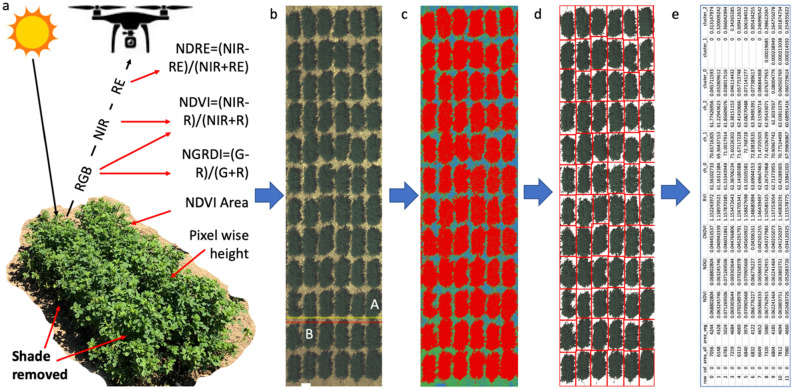
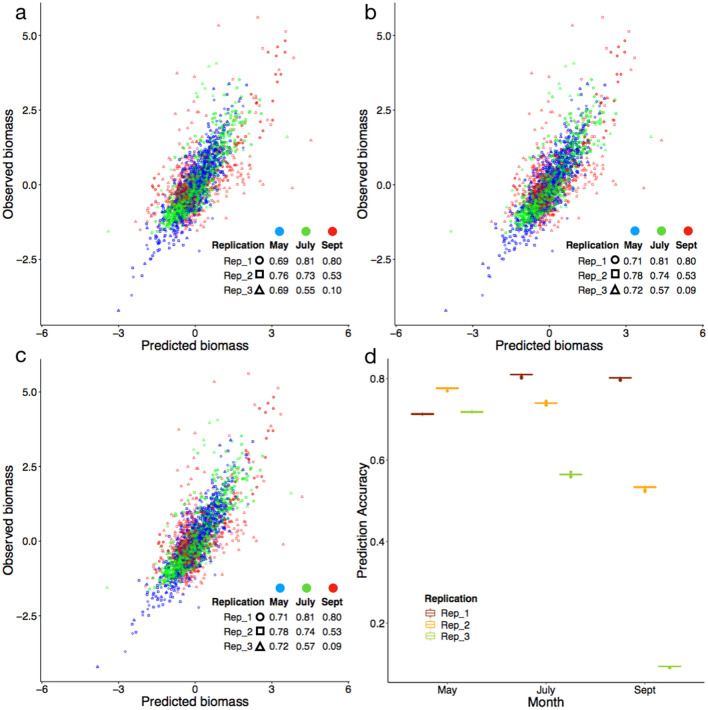
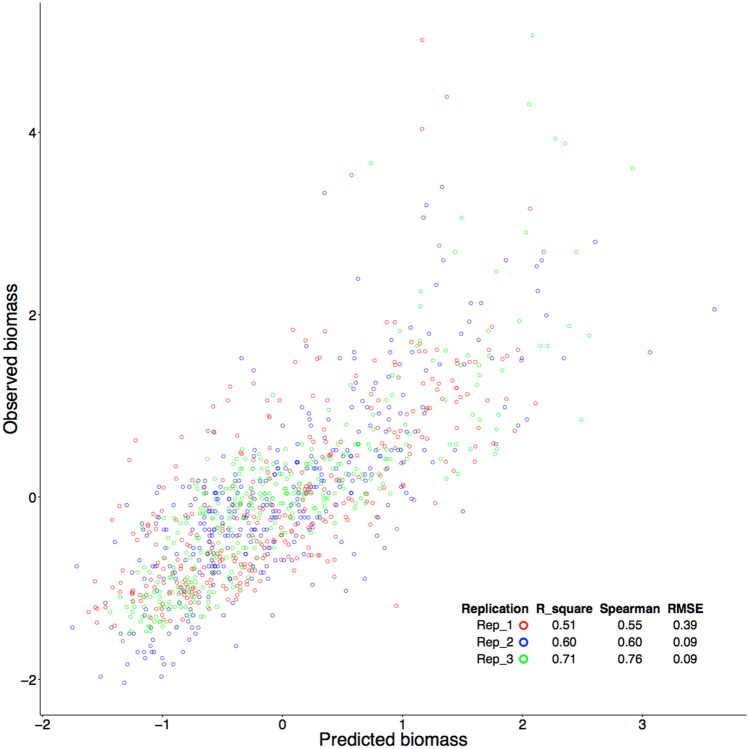
Alfalfa is the most widely cultivated forage legume, with approximately 30 million hectares planted worldwide. Genetic improvements in alfalfa have been highly successful in developing cultivars with exceptional winter hardiness and disease resistance traits. However, genetic improvements have been limited for complex economically important traits such as biomass. One of the major bottlenecks is the labor-intensive phenotyping burden for biomass selection. In this study, we employed two alfalfa fields to pave a path to overcome the challenge by using UAV images with fully automatic field plot segmentation for high-throughput phenotyping. The first field was used to develop the prediction model and the second field to validate the predictions. The first and second fields had 808 and 1025 plots, respectively. The first field had three harvests with biomass measured in May, July, and September of 2019. The second had one harvest with biomass measured in September of 2019. These two fields were imaged one day before harvesting with a DJI Phantom 4 pro UAV carrying an additional Sentera multispectral camera. Alfalfa plot images were extracted by GRID software to quantify vegetative area based on the Normalized Difference Vegetation Index. The prediction model developed from the first field explained 50-70% (R Square) of biomass variation in the second field by incorporating four features from UAV images: vegetative area, plant height, Normalized Green-Red Difference Index, and Normalized Difference Red Edge Index. This result suggests that UAV-based, high-throughput phenotyping could be used to improve the efficiency of the biomass selection process in alfalfa breeding programs.
紫花苜蓿是种植最广泛的饲料豆科植物,全世界约有 3000 万公顷。紫花苜蓿的遗传改良在培育具有卓越抗寒性和抗病性的品种方面取得了巨大成功。然而,对于复杂的经济重要性状,如生物量,遗传改良一直受到限制。其中一个主要瓶颈是生物量选择的田间表型繁重负担。在这项研究中,我们利用配备全自动田间小区分割的无人机图像,对两个紫花苜蓿田进行了研究,为克服这一挑战开辟了道路,以实现高通量表型分析。第一个田块用于开发预测模型,第二个田块用于验证预测。第一个和第二个田块分别有 808 和 1025 个小区。第一个田块有三次收获,生物量分别于 2019 年 5 月、7 月和 9 月进行测量。第二个田块于 2019 年 9 月进行了一次收获。这两个田块在收获前一天使用 DJI Phantom 4 pro 无人机进行了成像,该无人机搭载了额外的 Sentera 多光谱相机。通过 GRID 软件提取紫花苜蓿小区图像,根据归一化差值植被指数(NDVI)来量化植被面积。第一个田块开发的预测模型通过整合无人机图像的四个特征(植被面积、株高、归一化绿-红差值指数和归一化红边差值指数),解释了第二个田块 50-70%(R 平方)的生物量变化。这一结果表明,基于无人机的高通量表型分析可以用于提高紫花苜蓿育种计划中生物量选择过程的效率。