Bante Agegnehu, Mersha Abera, Tesfaye Azene, Tsegaye Behailu, Shibiru Shitaye, Ayele Gistane, Girma Meseret
School of Nursing, College of Medicine and Health Sciences, Arba Minch University, Arba Minch, Ethiopia.
Department of Medical Laboratory Sciences, College of Medicine and Health Sciences, Arba Minch University, Arba Minch, Ethiopia.
Patient Prefer Adherence. 2021 Feb 3;15:237-249. doi: 10.2147/PPA.S293647. eCollection 2021.
COVID-19 is one of the huge general wellbeing crisis for the planet. Since its first recognition, over 90.2 and 1.9 million people are infected and dead, respectively. Although it is not easily available for low-income countries, after many trials vaccination is initiated by some industrialized nations. However, still now there is no effective treatment for the infection. Henceforth, adherence with COVID-19 preventive and control measures is the only option to stop its spread and minimize its disastrous impact, especially, in developing nations like Ethiopia. Knowledge and behavior change are pillars to engage with preventive measures. Thus, the motivation behind this study was to assess communities' adherence with COVID-19 preventive measures and its associated factors among inhabitants of Dirashe district, Southern Ethiopia.
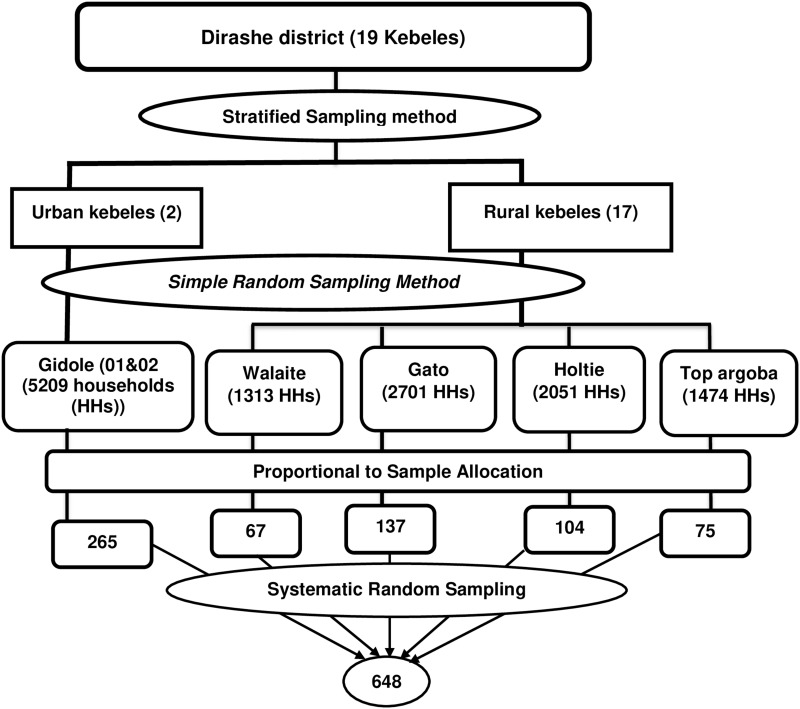
A cross-sectional study was directed among 648 inhabitants in Dirashe district from June 20 to July 5, 2020. A multistage sampling technique was applied to select the participants. A pretested, validated and reliable interviewer-administered survey tool comprising the socio-demographic characteristics, knowledge (α = 0.78), and adherence with COVID-19 preventive measures (α = 0.73) was used. The data were assorted electronically using Open Data Kit (ODK) collect version 1.17.2 android application and exported to Stata version 15.0 for analysis. Adjusted odds ratio (aOR) with 95% CI was used to identify variables associated with the community's adherence with COVID-19 preventive measures.
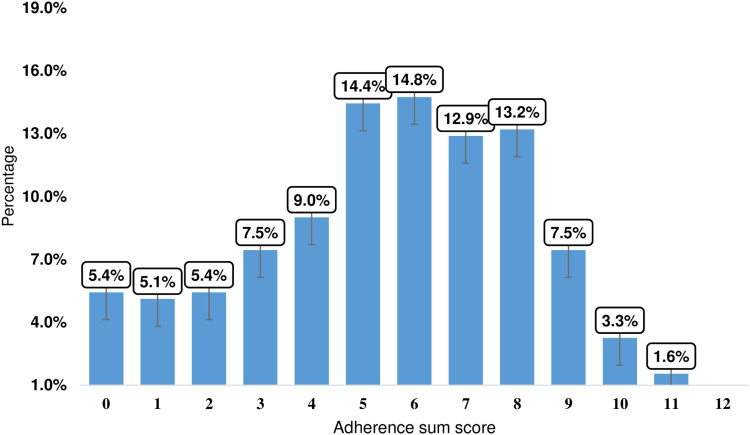
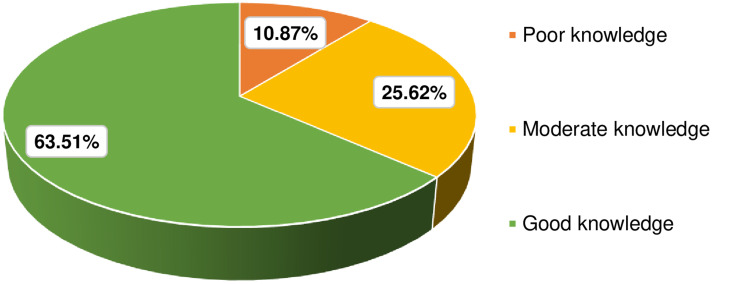
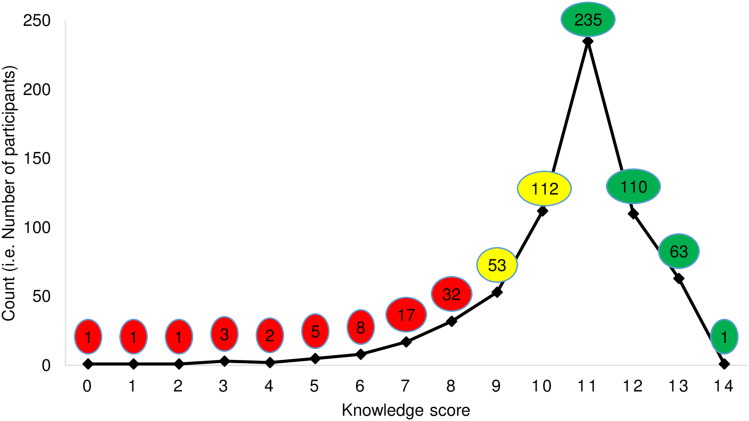
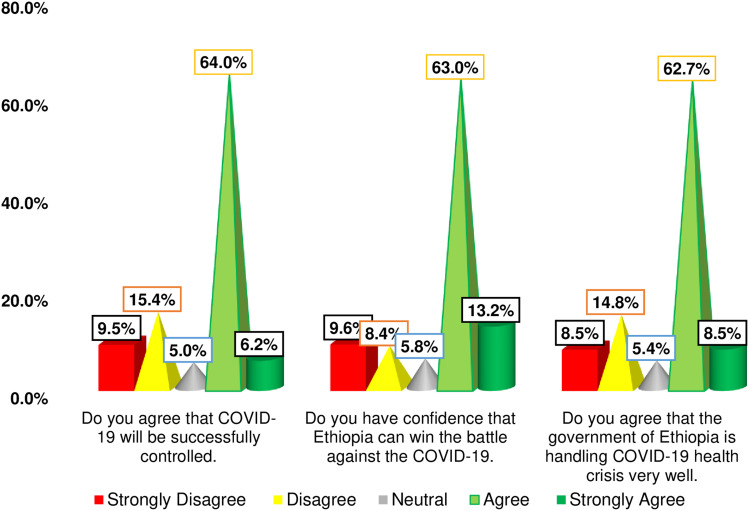
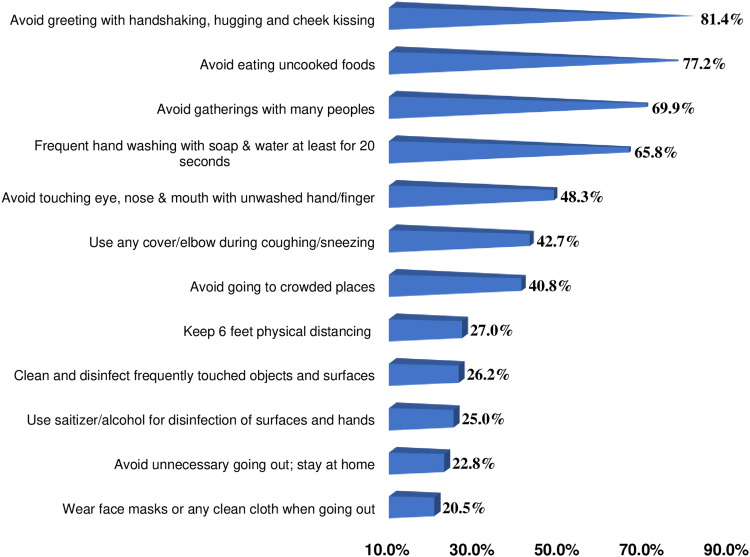
An aggregate of 644 inhabitants were participated in this study; of them, only 12.3% [95% confidence interval (CI): 9.8, 15.1] adhered to the recommended COVID-19 preventive measures. Likewise, 63.51% [95% CI: 59.7, 67.2] and 54.5% [95% CI: 50.6, 58.4] of the participants had good knowledge and favorable attitude towards COVID-19 preventive measures, respectively. Urban residence [aOR: 9.74, 95% CI: 4.72, 20.10], favorable attitude [aOR: 1.97, 95% CI: 1.05, 3.68] and concerned about COVID-19-related stigma [aOR: 2.43, 95% CI: 1.02, 5.79] were independently associated with communities adherence with COVID-19 preventive measures.
In general, communities' adherence to the recommended COVID-19 preventive measures was very low in the area. Addressing underprivileged population groups, disseminating teaching aids in local languages, behavioral change communications, and law enforcement is imperative to strengthen COVID-19 prevention practice.
新冠疫情是全球面临的重大公共卫生危机之一。自首次发现以来,全球分别有超过9020万人感染,190万人死亡。尽管低收入国家难以获取疫苗,但经过多次试验后,一些工业化国家已开始接种。然而,目前仍没有针对该感染的有效治疗方法。因此,遵守新冠疫情防控措施是阻止其传播并将灾难性影响降至最低的唯一选择,尤其是在像埃塞俄比亚这样的发展中国家。知识和行为改变是采取预防措施的关键。因此,本研究的目的是评估埃塞俄比亚南部迪拉舍地区居民对新冠疫情防控措施的遵守情况及其相关因素。
2020年6月20日至7月5日,在迪拉舍地区对648名居民进行了一项横断面研究。采用多阶段抽样技术选取参与者。使用了一个经过预测试、验证且可靠的访谈式调查工具,该工具包括社会人口学特征、知识(α = 0.78)以及对新冠疫情防控措施的遵守情况(α = 0.73)。数据通过Open Data Kit(ODK)收集版本1.17.2安卓应用程序以电子方式收集,并导出到Stata版本15.0进行分析。使用调整后的比值比(aOR)及95%置信区间(CI)来确定与社区对新冠疫情防控措施遵守情况相关的变量。
共有644名居民参与了本研究;其中,只有12.3%[95%置信区间(CI):9.8,15.1]遵守了推荐的新冠疫情防控措施。同样,63.51%[95% CI:59.7,67.2]和54.5%[95% CI:50.6,58.4]的参与者分别对新冠疫情防控措施有良好的了解和积极的态度。城市居住环境[aOR:9.74,95% CI:4.72,20.10]、积极的态度[aOR:1.97,95% CI:1.05,3.68]以及对新冠相关污名的担忧[aOR:2.43,95% CI:1.02,5.79]与社区对新冠疫情防控措施的遵守情况独立相关。
总体而言,该地区社区对推荐的新冠疫情防控措施的遵守程度非常低。必须针对弱势群体,以当地语言传播教学辅助工具,开展行为改变宣传活动并加强执法,以强化新冠疫情的预防工作。