Department of Native Hawaiian Health, John A. Burns School of Medicine, University of Hawai'i at Mānoa, Honolulu, HI.
Hālau Mōhala 'Ilima, Ka'ōhao, HI.
Ann Behav Med. 2021 Oct 4;55(10):1006-1018. doi: 10.1093/abm/kaaa127.
Native Hawaiians have higher hypertension (HTN) and cardiovascular disease (CVD) rates than non-Hispanic whites, calling for culturally responsive interventions to close this gap.
We tested the effects of a 6-month behavioral intervention, a cultural dance program based on hula (the customary dance of Hawai'i), for improving blood pressure (BP) and CVD risk among Native Hawaiians with uncontrolled HTN.
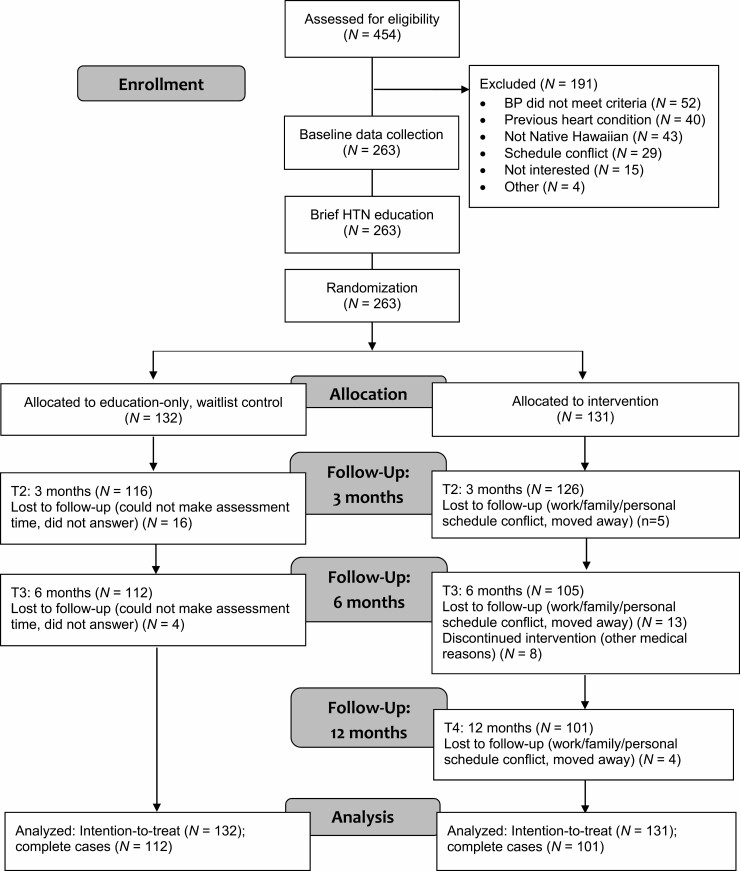
In a randomized controlled trial, we tested the effects of the hula-based intervention among 263 Native Hawaiians with uncontrolled HTN (systolic ≥ 140 or ≥ 130 mmHg if diabetes) and no CVD at enrollment. All participants received a brief culturally tailored heart health education before random assignment to the hula-based intervention (n = 131) or the education-only waitlist control (n = 132). Intervention received hula lessons and group-based activities for 6 months. Control received only 1-week education through 6 months.
Intervention yielded greater reductions in systolic (-15.3 mmHg) and diastolic (-6.4 mmHg) BP than control (-11.8 and -2.6 mmHg, respectively) from baseline to 6 months (p < .05). At 6 months, 43% of intervention participants compared to 21% of controls achieved a HTN stage <130/80 mmHg (p < .001). The 10-year CVD risk reduction was two times greater for the intervention group than the control group based on the Framingham Risk Score calculator. All improvements for intervention participants were maintained at 12 months.
This trial represents one of the few rigorously conducted examinations of an Indigenous practice leveraged for health promotion, with implications for other ethnic populations.
与非西班牙裔白人相比,夏威夷原住民的高血压(HTN)和心血管疾病(CVD)发病率更高,这就需要采取以文化为导向的干预措施来缩小这一差距。
我们测试了为期 6 个月的行为干预措施,即基于呼啦舞(夏威夷的传统舞蹈)的文化舞蹈项目,对改善血压(BP)和未经治疗的 HTN 夏威夷原住民的 CVD 风险的影响。
在一项随机对照试验中,我们在 263 名未经治疗的 HTN 夏威夷原住民(收缩压≥140mmHg 或糖尿病患者≥130mmHg)和入组时无 CVD 的人群中测试了基于呼啦舞的干预措施的效果。所有参与者在随机分配到基于呼啦舞的干预组(n=131)或仅接受教育的候补对照组(n=132)之前,都接受了简短的文化适应性心脏健康教育。干预组接受呼啦舞课程和基于小组的活动,为期 6 个月。对照组仅在 6 个月内接受 1 周的教育。
与对照组相比,干预组在 6 个月时收缩压(-15.3mmHg)和舒张压(-6.4mmHg)的降低幅度更大(分别为-11.8mmHg 和-2.6mmHg,p<0.05)。在 6 个月时,与对照组相比,干预组有 43%的参与者达到了 HTN 阶段<130/80mmHg,而对照组为 21%(p<0.001)。根据弗雷明汉风险评分计算器,干预组的 10 年 CVD 风险降低幅度是对照组的两倍。所有干预组参与者的改善都在 12 个月时得到了维持。
这项试验代表了对促进健康的本土实践进行的为数不多的严格检查之一,对其他族裔群体具有启示意义。