de Haas Hein
University of Amsterdam, Amsterdam, Netherlands.
Comp Migr Stud. 2021;9(1):8. doi: 10.1186/s40878-020-00210-4. Epub 2021 Feb 24.
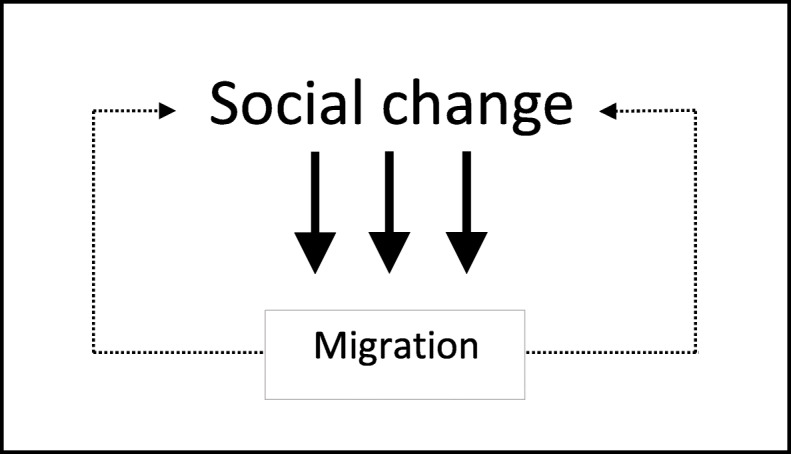
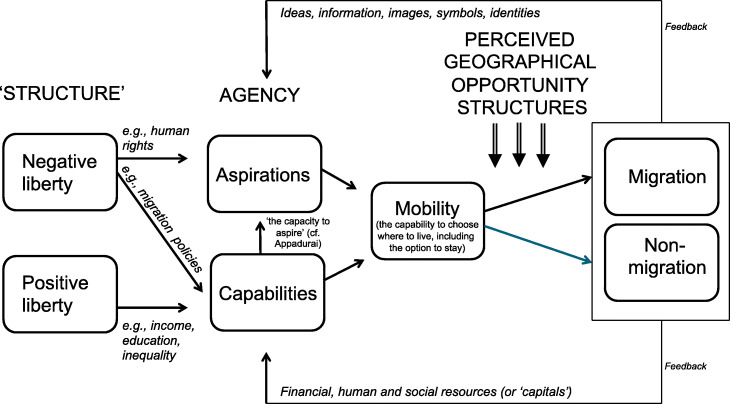
This paper elaborates an aspirations-capabilities framework to advance our understanding of human mobility as an intrinsic part of broader processes of social change. In order to achieve a more meaningful understanding of agency and structure in migration processes, this framework conceptualises migration as a function of aspirations and capabilities to migrate within given sets of perceived geographical opportunity structures. It distinguishes between the instrumental (means-to-an-end) and intrinsic (directly wellbeing-affecting) dimensions of human mobility. This yields a vision in which moving and staying are seen as complementary manifestations of migratory agency and in which human mobility is defined as people's capability to choose where to live, including the option to stay, rather than as the act of moving or migrating itself. Drawing on Berlin's concepts of positive and negative liberty (as manifestations of the widely varying structural conditions under which migration occurs) this paper conceptualises how macro-structural change shapes people's migratory aspirations and capabilities. The resulting framework helps to understand the complex and often counter-intuitive ways in which processes of social transformation and 'development' shape patterns of migration and enable us to integrate the analysis of almost all forms of migratory mobility within one meta-conceptual framework.
本文阐述了一个愿望-能力框架,以增进我们对人口流动的理解,将其视为更广泛社会变革进程的内在组成部分。为了更有意义地理解移民过程中的能动性和结构,该框架将移民概念化为在给定的一系列感知到的地理机会结构内迁移的愿望和能力的函数。它区分了人口流动的工具性(达到目的的手段)和内在性(直接影响福祉)维度。这产生了一种观点,即迁移和定居被视为移民能动性的互补表现,并且人口流动被定义为人们选择居住地点的能力,包括留下的选择,而不是迁移或移民行为本身。借鉴柏林关于积极自由和消极自由的概念(作为移民发生时广泛不同的结构条件的表现),本文概念化了宏观结构变化如何塑造人们的移民愿望和能力。由此产生的框架有助于理解社会转型和“发展”进程塑造移民模式的复杂且往往违反直觉的方式,并使我们能够将几乎所有形式的迁移流动分析整合到一个元概念框架内。