Catalan Health System Observatory, Agència de Qualitat i Avaluació Sanitàries de Catalunya (AQuAS), 81-95 (2a planta), 08005, Barcelona, Spain.
CIBER de Epidemiología y Salud Pública (CIBERESP), Barcelona, Spain.
Int J Equity Health. 2021 Mar 10;20(1):73. doi: 10.1186/s12939-021-01397-3.
According to many conceptual frameworks, the first step in the monitoring cycle of health inequalities is the selection of relevant topics and indicators. However, some difficulties may arise during this selection process due to a high variety of contextual factors that may influence this step. In order to help accomplish this task successfully, a comprehensive review of the most common topics and indicators for measuring and monitoring health inequalities in countries/regions with similar socioeconomic and political status as Catalonia was performed.
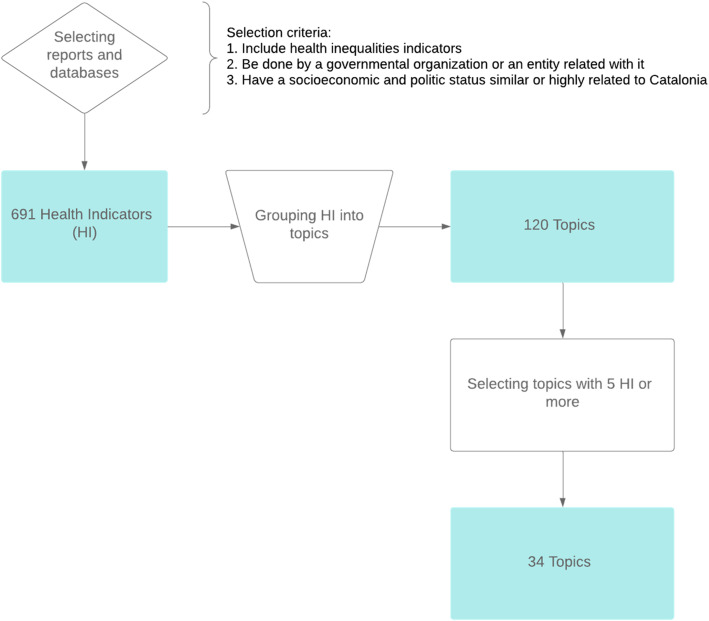
We describe the processes and criteria used for selecting health indicators from reports, studies, and databases focusing on health inequalities. We also describe how they were grouped into well-known health topics. The topics were filtered and ranked by the number of indicators they accounted for.
We found 691 indicators used in the study of health inequalities. The indicators were grouped into 120 topics, 34 of which were selected for having five indicators or more. Most commonly found topics in the list include "Life expectancy", "Infant mortality", "Obesity and overweight (BMI)", "Mortality rate", "Regular smokers/tobacco consumption", "Self-perceived health", "Unemployment", "Mental well-being", "Cardiovascular disease/hypertension", "Socioeconomic status (SES)/material deprivation".
A wide variety of indicators and topics for the study of health inequalities exist across different countries and organisations, although there are some clear commonalities. Reviewing the use of health indicators is a key step to know the current state of the study of health inequalities and may show how to lead the way in understanding how to overcome them.
根据许多概念框架,健康不平等监测周期的第一步是选择相关主题和指标。然而,由于可能影响这一步的各种背景因素,在选择过程中可能会出现一些困难。为了帮助成功完成这项任务,对与加泰罗尼亚具有相似社会经济和政治地位的国家/地区衡量和监测健康不平等的最常见主题和指标进行了全面审查。
我们描述了从关注健康不平等的报告、研究和数据库中选择健康指标的过程和标准。我们还描述了如何将它们分组到知名的健康主题中。根据涵盖的指标数量对主题进行过滤和排序。
我们发现了 691 个用于研究健康不平等的指标。这些指标被分为 120 个主题,其中 34 个被选中,因为它们有五个或更多的指标。列表中最常见的主题包括“预期寿命”、“婴儿死亡率”、“肥胖和超重(BMI)”、“死亡率”、“经常吸烟者/烟草消费”、“自我感知健康”、“失业”、“心理健康”、“心血管疾病/高血压”、“社会经济地位(SES)/物质匮乏”。
尽管存在一些明显的共性,但不同国家和组织在研究健康不平等时存在各种各样的指标和主题。审查健康指标的使用是了解健康不平等研究现状的关键步骤,它可以显示如何引领理解如何克服这些不平等的道路。