Graduate School of Peking, Union Medical College, Beijing, People's Republic of China.
National Research Institute for Family Planning, Da Huisi Road, 12#, Beijing, People's Republic of China.
BMC Cardiovasc Disord. 2021 Mar 19;21(1):145. doi: 10.1186/s12872-021-01948-0.
Inconsistent results were found in the association between serum alanine aminotransferase (ALT) and hypertension among population-based studies. This study evaluated the association between ALT and hypertension among Chinese reproductive-age population by utilizing registration data from National Free Pre-pregnancy Checkups Project in 2016-2017.
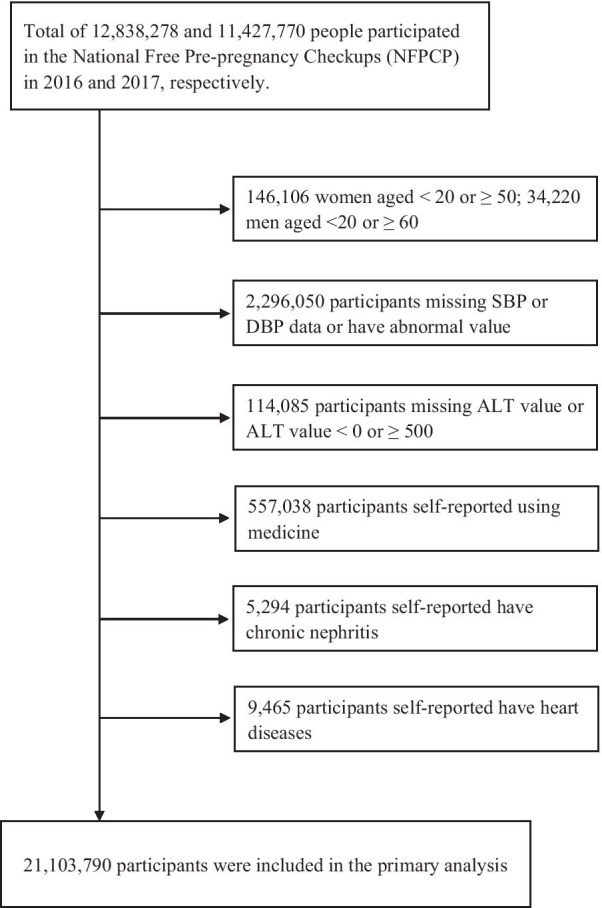
The 21,103,790 registered participants were eligible for analysis, including women who were 20-49 years old and men who were 20-59 years old with available data for ALT and blood pressure (BP). Logistic regression was conducted to estimate odds ratio (OR) for the association between ALT and hypertension as a binary outcome. Linear regression was used to examine the association between ALT and BP as a continuous outcome.
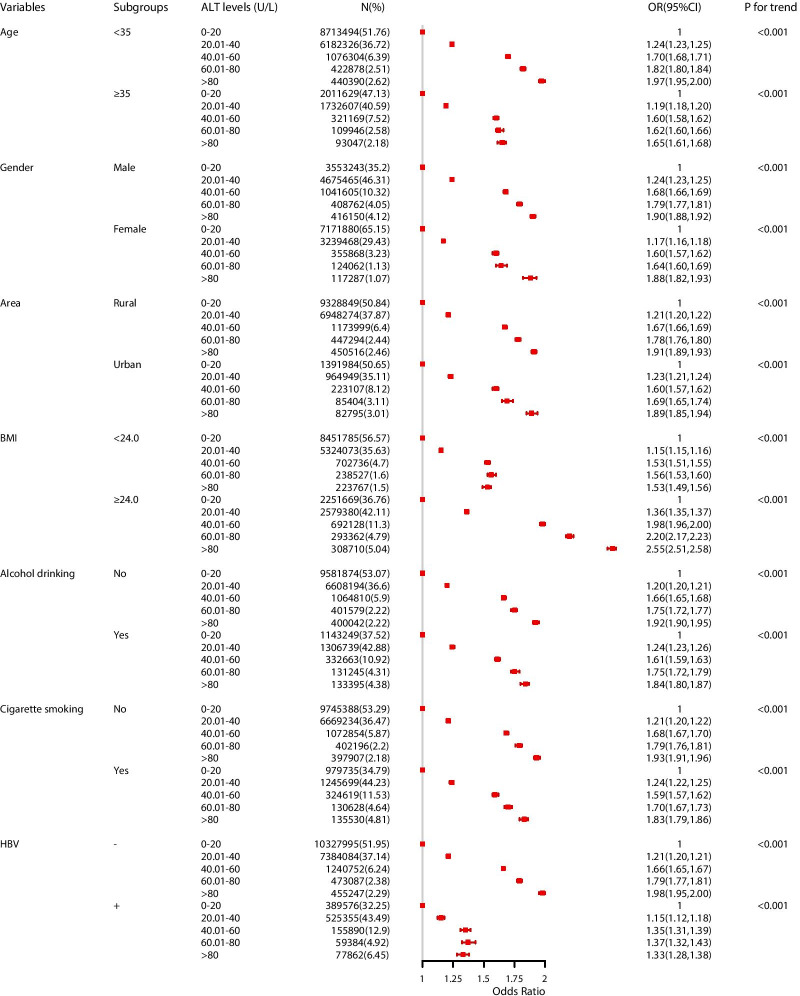
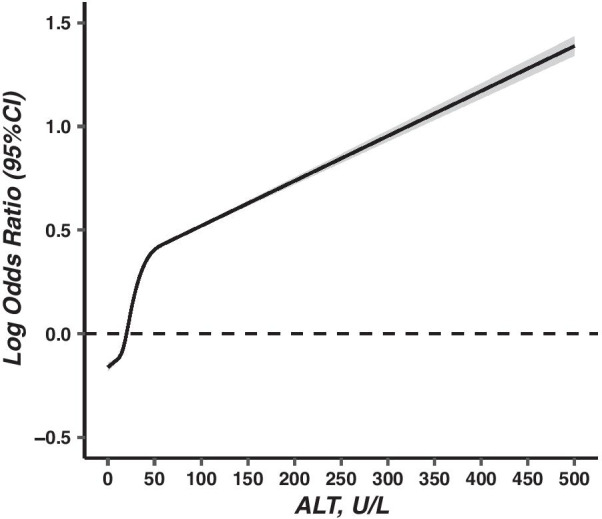
In total, 4.21% of the participants were hypertensive, and 11.67% had elevated ALT (> 40 U/L). Hypertension prevalence was 3.63% and 8.56% among participants with normal and elevated ALT levels. A strong linear relationship was found between serum ALT levels and the odds of hypertension after adjustment for potential confounders. The multivariable-adjusted ORs for hypertension were 1, 1.22 (1.21, 1.22), 1.67 (1.65 1.68), 1.78 (1.76, 1.80), and 1.92 (1.90, 1.94) in participants with ALT levels of ≤ 20, 20.01-40, 40.01-60, 60.01-80, and > 80 U/L, respectively. Systolic and diastolic BPs rose by 1.83 and 1.20 mmHg on average, for each 20 U/L increase in ALT (P < 0.001). The association was consistent among subgroups and tended to be stronger among populations who are overweight (body mass index ≥ 24 kg/m) (χ = 52,228, P < 0.001), alcohol drinking (χ = 100,730, P < 0.001) and cigarette smoking (χ = 105,347, P < 0.001).
Our cross-sectional analysis suggested a linear association between serum ALT and hypertension or BP, which indicated that abnormal liver metabolism marked by elevated serum ALT could play a role in hypertension or elevated BP condition.
基于人群的研究发现血清丙氨酸氨基转移酶(ALT)与高血压之间的关联结果不一致。本研究利用 2016-2017 年全国免费孕前检查项目的登记数据,评估了 ALT 与中国育龄人群高血压之间的关系。
共有 21103790 名符合条件的参与者纳入分析,包括年龄在 20-49 岁的女性和年龄在 20-59 岁的男性,且有 ALT 和血压(BP)数据。采用 logistic 回归估计 ALT 与高血压作为二项结局之间的比值比(OR)。采用线性回归分析 ALT 与 BP 作为连续结局之间的关系。
共有 4.21%的参与者患有高血压,11.67%的参与者 ALT 升高(>40 U/L)。正常 ALT 水平和升高 ALT 水平参与者的高血压患病率分别为 3.63%和 8.56%。在校正潜在混杂因素后,血清 ALT 水平与高血压的发生几率之间存在很强的线性关系。多变量校正后的高血压 OR 分别为 1、1.22(1.21,1.22)、1.67(1.65,1.68)、1.78(1.76,1.80)和 1.92(1.90,1.94),ALT 水平分别为 <=20、20.01-40、40.01-60、60.01-80 和 >80 U/L。平均而言,ALT 每增加 20 U/L,收缩压和舒张压分别升高 1.83 和 1.20 mmHg(P < 0.001)。该关联在亚组中是一致的,在超重人群(体重指数≥24 kg/m)(χ²=52228,P < 0.001)、饮酒人群(χ²=100730,P < 0.001)和吸烟人群(χ²=105347,P < 0.001)中,这种关联似乎更强。
本横断面分析提示血清 ALT 与高血压或血压之间存在线性关系,这表明以血清 ALT 升高为标志的异常肝脏代谢可能在高血压或血压升高的情况下发挥作用。