Kohler Daria, Schindler Gregor, Hahn Lothar, Milvich Johannes, Hofmann Andreas, Länge Kerstin, Freude Wolfgang, Koos Christian
Institute of Photonics and Quantum Electronics (IPQ), Karlsruhe Institute of Technology (KIT), Engesserstrasse 5, 76131, Karlsruhe, Germany.
Institute of Microstructure Technology (IMT), Karlsruhe Institute of Technology (KIT), Hermann-von-Helmholtz-Platz 1, 76344, Eggenstein-Leopoldshafen, Germany.
Light Sci Appl. 2021 Mar 26;10(1):64. doi: 10.1038/s41377-021-00486-w.
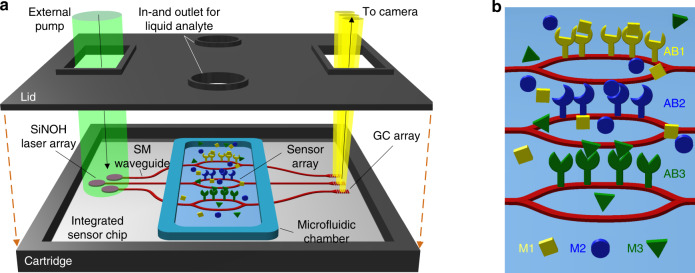
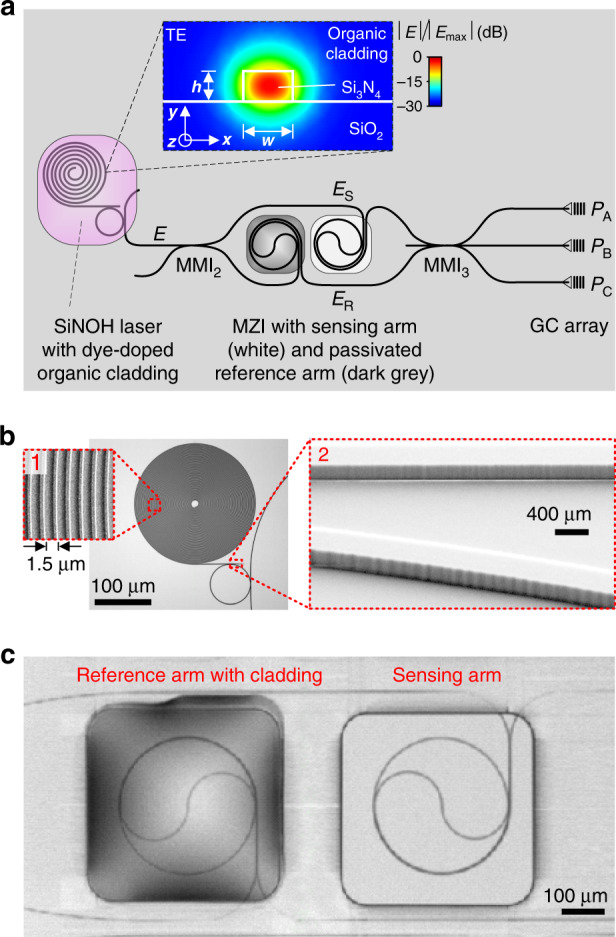
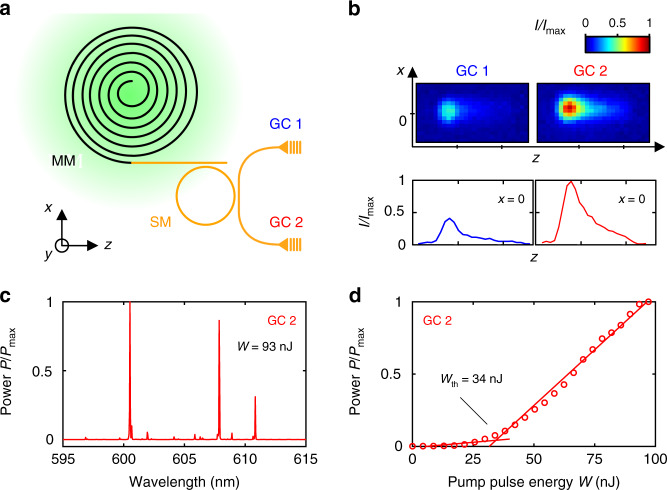
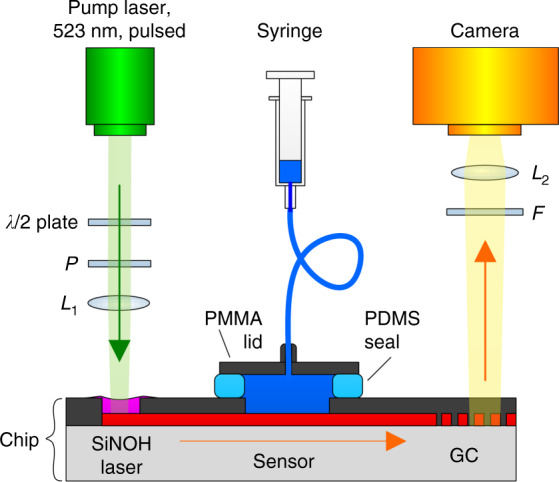
Early and efficient disease diagnosis with low-cost point-of-care devices is gaining importance for personalized medicine and public health protection. Within this context, waveguide-(WG)-based optical biosensors on the silicon-nitride (SiN) platform represent a particularly promising option, offering highly sensitive detection of indicative biomarkers in multiplexed sensor arrays operated by light in the visible-wavelength range. However, while passive SiN-based photonic circuits lend themselves to highly scalable mass production, the integration of low-cost light sources remains a challenge. In this paper, we demonstrate optical biosensors that combine SiN sensor circuits with hybrid on-chip organic lasers. These SiN-organic hybrid (SiNOH) lasers rely on a dye-doped cladding material that are deposited on top of a passive WG and that are optically pumped by an external light source. Fabrication of the devices is simple: The underlying SiN WGs are structured in a single lithography step, and the organic gain medium is subsequently applied by dispensing, spin-coating, or ink-jet printing processes. A highly parallel read-out of the optical sensor signals is accomplished with a simple camera. In our proof-of-concept experiment, we demonstrate the viability of the approach by detecting different concentrations of fibrinogen in phosphate-buffered saline solutions with a sensor-length (L-)-related sensitivity of S/L = 0.16 rad nM mm. To our knowledge, this is the first demonstration of an integrated optical circuit driven by a co-integrated low-cost organic light source. We expect that the versatility of the device concept, the simple operation principle, and the compatibility with cost-efficient mass production will make the concept a highly attractive option for applications in biophotonics and point-of-care diagnostics.
利用低成本的即时检测设备进行早期高效疾病诊断,对于个性化医疗和公共卫生防护正变得愈发重要。在此背景下,基于氮化硅(SiN)平台的波导(WG)型光学生物传感器是一个特别有前景的选择,它能在可见波长范围内由光驱动的多路复用传感器阵列中对指示性生物标志物进行高灵敏度检测。然而,虽然基于SiN的无源光子电路易于大规模生产,但集成低成本光源仍是一项挑战。在本文中,我们展示了将SiN传感器电路与混合片上有机激光器相结合的光学生物传感器。这些SiN-有机混合(SiNOH)激光器依赖于一种掺杂染料的包层材料,该材料沉积在无源波导顶部,并由外部光源进行光泵浦。器件制造简单:底层的SiN波导通过单一光刻步骤进行结构化,随后通过分配、旋涂或喷墨打印工艺施加有机增益介质。利用一个简单的相机即可实现对光学传感器信号的高度并行读出。在我们的概念验证实验中,我们通过检测磷酸盐缓冲盐溶液中不同浓度的纤维蛋白原,以S/L = 0.16 rad nM mm的与传感器长度(L)相关的灵敏度证明了该方法的可行性。据我们所知,这是首次展示由共集成的低成本有机光源驱动的集成光路。我们预计,该器件概念的多功能性、简单的操作原理以及与经济高效的大规模生产的兼容性,将使其成为生物光子学和即时检测诊断应用中极具吸引力的选择。