Department of Physics and Center for Biological Physics, Arizona State University, Tempe, AZ, USA.
Departamento de Quimica Fisica, Facultad de Ciencias, Universidad de Granada, Granada, Spain.
Nat Commun. 2021 Mar 25;12(1):1852. doi: 10.1038/s41467-021-22089-0.
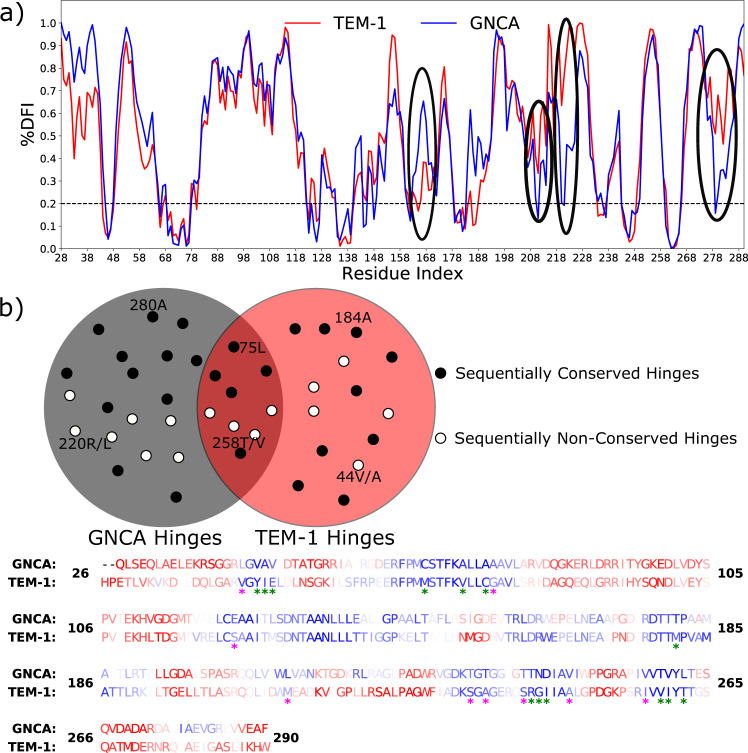
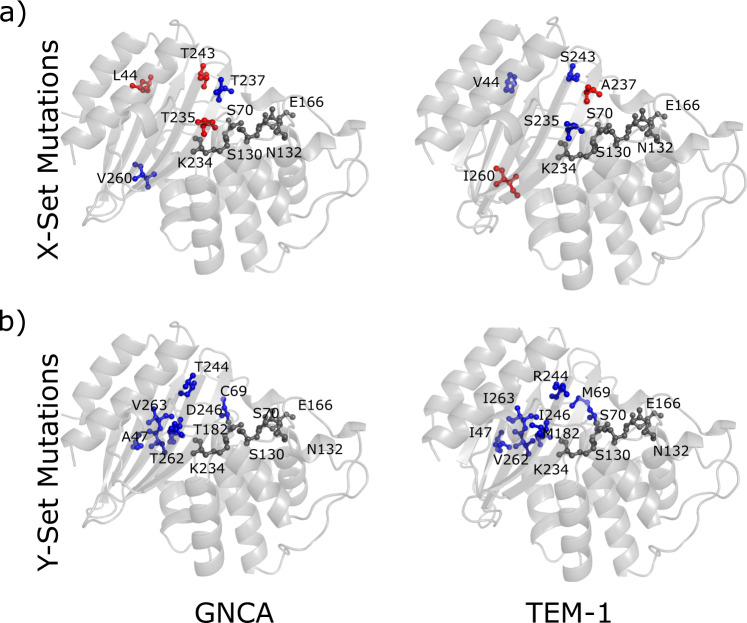
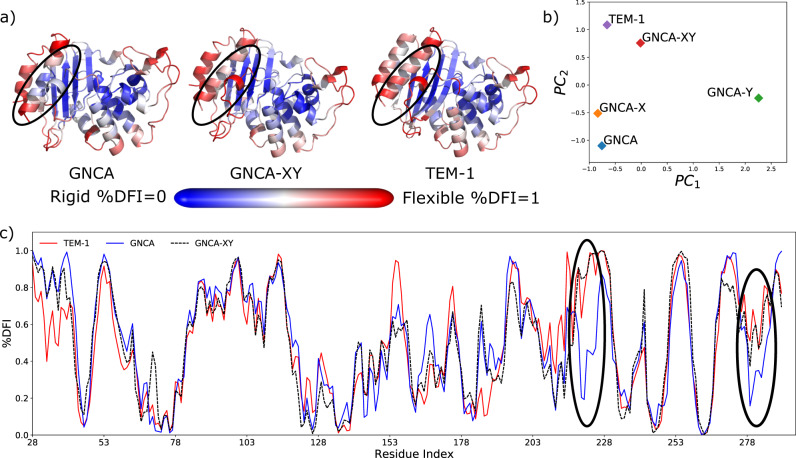
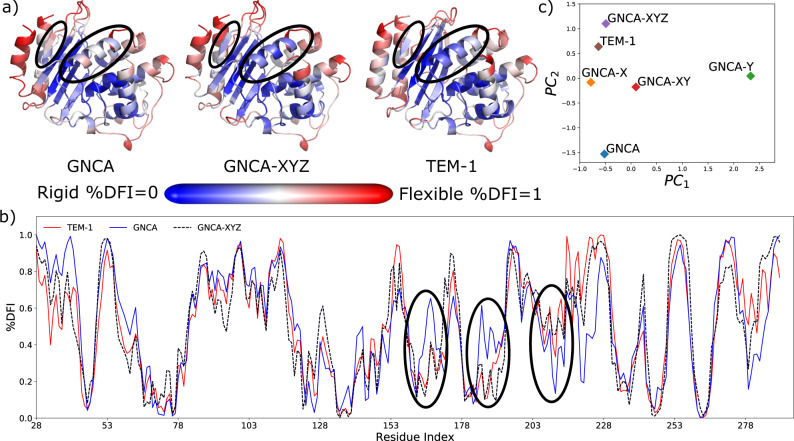
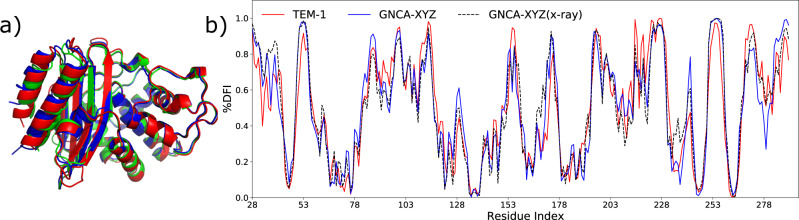
TEM-1 β-lactamase degrades β-lactam antibiotics with a strong preference for penicillins. Sequence reconstruction studies indicate that it evolved from ancestral enzymes that degraded a variety of β-lactam antibiotics with moderate efficiency. This generalist to specialist conversion involved more than 100 mutational changes, but conserved fold and catalytic residues, suggesting a role for dynamics in enzyme evolution. Here, we develop a conformational dynamics computational approach to rationally mold a protein flexibility profile on the basis of a hinge-shift mechanism. By deliberately weighting and altering the conformational dynamics of a putative Precambrian β-lactamase, we engineer enzyme specificity that mimics the modern TEM-1 β-lactamase with only 21 amino acid replacements. Our conformational dynamics design thus re-enacts the evolutionary process and provides a rational allosteric approach for manipulating function while conserving the enzyme active site.
TEM-1 β-内酰胺酶对青霉素类抗生素具有强烈的降解偏好。序列重建研究表明,它是从最初能够适度降解多种β-内酰胺抗生素的酶进化而来的。这种从通才到专家的转变涉及了 100 多个突变变化,但保留了折叠和催化残基,这表明动力学在酶进化中起着重要作用。在这里,我们开发了一种构象动力学计算方法,根据铰链移位机制合理塑造蛋白质的灵活性特征。通过故意加权和改变一个假定的前寒武纪β-内酰胺酶的构象动力学,我们设计了酶的特异性,通过仅 21 个氨基酸替换来模拟现代 TEM-1 β-内酰胺酶。因此,我们的构象动力学设计重新模拟了进化过程,并提供了一种合理的变构方法来操纵功能,同时保留酶的活性位点。